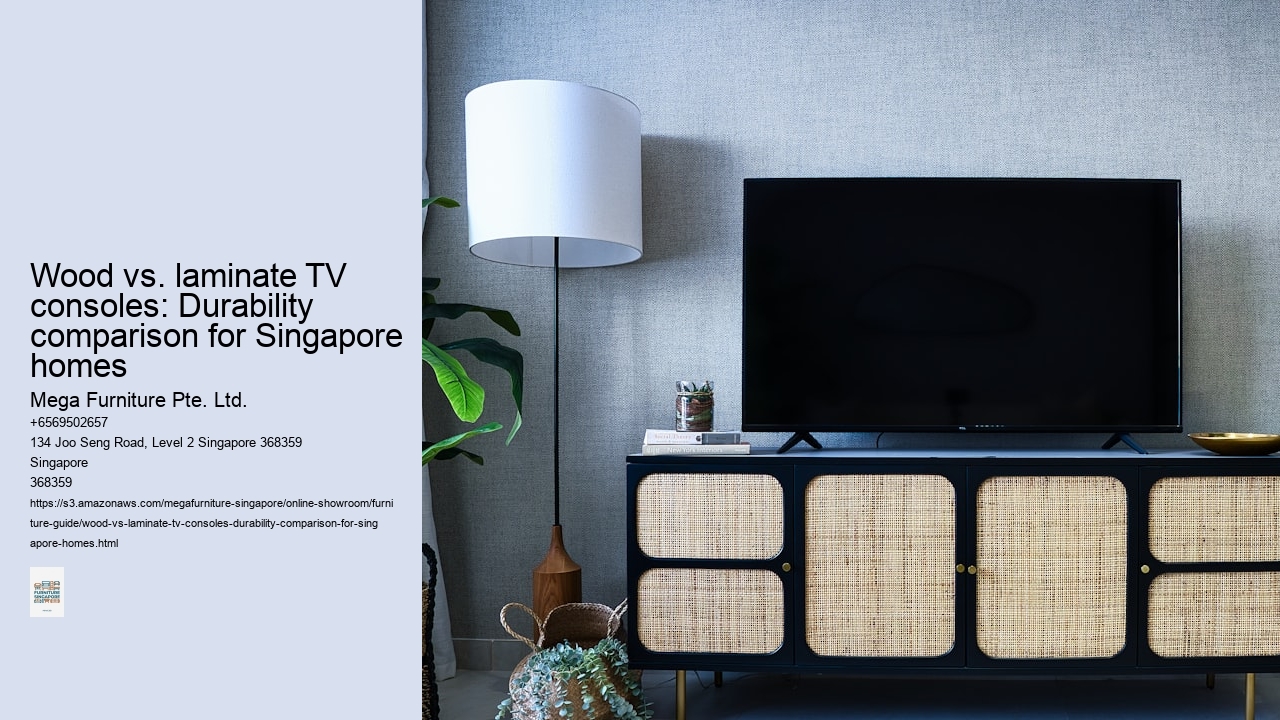
In many BTO flats, the living room aircon gets switched off overnight. You can feel the change by morning — that damp, heavy stillness settling over the furniture. For a TV console, that’s the daily test. Solid wood, be it oak, walnut, or rubberwood, is hygroscopic; it absorbs moisture directly from the air. Over months where the humidity consistently exceeds 80%, untreated planks expand and their edges can lift, creating a subtle but perceptible curl. This isn't just a surface issue; it's a structural one that can cause drawers to bind and doors to sit unevenly against their frames.
Laminate construction sidesteps this problem through its layered engineering. The decorative surface is fused to a moisture-resistant particleboard or MDF core, a material far less reactive to ambient moisture. The result is a panel that maintains its flatness and dimensions even in a non-air-conditioned room. It’s why laminate TV consoles are a pragmatic default for the local climate — you’re not fighting physics every monsoon season. The visual trade-off, of course, is that you lose the depth and character of real wood grain under your fingertips.
When evaluating laminate, the core’s quality is the critical factor. Look for boards graded P2 or E0, which indicate lower formaldehyde emissions and better moisture resistance. A P2-rated board, for instance, is engineered to withstand the cyclical swelling stresses of a humid environment. This stability means a 180cm floating console won't develop a sag or a bow over time, even loaded with a 65-inch screen and media players. It’s a material choice that prioritises longevity and low maintenance, which for many families upgrading their media wall is the sensible priority.
That’s not to dismiss solid wood entirely, but it demands more consideration. If you’re set on a teak or oak console for a condo living room that’s perpetually climate-controlled, the risk is minimal. In a typical resale flat where the windows are open all day, however, you’re committing to a more attentive relationship with the piece. You’ll want to ensure it has a robust, properly sealed finish and perhaps even employ a dehumidifier during the wettest months. The choice, then, often comes down to whether you view the console as a static platform or a living material that responds to its environment.
That glossy surface on a budget console often hides a paper-thin veneer, a layer so fragile it can delaminate from Singapore's humidity within a year. You want a substantial veneer, thick enough to be lightly sanded and refinished if it gets scuffed by a vacuum cleaner or a child's toy. Run your fingernail along an edge or a drawer front; if you feel a distinct, sharp lip where the veneer ends, that's a red flag for premature peeling. A quality wood-veneer console should feel like solid timber, with a surface that seamlessly wraps around corners without any telltale ridges. This isn't just about aesthetics—it’s about a finish that survives the humid months without bubbling at the seams.
Forget corner brackets and glue; the true test of a wooden frame is in its joinery. In a proper wooden TV console, you'll find dovetail or mortise-and-tenon joints, interlocking wood with wood for a connection that tightens over time, not loosens. Probe inside drawers and along the back of the frame with a flashlight; stapled or screwed butt joints are a shortcut that leads to wobbles under the weight of a 75-inch TV and soundbar. That structural rigidity matters in a BTO living room where the console gets leaned on during movie nights and becomes a de facto shelf for heavy books. It’s the difference between a piece that lasts a decade and one that gets listed on Carousell after two years.
On laminate consoles, the edges give away the build quality immediately. Cheap versions have sharp, unfinished seams where the laminate sheet is poorly wrapped, leaving a vulnerable edge that chips and swells. What you're looking for is a fully sealed, rounded-over edge that feels smooth and continuous from the top surface right down the side. This isn't just a tactile nicety—it's a moisture barrier for our climate, preventing the particleboard core from sucking in ambient dampness. A seamless edge also resists catching dust and is far easier to wipe down in a family living space.
Your knuckles are a simple diagnostic tool. A firm tap on doors, side panels, and the top surface should return a solid, muted thud, indicating a substrate of plywood or solid wood. A hollow, cardboard-like echo, however, signals flimsy particleboard or honeycomb paper filling—materials that sag and warp. This test is crucial for consoles you plan to wall-mount or that will bear heavy AV equipment; hollow-core panels simply won't hold up. It’s a quick check that separates substantial furniture from disposable flat-pack imitations.
The final finish should feel like part of the material, not a plasticky film slapped on top. On wood, look for a penetrating oil or lacquer that enhances the grain texture you can actually feel. On laminate, the surface should have a slight texture for grip, not a high-gloss sheen that shows every fingerprint and water ring. A good finish resists the common assaults of a Singapore home: condensation from a cold drink, scuffs from slippers, and the occasional splash from a humidifier. A console that can’t handle that isn’t built for daily life, just for show.
A 200-centimetre console against a three-metre HDB living room wall doesn’t look grand—it just looks lonely, leaving two empty wings that collect dust and visual clutter. The common impulse is to fill the entire wall, but proportion is more about balance than sheer coverage; a console that’s too long for the space can dwarf a 55-inch TV, while one that’s too short makes the setup look temporary and under-scaled. In a typical 4-room BTO layout, where the living room wall might be the room’s only real feature, a console spanning roughly two-thirds of the wall’s length creates a much more anchored, intentional look.
That miscalculation often pairs with overloading the unit’s storage, especially with floating consoles. Many are rated for around 15kg per shelf, a limit that’s quickly breached by a gaming console, a stack of hardcover books, and a few decorative objects. The result is a subtle, irreversible sag in the middle—a telltale sign of a laminate shelf pushed beyond its engineered capacity, and a compromise you’ll notice every time you walk into the room.
Then there’s the cable jungle. Buyers focus on the console’s facade—its oak veneer or matte laminate finish—and forget the rear access. Consoles without dedicated cable management traps, or with poorly placed cut-outs, force all your HDMI and power cords into a single tangled knot pressed against the wall. It’s not just unsightly; it makes swapping out a soundbar or PlayStation a frustrating, half-hour ordeal of untangling and re-routing.
You can avoid these pitfalls by measuring your wall first, then subtracting at least 30 centimetres from each end for floor lamps or plant stands. Check the load rating for any floating model, and treat that 15kg limit as a firm ceiling, not a suggestion. And for cable chaos, insist on a console with multiple, generously sized rear grommets—they’re the difference between a clean media wall and a permanent nest of wires.
A spec sheet lists drawer glide smoothness, but it doesn’t tell you how that mechanism will feel when loaded with a PlayStation 5, an AV receiver, and a tangle of cables. That’s a judgement you can only make in person, by opening and closing a unit yourself — the subtle difference between a glide that sticks at 10kg and one that remains silent under 15kg is what separates a frustrating daily interaction from a seamless one. Showrooms at Joo Seng or Tampines let you test exactly this, using the actual equipment you plan to store, because a console that looks perfect online can reveal a disappointing, gritty action in your own living room.
Colour accuracy is another critical reason to visit. The warm, dramatic lighting in a showroom is designed for appeal, not accuracy; it can make a walnut laminate look richly textured and a white oak veneer appear creamy. You need to see that same finish under the stark, cool-white LED downlights typical in a 4-room BTO living room — the difference can be stark, turning a intended neutral centrepiece into a piece that clashes with your existing grey sofa or beige walls. It’s a mismatch you’ll notice every time you watch TV.
Then there’s the physical inspection, which reveals details online imagery consistently misses. You can run a finger along laminate edge banding to check for seamless integration or detect a slight, sharp lip that will snag cloths during dusting. You can assess the grain matching across cabinet doors — a sign of quality manufacturing where patterns align, versus a haphazard patchwork that cheapens the look. These are the tangible details that define a console’s perceived quality and longevity, long after the initial purchase excitement fades.
For a piece meant to anchor your media wall and withstand daily family use, these hands-on checks are non-negotiable. It transforms the purchase from a speculative online order into an informed decision. You can browse the full range of options at Megafurniture’s showrooms, confident that the console you choose has passed a practical, real-world assessment — not just a digital one.
The delivery crew will have the boxed console at your void deck, but that 210cm lift opening in your 1990s HDB block isn't a suggestion—it's a hard limit. Many older resale flats, especially those in neighbourhoods like Bedok or Queenstown, have lift heights just under that mark; a floor-standing TV console packed flat can easily exceed 200cm in length, leaving you with a costly, aborted delivery and a call to arrange professional dismantling on the spot. Confirm the exact interior lift dimensions with your retailer before the truck is dispatched, because the alternative is a manual haul up twelve floors, which most standard delivery terms explicitly don't cover.
Assembly in Singapore homes often involves mounting to hollow BDB brick walls, a common partition material in HDB flats that requires specific fixings. A professional assembly team won't just screw into any point; they'll use a stud finder to locate the vertical studs or employ heavy-duty wall anchors designed for the cavity, ensuring your wall-mounted or floating console doesn't pull away under the weight of a 75-inch TV and soundbar. It's a detail that separates a secure installation from a worrying tilt six months in.
For the console itself, the warranty fine print matters more than the headline duration. Seek explicit coverage for laminate delamination in our humidity—a failure where the decorative layer bubbles or peels at the edges—and for hinge mechanism failure on any doors. A robust five-year warranty should list these components specifically, not just offer a vague guarantee on "workmanship." Cheaper consoles often protect only the frame, leaving you with perfectly intact particleboard shelves attached to doors that won't close properly.
That five-year mark is a good benchmark; it typically covers the period when laminate surfaces are most likely to show wear from daily dusting and accidental knocks, and when soft-close hinges undergo their ten-thousandth cycle. It’s also roughly the lifespan of a child’s most destructive phase, which is its own kind of stress test.
Finally, consider the logistics of a future replacement. A console that’s wall-mounted and custom-fitted into a media wall niche in your BTO is far harder to remove and dispose of than a free-standing piece. Some retailers offer take-away services for old furniture, a practical perk worth checking during purchase, especially if you’re in a flat with limited rubbish centre space. You can explore options that include this service when you browse the TV console range.
The most common material questions aren't about trends, but about practical survival in a 24°C flat with 80% humidity outside. Buyers aren'tt asking for a lecture on engineered wood; they want to know if their new console will warp under a 75-inch TV or turn into a streaky mess after one wipe.
Will solid teak crack in an air-con room? It can, if the humidity fluctuates too rapidly. While solid wood like teak or rubberwood is prized for its longevity, Singapore's climate is a constant push-pull between the dry, conditioned air inside and the pervasive moisture outside. That stress can cause fine checking or slight movement over time. The key is stability — avoid placing the console directly under an air-con vent where it's subjected to the most extreme and frequent shifts.
Can a laminate console hold a 75-inch TV? You'll need to check the specific load rating, which should account for the TV's weight plus any soundbar or centre speaker. A typical 75-inch TV can weigh 30kg or more, and a well-built laminate console with robust internal framing and proper leg support can handle it. Look for specifications that mention static load capacity; for larger setups, a console with a central leg or a reinforced back panel offers more peace of mind than a fully floating design.
How to clean laminate without streaks? Use a damp, not wet, microfibre cloth and avoid abrasive sprays or scouring pads. Laminate's melamine surface is durable but can show every swipe if cleaned with glass cleaner or oily polishes. A simple solution of water with a drop of dish soap works for most spills — just wipe dry immediately with a separate cloth to prevent water from seeping into the seams. That high-gloss finish popular in many BTO living rooms is especially prone to showing fingerprints, so a quick daily dust with a dry microfibre cloth is your best defence.
The real test isn't in a showroom in Tampines, but in your own living room after a year of sun from the west-facing window and the occasional splash of kopi. Material choice, in the end, is about matching the console's inherent properties to the specific chaos of your household.
The decision between wood and laminate for your TV console often boils down to a single, overlooked detail — the texture under a toddler’s fingernails or a cat’s paw. For households with young children or pets, a textured laminate isn’t just a stylistic choice; it’s a practical shield against the daily scuffs and scratches that a glossy veneer or soft wood would show immediately. That matte, grained finish hides marks beautifully, and a high-pressure laminate top can withstand dropped toys, spilled juice, and the occasional pet claw without needing a second thought. It’s the workhorse finish for a busy family room in a Tampines EC or a Bedok resale flat — where the console is lived on, not just looked at. Solid wood becomes a viable, even desirable, option in a different environment: the air-conditioned living room of a landed property. Consistent cooling and humidity control mitigate wood’s natural tendency to warp or crack in Singapore’s equatorial climate, allowing you to appreciate the material’s inherent warmth and character. The deep grain of oak or the subtle figuring of walnut becomes a feature piece for the wall, aging gracefully with a patina that laminate cannot replicate. This pairing makes sense — a stable, controlled space for a natural material that reacts to its surroundings. Regardless of your material choice, the most critical step happens before you order: measure your wall. Twice. TV console lengths are precise, ranging from 180cm for a 55-inch TV to 240cm for a 75-inch set, and an error of even five centimetres can throw off the entire proportions of your media wall. Account for power points, skirting boards, and any existing cabinetry; a console that’s too long looks crammed, while one that’s too short leaves awkward gaps that defeat the purpose of a streamlined look. It’s a simple task, but one that homeowners often rush — and regret. Your final selection, then, isn't just about preferring one look over another. It's about matching the material's physical reality to your household's daily reality. A console is a long-term investment in both storage and style; getting this pairing right means the piece will look good not just on delivery day, but for years after, surviving the realities of your specific
living space.
The footprint of a BTO master bedroom rarely exceeds 12 square metres, which leaves the shorter wall-often the one opposite the bed-as the sole candidate for a TV. A Bookshelf earns its place in Singapore homes through dual function — book and decor storage in the open shelves, soft visual division when placed mid-room in open-plan condominium layouts. Megafurniture's combined display unit and bookshelf hub covers tall book racks, cubby-hole designs, ladder shelves, modular cube systems, and glass-door pieces in oak, walnut, and MDF veneer finishes. Solid-wood pieces typically start around $425, with most heights spanning 120cm to 220cm to fit standard 2.6m HDB ceilings.. In that space, a console's length is non-negotiable; it must sit within 120 to 240 centimetres to avoid crowding the door swing or blocking the wardrobe. Anything longer simply won't fit, turning a simple purchase into a logistical headache.
Condo living rooms, with their emphasis on clean media walls, demand a different calculus. Here, floor space is a premium often sacrificed for a sense of airiness, which is why floating consoles have become a default. They preserve the visible floor area, creating that sought-after illusion of a larger room, while housing the inevitable tangle of media boxes and game consoles out of sight.
Proportion is the other silent rule. A TV console anchors the wall opposite the sofa in the same way a tall bookshelf anchors a corner — long horizontal piece, mix of open and closed storage, defines the visual weight of one whole side of the room. Megafurniture's TV Console range covers floating wall-mounted designs, low-profile freestanding consoles, and modular feature-wall configurations. Most pieces sit at 40-50cm height, sized for screens up to 75 inches.. A 65-inch television, now common in many living rooms, needs a surface around 180 centimetres long to sit properly without an awkward overhang on either side. That's a practical guideline, not just an aesthetic one-a screen that dwarfs its console looks precarious and throws the entire wall composition off balance.
Material choice becomes secondary to these spatial dictates. You could select the most durable solid wood, but if the unit is 250 centimetres long, it's useless for that 4-room flat layout. The buyer's first question shouldn't be about laminate or wood, but about tape measure readings for their specific wall and screen size.
It's a common sight in showrooms: shoppers admiring a beautiful, full-length media console, only to realise it would engulf their entire HDB feature wall. The living room's focal point deserves a console that frames it, not one that fights it for dominance.
The footprint of a BTO master bedroom rarely exceeds 12 square metres, which leaves the shorter wall—often the one opposite the bed—as the sole candidate for a TV. In that space, a console’s length is non-negotiable; it must sit within 120 to 240 centimetres to avoid crowding the door swing or blocking the wardrobe. Anything longer simply won’t fit, turning a simple purchase into a logistical headache.
Condo living rooms, with their emphasis on clean media walls, demand a different calculus. Here, floor space is a premium often sacrificed for a sense of airiness, which is why floating consoles have become a default. They preserve the visible floor area, creating that sought-after illusion of a larger room, while housing the inevitable tangle of media boxes and game consoles out of sight.
Proportion is the other silent rule. A 65-inch television, now common in many living rooms, needs a surface around 180 centimetres long to sit properly without an awkward overhang on either side. That’s a practical guideline, not just an aesthetic one—a screen that dwarfs its console looks precarious and throws the entire wall composition off balance.
Material choice becomes secondary to these spatial dictates. You could select the most durable solid wood, but if the unit is 250 centimetres long, it’s useless for that 4-room flat layout. The buyer’s first question shouldn’t be about laminate or wood, but about tape measure readings for their specific wall and screen size.
It’s a common sight in showrooms: shoppers admiring a beautiful, full-length media console, only to realise it would engulf their entire HDB feature wall. The living room’s focal point deserves a console that frames it, not one that fights it for dominance.