The humidity in a typical Bedok flat can spike above 80% overnight, and that’s when a solid wood TV console starts to swell at the joints. Moisture-resistant plywood or engineered wood with a sealed finish holds up better here; it’s not about avoiding wood entirely, but choosing a stable substrate that won’t warp after a few monsoon seasons. You’ll find these treated panels in many floor-standing consoles, often paired with laminate surfaces that resist the damp — a practical compromise for a climate that demands it.
Households with cats face a different test. A scratch-proof finish isn’t just a luxury; it’s a necessity for any console placed in a room where pets roam. Look for textured laminates or hardened lacquers, surfaces that a claw can’t easily mar, because that sleek MDF veneer in a showroom won’t survive a determined feline. The console’s lower edges and corners are particularly vulnerable, so a tougher material there can save the piece’s appearance for years.
Cable management is less about aesthetics and more about toddler safety in many Singapore homes. A console with sliding doors or solid panels, rather than open shelves, completely hides power strips and dangling wires from curious hands. That’s a straightforward solution, but it requires internal space for a tangled nest of HDMI, power, and optical cords — a depth of at least 50cm helps organise the chaos behind closed doors.
Ventilation is often overlooked when housing gaming consoles or media players inside an enclosed cabinet. Those units generate heat, and a sealed space with no airflow can shorten their lifespan or trigger overheating warnings. Opt for a design with a perforated back panel, or at least ensure there’s a generous gap behind the console for air to circulate; a floating wall-mounted unit often provides this naturally, while a floor-standing one might need deliberate placement away from the wall.
Finally, consider the console’s length relative to your TV and room — a 75-inch screen needs a console around 200cm to feel proportionate, but that long span also becomes a focal point for all these practical challenges. It’s a single piece that must solve for moisture, pets, wires, and heat, which makes material and feature selection more critical than in drier, pet-free climates.
Singaporean humidity doesn't just warp wood—it reveals a product's true nature. Buyer wants a console that won't sag under a 75-inch screen, so they should look for CNC-cut plywood, not chipboard or MDF. Chipboard swells and crumbles over time, especially along the edges of drawer cavities and shelf pin holes. Proper plywood, with its cross-grain layers, resists this internal stress far better. It's the difference between a console that lasts a decade in a Tampines condo and one that needs replacing before your BTO's MOP is up.
Plastic runners on a loaded media console are a short-term fix. Metal glides—full-extension, preferably with a soft-close mechanism—handle the constant weight of game consoles and AV receivers without sagging. That smooth, silent operation you get in a showroom should feel exactly the same five years later in your 4-room flat. Cheap plastic components degrade with friction and heat from electronics, eventually sticking or collapsing. It's a small detail you only notice when it fails, usually with a drawer full of cables.
High-gloss laminate might look sleek in a showroom, but it's a fingerprint magnet in a family living room. For Singapore's climate, a matte or textured laminate finish resists humidity and is easier to maintain with simple wiping. Real wood veneers are beautiful but can cup or peel along seams if the substrate isn't perfectly sealed. In many homes, the console sits near a window or an air-con unit, creating micro-cycles of expansion and contraction that test any finish's limits.
You can't judge construction from a product photo online. At a physical showroom, like Megafurniture's Joo Seng location, pull open the drawers and look inside the cabinet. Check for solid corner blocks, proper dowel or mortise-and-tenon joints, and that the back panel is securely fastened—not just stapled. A well-built console should feel rigid and silent when you give it a firm shake; any creaks or wobbles here will only amplify on your uneven HDB floor.
The real test happens during the monsoon months. Even within a climate-controlled space, temperature differences between a cool concrete wall and the room's air create condensation. A console's weakest points are its unfinished edges and the insides of drawers, where moisture seeps in and softens the material. Sealed, painted interiors and edge-banding on all exposed plywood surfaces are non-negotiable signals of a piece built for local conditions. It's why some imported furniture, designed for drier climates, simply falls apart here within a couple of years.
A 200cm console crammed against a 150cm wall is a common sight in new BTO flats, and it’s rarely a good one. Buyer gets excited by the storage, forgets to measure, and ends up with a cabinet that overwhelms the room and juts awkwardly into walkways. That’s just the start of the spatial miscalculation — many also ignore rear access, forgetting that a router, modem, and game console need a spaghetti junction of cables that must be reachable for resetting or upgrading. A console shoved flush to the wall with no rear gap traps those cables in a permanent, frustrating tangle.
Heat build-up is the silent killer of AV equipment. Stack a media player, a soundbar amp, and a gaming console into a closed compartment with a single 5cm vent at the back, and you’re essentially baking your electronics. In a non-air-conditioned HDB living room, that ambient heat shortens component lifespans and can even trigger safety cut-offs. Look for designs with open backs, substantial rear cable ports, or better yet, integrated wire management channels that allow for actual airflow behind the unit.
Material choices matter immensely with Singapore’s dust. In older estates like Bedok or Tampines, or anywhere near construction, open shelving becomes a daily dusting chore. Glass-fronted doors, while sometimes considered fussy, are a practical saviour; they keep display items visible while cutting cleaning frequency by about eighty percent. It’s a trade-off between that perfectly curated, open look and accepting that your living room isn’t a showroom — it’s a home that accumulates fine particulate matter every time a window is opened.
The impulse to maximise storage is understandable in our compact flats, but it often leads to these functional oversights. A better approach is to measure your wall, then subtract at least 20cm for visual breathing room and practical side access. Prioritise consoles with thoughtful ventilation, whether through slatted sides, raised legs, or dedicated cable-routing systems. For a range that considers these local quirks, from compact 140cm units for smaller walls to larger media consoles with integrated cable management, browse the TV console collection at Megafurniture. The goal isn’t just to fit a box under the TV, but to choose one that actually works with your equipment and your lifestyle for the next five years.
The Joo Seng showroom’s warehouse lighting is unforgiving, which is exactly what you want — every fingerprint smudge on a laminate finish, every wobbly drawer runner, shows up under the fluorescents. You’ll find that tactile check is non-negotiable; a smooth-gliding drawer for your media boxes feels premium, while a gritty, hesitant slide signals a mechanism that won’t last the humid season. Run your hand along the edge of a sintered stone top or a rubberwood veneer; the difference between a cool, hard durability and a warmer, potentially more delicate surface becomes immediately apparent. This is where you confirm the stability, too — a firm shove on a corner shouldn’t send a shudder through the entire unit, especially in a household with young children or an excitable pet.
Floor-standing consoles dominate the floor space, offering a solid, traditional anchor for a 65-inch TV in a 4-room BTO living room. Their heft provides confidence, but it’s worth comparing them directly against the floating models displayed on the feature wall. The visual lift of a wall-mounted console can make a narrow HDB corridor-feeling space seem airier, freeing up the floor for robot vacuums or toy storage. Yet that clean look depends entirely on your wall’s integrity; a poorly executed mount on a resale flat’s hollow-brick partition is a disaster waiting to happen.
This is where modular options earn their keep. For those odd corners beside a bomb shelter protrusion or an awkwardly placed column, a single, long console often won’t fit. Megafurniture’s collection includes L-shaped configurations and linkable units that can be organised to wrap around these obstructions, turning dead space into functional storage. It’s a practical solution that beats trying to force a standard 180cm piece into a 170cm gap.
Assessing these options in person at Tampines lets you visualise proportions against your own wall. Bring your room’s dimensions and a tape measure — the 240cm console that looks proportionate in a vast showroom can utterly overwhelm a modest condo media wall. The final choice often comes down to a simple test: does the drawer action feel smooth, and does the unit sit rock-solid without a hint of sway? If it passes, you’re looking at a piece that should last.
The delivery guy will call from downstairs, and that’s when you realise your new 200cm TV console won’t fit in the lift. It’s a classic Singaporean moment, one that turns a simple delivery into a stairwell negotiation. Island-wide delivery services, like the one offered by Megafurniture, solve the distance problem, but HDB lift dimensions often dictate the final logistics; anything over about 180cm in length becomes a two-person carry up the stairs. For a floor-standing console in a 4-room BTO, you’ll want to confirm the packaged dimensions, not just the product’s finished size. That sleek, solid wood piece might arrive in a box that’s 30cm taller and wider than you expect.
Professional assembly isn’t a luxury here—it’s often a necessity to protect your floors. The laminate or engineered timber common in many HDBs and condos scratches easily when heavy panels are dragged across them. A proper two-person team will lift and position the unit, securing back panels and levelling feet without gouging your living room floor. They’ll also handle the final adjustments, ensuring doors align and drawers slide smoothly, which is far harder to correct after the fact if you’ve attempted a solo build.
Warranties for furniture like TV consoles typically cover structural defects—a cracked frame or a failed drawer runner—but rarely extend to superficial finish wear. The sheen on that walnut veneer or the matte paint on an MDF console will naturally dull with dusting and sunlight over the years, and that’s considered normal. Crucially, you must verify the clauses around moisture damage; in our humid climate, especially for units placed near air-conditioner vents or windows, some warranties become void if swelling is deemed due to environmental factors and not a manufacturing fault.
It’s worth browsing the options with these practicalities in mind. A console that’s straightforward to assemble, with a clear warranty that acknowledges Singapore’s climate, saves more headaches than any extra storage drawer ever could.
The search history for TV consoles in Singapore is a precise map of local anxieties: it's all about fitting a specific object into a specific, often challenging, space.
Console length for a 65-inch TV on a 4-metre wall? Aim for a console around 180cm to 200cm long. That provides a balanced, anchored look under the 65-inch screen, which itself is roughly 145cm wide, while leaving decent breathing room on either side of a typical 4-metre HDB living room wall. You could push to 240cm if you want a substantial media wall feel, but anything shorter than the TV’s width tends to look unstable, like a hat perched on a pin.
Best material for a landed house with dogs? Skip softwoods and delicate veneers. Go for engineered wood with a tough, lacquered finish, sintered stone tops, or powder-coated metal frames—materials that can handle claws, humidity, and the occasional enthusiastic tail wag without showing every mark. That rustic solid teak piece might look great now, but it’ll look battle-scarred within a year.
Floating console weight limit on HDB drywall? This is where you need to be careful. A typical hollow drywall partition in a BTO flat might only support 15 to 25kg without proper reinforcement, which rules out most solid-wood consoles loaded with gear. Proper installation is non-negotiable: you must anchor the mounting bracket directly into the concrete structural wall or use heavy-duty hollow-wall anchors rated for the console’s total weight, which can easily hit 40kg once you add a soundbar and game consoles.
Can a console hide a router and NAS drives? Yes, but with a caveat. Look for models with a dedicated rear cable management compartment and ventilated back panels; a fully sealed cabinet will turn into a heatbox for your electronics. Some designs include a discrete vertical slot at the back just for routing cables and letting heat escape, which is a smart solution for keeping that tangle of black boxes and blinking lights out of sight.
The moment you measure your living room wall is the moment a TV console stops being a picture and starts being a piece of furniture you have to live with. Get it wrong, and you’re stuck with a cabinet that crowds your walkway or looks like a toy beneath a 75-inch screen. So before you head to a showroom, grab a tape measure and note three things: your available wall width, your TV’s diagonal size, and a firm count of every media box, game console, and router that needs to hide.
For a typical 4-room BTO living room, where the main wall might be around three to four metres, a console length between 180cm and 240cm often works. It needs to be at least as wide as the TV’s base for visual stability—a 65-inch set, roughly 145cm wide, looks awkward on a 120cm console. Then, open your existing cabinet and literally list the equipment. A modern setup might need space for a soundbar, a PlayStation, an Apple TV, a fibre modem, and their accompanying power bricks; that’s five devices before you even consider board games or spare blankets. Floor-standing consoles with a mix of deep drawers and adjustable shelves handle this best, keeping cables contained and consoles ventilated.
Consider your flat’s specific conditions, too. If the console will sit near a window in a high-humidity neighbourhood like Bedok or Marine Parade, prioritise moisture-resistant materials like laminated MDF or treated rubberwood over solid, untreated timber. For families with young children, models with soft-close, sliding doors are a safer choice than hinged doors that little fingers can catch—it’s a small detail that prevents a lot of tears.
Finally, sync your purchase with your renovation calendar. Delivery can take four to eight weeks for made-to-order items, so confirm the timeline before you commit. And bring your floor plan when you visit; it lets you visualise the console’s footprint in your actual space and discuss built-in options. You can browse a range of sizes and configurations at Megafurniture’s collection to match your notes.
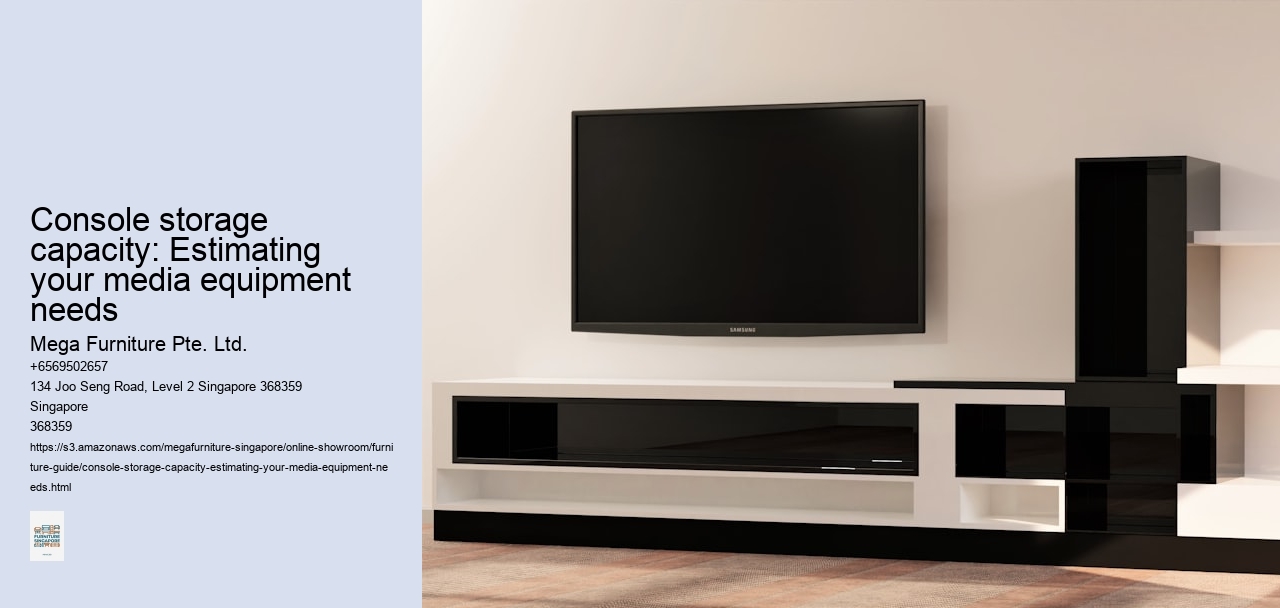
The master bedroom in a 4-room BTO flat typically clocks in at 12 square metres - that's a concrete reality dictating furniture choices. A common bedroom is even tighter. A TV console anchors the wall opposite the sofa in the same way a tall bookshelf anchors a corner — long horizontal piece, mix of open and closed storage, defines the visual weight of one whole side of the room. Megafurniture's TV Console range covers floating wall-mounted designs, low-profile freestanding consoles, and modular feature-wall configurations. Most pieces sit at 40-50cm height, sized for screens up to 75 inches.. In these spaces, a console pushing 240 centimetres simply won't fit; you'll be navigating around it. The practical rule is that a 180-centimetre unit comfortably anchors a 55-inch television, leaving enough wall on either side for the room to breathe. Go longer, and you're sacrificing walkway space for a piece that dominates.
Condo layouts introduce a different set of constraints, particularly with built-in media walls. Here, the console often becomes a floating element, integrated into a feature wall that might house concealed wiring or ambient lighting. Lengths can stretch to 240 centimetres to match a 75-inch screen, but the installation details are critical. If that wall contains conduit pipes for your AV system, a floor-standing console with a solid back panel becomes a nightmare - you can't access the ports. A floating design, mounted with a generous gap behind, is the only sensible solution.
That's why measuring isn't a suggestion; it's a mandatory step. You need three numbers: the wall length where the console will live, the ideal viewing distance from your sofa, and the precise height of any existing power points or data ports on that wall. A console that's too low can block a socket entirely, while one that's too high throws off your screen's sightline. It's a common oversight, resulting in a tangle of visible extension cords snaking up the wall - an instant ruin of that clean, built-in look.
For design-focused buyers, the console's proportions become part of the room's architecture. In a Tampines or Bedok resale flat with a long living room wall, a 220-centimetre sintered stone console can act as a grounded, low-slung anchor. The choice between rubberwood for warmth or a lacquered finish for reflection isn't just about style; it's about how light travels in your specific space during the evening. That deliberate alignment of dimensions, material, and function is what separates a mere TV stand from a considered piece of living room furniture.
You'll find a range of lengths and styles, from compact wall-mounted units to expansive floating consoles, suited to these local dimensions at Megafurniture's collection. The key is to match the cabinet to the room's actual footprint, not the television's advertised size.
The master bedroom in a 4-room BTO flat typically clocks in at 12 square metres — that’s a concrete reality dictating furniture choices. A common bedroom is even tighter. In these spaces, a console pushing 240 centimetres simply won’t fit; you’ll be navigating around it. The practical rule is that a 180-centimetre unit comfortably anchors a 55-inch television, leaving enough wall on either side for the room to breathe. Go longer, and you’re sacrificing walkway space for a piece that dominates.
Condo layouts introduce a different set of constraints, particularly with built-in media walls. Here, the console often becomes a floating element, integrated into a feature wall that might house concealed wiring or ambient lighting. Lengths can stretch to 240 centimetres to match a 75-inch screen, but the installation details are critical. If that wall contains conduit pipes for your AV system, a floor-standing console with a solid back panel becomes a nightmare — you can’t access the ports. A floating design, mounted with a generous gap behind, is the only sensible solution.
That’s why measuring isn’t a suggestion; it’s a mandatory step. You need three numbers: the wall length where the console will live, the ideal viewing distance from your sofa, and the precise height of any existing power points or data ports on that wall. A console that’s too low can block a socket entirely, while one that’s too high throws off your screen’s sightline. It’s a common oversight, resulting in a tangle of visible extension cords snaking up the wall — an instant ruin of that clean, built-in look.
For design-focused buyers, the console’s proportions become part of the room’s architecture. In a Tampines or Bedok resale flat with a long living room wall, a 220-centimetre sintered stone console can act as a grounded, low-slung anchor. The choice between rubberwood for warmth or a lacquered finish for reflection isn’t just about style; it’s about how light travels in your specific space during the evening. That deliberate alignment of dimensions, material, and function is what separates a mere TV stand from a considered piece of living room furniture.
You’ll find a range of lengths and styles, from compact wall-mounted units to expansive floating consoles, suited to these local dimensions at Megafurniture’s collection. The key is to match the cabinet to the room’s actual footprint, not the television’s advertised size.