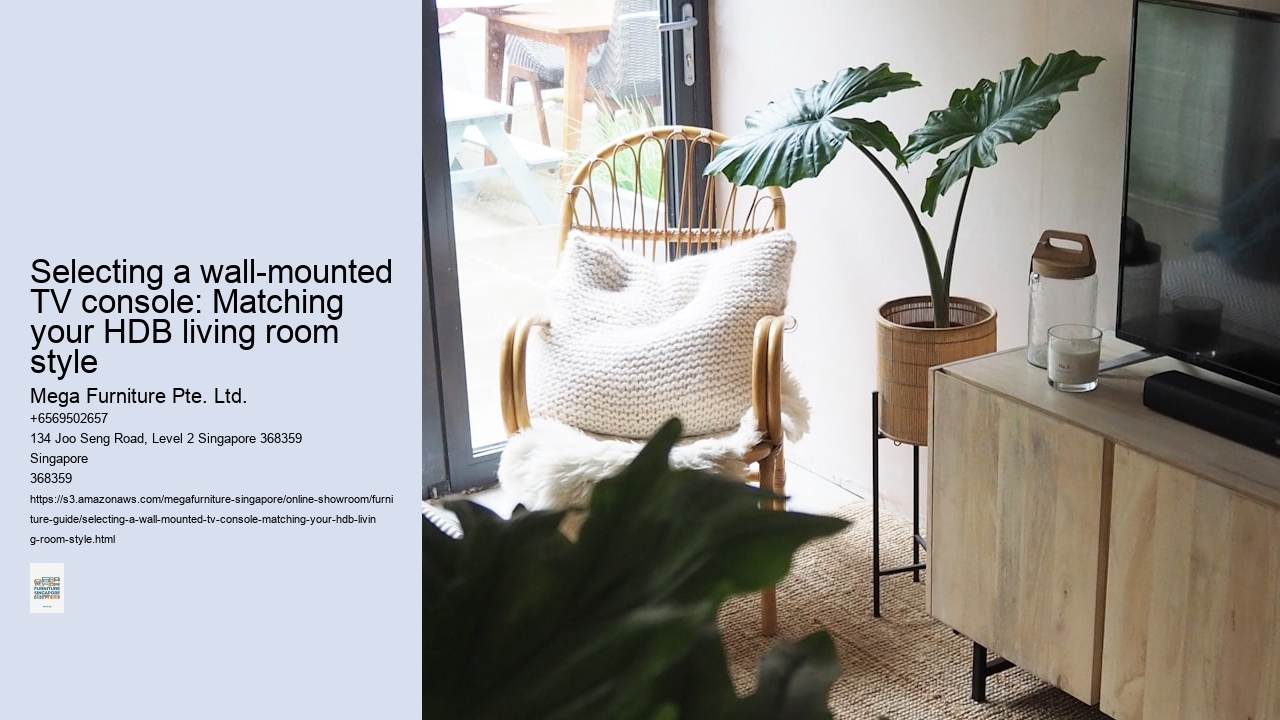
That laminate console in your Tampines flat might look purely aesthetic, but its real job starts when the monsoon air settles in and the humidity hits 80%. Solid wood, especially in a non-air-conditioned living room, can warp and swell over a single season — it’s a beautiful but often impractical choice for our climate. Engineered wood, laminates, and sintered stone tops are the pragmatic favourites; they resist moisture absorption, meaning your console’s doors won’t start sticking by Chinese New Year.
Consider the household traffic, too. A high-gloss finish will show every swipe from a cat’s claw or a toddler’s toy truck, turning your centrepiece into a map of micro-scratches. A textured woodgrain laminate or a matte, lacquered finish hides a multitude of sins. Rounded corners aren’t just a design trend; they’re a necessary concession to safety in a 12–18 sqm living room where every centimetre is a potential hip-bruiser.
Sizing is where most buyers get it wrong. A 65-inch TV on a 160cm console looks top-heavy and precarious, like a hat that’s two sizes too small. For visual balance, the console length should exceed the TV width by 15 to 30cm — that extra breathing room on each side grounds the setup and provides practical space for bookshelf speakers or a decorative vase. In many four-room BTO layouts, this means a 180cm to 220cm unit becomes the sweet spot.
It’s a balance of resisting the environment and accommodating the life within it. You’re not just buying a shelf for the television; you’re installing a workhorse that needs to withstand damp air, boisterous pets, and the constant shuffle of living. The right choice feels solid and settled, a calm anchor against the room’s daily chaos. For a curated range that addresses these specific local considerations, you can browse the options at Megafurniture.
That new console in your BTO living room will likely be laminated MDF. It’s the default for a reason—cost-effective, easy to clean, and available in nearly any finish to match your feature wall. But buyer beware: in Singapore’s humidity, cheaper versions can warp over time, especially on longer units spanning 180cm or more. Look for boards with a thick, sealed laminate and proper edge banding; a warped top panel means your 65-inch TV will never sit level. It’s a pragmatic choice for the first five years, not a family heirloom.
Rubberwood offers a solid-wood entry point without the teak price tag. It’s stable, sustainably sourced from mature trees, and takes stains beautifully for a consistent mid-tone finish. You’ll find it in many mid-range consoles because it resists the seasonal movement that plagues some hardwoods in our climate. The grain is generally straight and subtle, which works well for modern, Scandinavian, or industrial living room schemes. Just confirm the finish is properly sealed to protect against moisture from the wall.
A smooth drawer reveals more about build quality than the cabinet’s face. Full-extension, soft-close slides are non-negotiable for accessing media gear tucked at the back. Test them in a showroom—they should glide effortlessly even when loaded with game consoles and power bricks. Cheap runners feel gritty, sag over time, and won’t withstand daily use from kids rummaging for controllers. This is one detail where you shouldn’t compromise; it’s the difference between a console that functions and one that frustrates.
HDB floors are rarely perfectly flat, and a wobbly console is a safety hazard. Adjustable leg levellers, often hidden behind a toe-kick, let you stabilise the unit on uneven tiles or parquet. Some higher-end models include screw-on feet you can tweak with an Allen key after installation. It’s a small feature that makes a huge difference for stability, especially on floating designs where the entire weight is concentrated on a few points. Ignore it, and you’ll hear that annoying rock every time you dust.
Many buyers forget to check the back of the unit, but a proper backing panel is critical. It should be a solid sheet of MDF or plywood, not flimsy cardboard or an open frame. This seals the console against wall moisture, which is a constant issue in our humid flats, and prevents dust from settling on your cables. A good back also adds structural rigidity to longer spans, preventing the cabinet from twisting. It’s the unseen barrier that protects your investment from the damp concrete wall it’s mounted against.
The most frequent regret isn't about colour or material — it's discovering your console sits awkwardly beside the main door, leaving a narrow strip of wall that can't accommodate a standard 240cm unit. This oversight happens because buyers measure the wall where the TV will go, but forget to account for the door frame's intrusion; in many four-room BTO layouts, that leaves you with a practical length around 180cm, which forces a compromise between console storage and a 75-inch screen's proportions.
Cable management gets overlooked, too, especially when stacking a media player, soundbar, and gaming console. A wall-mounted unit with a solid back panel might look sleek, but it often traps heat and makes rerouting cables a nightmare every time you upgrade equipment. Opt for a design with ventilation gaps or a removable panel — it's a small detail that saves considerable hassle in a humid climate where electronics already run warm.
Choosing a console that's too short for a large TV is another common misstep. A 75-inch screen needs a base around 200cm to feel balanced and prevent that top-heavy look; a 120cm console underneath just appears dwarfed, making the entire wall arrangement feel unstable. Dark finishes, like charcoal laminate or walnut veneer, can compound the problem in north-facing living rooms — they absorb the limited natural light and visually shrink the space, which is why lighter oak or white sintered stone often work better in those conditions.
Then there's the practical matter of depth. A console that's only 30cm deep might fit a slim soundbar, but it won't conceal the bulk of an older set-top box or a PlayStation 5; you'll end up with cables and devices spilling over the edge, defeating the purpose of a storage-focused piece. Aim for a depth of at least 40cm, and consider a model with adjustable shelves to organise that clutter internally.
For buyers navigating these trade-offs, Megafurniture's collection offers a range of wall-mounted options with the necessary proportions and smart detailing. It's worth visiting their showrooms in Tampines or Joo Seng to see how different lengths and finishes behave in a simulated living room layout — you'll quickly spot which designs solve for storage without sacrificing the clean lines you're after.
A buyer can study laminate finishes online for hours, but there’s no substitute for running a hand along a drawer's edge to feel its lacquer—or spotting the subtle grain mismatch that only daylight reveals. That’s the core argument for a trip to Megafurniture’s Joo Seng showroom; you’re there to assess the physical details that digital images inherently flatten. The smoothness of a storage mechanism, for instance, is a tactile experience—you need to test the glide of a drawer weighted with a stack of Blu-rays or feel the dampened close of a cabinet door. What looks robust in a product shot might feel flimsy in person, a critical distinction for a piece meant to house expensive media equipment and withstand daily use. At their Tampines outlet, the consoles are staged in full room-set contexts, which offers a different kind of clarity. It’s one thing to note a console’s 180cm length on a spec sheet, quite another to see it anchored beneath a 65-inch TV in a mock-up of a 4-room BTO living room. This lets you gauge real proportions against your own space, understanding how much wall it will command and what floor space remains free. You can visualise how a floating design might lift the room or how a dark walnut finish absorbs light in a north-facing flat. The practical tests you can perform are uniquely valuable. Try sliding out a drawer while imagining your AV receiver and game consoles inside—does the mechanism still glide? Check if cable management cut-outs align with your power point locations, or if the open shelving is deep enough for a soundbar. These are functional specifics that online reviews often gloss over. For homeowners in neighbourhoods like Bedok or Tampines, it’s a short trip to verify what could become a central, long-term fixture in the home. Ultimately, committing to a large furniture item sight-unseen is a gamble, especially for a feature piece like a wall-mounted console. A showroom visit turns abstract dimensions and material descriptions into concrete reality. You’ll leave either with confidence in your choice or a saved receipt—both better outcomes than buyer’s remorse. You can explore the options at Megafurniture’s Joo Seng location or browse their
TV console collectiononline to shortlist models first.
Delivery isn't just about the truck arriving; it's about that final, often unspoken hurdle between the lift lobby and your living room. For buyers in walk-up apartments around Eunos or older estates near Tanah Merah, confirming stair-climbing service is crucial — a 240cm console packed in a flat carton won't fit through a typical stairwell without a team to manoeuvre it. Many suppliers now list this as a standard service, but you'll want to verify it before purchase, especially if your unit is on the third floor or higher. Professional assembly, particularly for wall-mounted units, isn't a luxury in Singapore; it's a necessity for safety and compliance. A console designed to hold a 65-inch television and media equipment carries significant weight, and secure mounting to HDB concrete walls requires specific hardware and technique. A proper installer will assess your wall type, use appropriate anchors, and ensure the unit is perfectly level — a DIY attempt with standard screws risks not just a crooked console but a catastrophic failure. That peace of mind is worth the typical assembly fee. Warranty terms here need careful scrutiny, with humidity being a silent culprit. Singapore's climate can affect materials over time, potentially causing warping in solid wood panels or corrosion in metal brackets. Reputable suppliers offer warranties of at least one year that explicitly cover structural integrity and hardware, not just superficial scratches. Look for clauses that address environmental factors; a warranty that only covers manufacturing defects might leave you exposed if a laminated panel starts to peel after nine months of constant air-conditioner cycling. The logistics, from stair-climbing to wall-mounting, form a hidden part of the total cost and effort. It's the unglamorous backend that determines whether your feature piece stays securely on the wall for years, or becomes a recurring headache. You can
browse the optionswith these practicalities in mind, factoring them into your budget alongside the design and dimensions.
The most telling questions about TV consoles don't come from showrooms — they're typed into search bars at 10pm, when the renovation spreadsheet is open and the tape measure is out. Singaporean buyers think in centimetres and kilograms, in BTO floor plans and afternoon sun angles. Here are the concrete answers.
TV console standard height for a 55-inch TV? Aim for a centreline around 105–115cm from the floor. That puts the screen's middle roughly at seated eye level for a typical sofa, preventing neck strain during a three-hour movie marathon. The console itself should be low-profile, often 40–50cm tall, to keep the TV as the visual anchor without leaving an awkward gap.
Can a wall-mounted unit hold a 30kg AV receiver? It depends entirely on the mounting system and wall. A properly installed, heavy-duty bracket fixed into solid brick or reinforced concrete can handle that load. Many standard floating consoles, however, have weight limits per shelf — always check the specs, and when in doubt, place the heaviest components on the lowest, most supported section.
Best colour for a west-facing living room? Lighter finishes reflect heat and light, making a room feel larger and cooler. Think oak, ash, or light grey laminate. Dark walnut or espresso tones will absorb that strong afternoon sun and can make a compact space feel heavier, though they hide dust better. The real trick is pairing it with sheer curtains.
Difference between a 180cm and 210cm console in a 4-room BTO? It's about proportion and pathway. A 210cm unit might fill the wall under a 65-inch TV perfectly, but in a narrower living room, it could crowd the walkway to the balcony or dining area. The 30cm difference is often the margin between a balanced media wall and a space that feels cluttered — measure your clear floor space after allowing for the sofa's depth.
The final decision often hinges on a mismatch of just ten centimetres. You’ve measured your 65-inch TV, your 3.2-metre feature wall, and calculated the volume needed for an AV receiver, two game consoles, and a tangle of cables. Yet the sleek, 180-centimetre floating console you’ve bookmarked only offers a single shelf—it’s a display piece, not a containment unit. In many four-room BTO layouts, that’s a critical error. Cross-reference your numbers ruthlessly, because a console that’s too short for the wall looks orphaned, and one with insufficient storage simply pushes clutter elsewhere.
Your choice now narrows to two distinct philosophies. A pure storage piece, often with full-height cabinet doors and multiple internal shelves, prioritises utility; it swallows everything, presenting a clean, monolithic face to the room. The alternative is a feature display, which blends closed cabinets with open shelving or niches. This style demands curation—you’ll need a few decorative objects that can withstand daily scrutiny, turning your media wall into an active part of the living room’s decor. That open shelving collects dust in HDBs, but for some, the visual payoff is worth the weekly wipe-down.
Before committing, there’s one non-negotiable step. You must physically verify the console’s presence in your specific space. Tape its exact dimensions on the wall using masking tape, and live with that outline for a day. Observe how it affects the walkway to the kitchen, or whether it crowds the entrance to the common bedroom. More crucially, get on the floor and locate your power points and data ports; a wall-mounted unit that blocks all cable access is worse than useless. That beautiful floating design is a liability if it forces you to run a power strip across your new laminate flooring.
This final verification often reveals the truth of your living room’s traffic flow and wiring quirks. It’s the difference between a console that merely fits and one that truly functions, letting you finally organise your media collection without compromise. For a comprehensive range of styles that can meet either storage-heavy or display-oriented needs, browse the options at Megafurniture’s collection.
The typical BTO living room stretches just 3 to 3.5 metres wall-to-wall - that's the reality. A console longer than 240cm in that space doesn't just look wrong; it blocks doorways and makes the room feel like a corridor. You'll find the sweet spot is a unit around 180cm to 220cm long; that'll comfortably centre under a 55- to 65-inch TV while leaving breathing room for your air-con unit or a plant in the corner.
In a compact resale flat, every centimetre of floor space counts for traffic flow. A wall-mounted, floating console solves that - it clears the floor entirely, allowing easy movement around a standard 240cm sofa. That's crucial in older layouts where the living room might also be the main passage to the kitchen. The visual lift also makes a low ceiling feel less oppressive, a common trick in flats around Bedok or Queenstown.
Condo owners face a different proportional challenge. The media wall in a new launch, with its floor-to-ceiling feature, demands a console with substantial length to avoid a dwarfed, toy-like look. A 75-inch screen on a vast blank wall needs a console that's at least two-thirds its width, if not matching it entirely; anything less looks accidental, not designed. The choice then leans toward longer, low-profile units in materials like sintered stone or walnut veneer that can anchor the entire composition.
Material choice here is about more than aesthetics - it's about enduring the humidity. Laminate finishes are practical, but the real workhorse in many family homes is a rubberwood frame with a robust melamine top; it wipes clean after supper and withstands the occasional bumped knee from a toddler. Open shelving might look appealing in a showroom, but in a lived-in space, it's often where dust collects and clutter accumulates - buyers favour consoles with a mix of concealed compartments for routers and game consoles, plus just one or two display niches.
Ultimately, the right console isn't just a stand for your television; it's the functional anchor that organises the room's entire lower sightline. Getting the proportions wrong throws the whole space off balance, while the right dimensions - married to sensible storage - make a 3-metre room feel intentionally curated.
The typical BTO living room stretches just 3 to 3.5 metres wall-to-wall — that's the reality. A console longer than 240cm in that space doesn't just look wrong; it blocks doorways and makes the room feel like a corridor. You’ll find the sweet spot is a unit around 180cm to 220cm long; that’ll comfortably centre under a 55- to 65-inch TV while leaving breathing room for your air-con unit or a plant in the corner.
In a compact resale flat, every centimetre of floor space counts for traffic flow. A wall-mounted, floating console solves that — it clears the floor entirely, allowing easy movement around a standard 240cm sofa. That's crucial in older layouts where the living room might also be the main passage to the kitchen. The visual lift also makes a low ceiling feel less oppressive, a common trick in flats around Bedok or Queenstown.
Condo owners face a different proportional challenge. The media wall in a new launch, with its floor-to-ceiling feature, demands a console with substantial length to avoid a dwarfed, toy-like look. A 75-inch screen on a vast blank wall needs a console that’s at least two-thirds its width, if not matching it entirely; anything less looks accidental, not designed. The choice then leans toward longer, low-profile units in materials like sintered stone or walnut veneer that can anchor the entire composition.
Material choice here is about more than aesthetics — it's about enduring the humidity. Laminate finishes are practical, but the real workhorse in many family homes is a rubberwood frame with a robust melamine top; it wipes clean after supper and withstands the occasional bumped knee from a toddler. Open shelving might look appealing in a showroom, but in a lived-in space, it’s often where dust collects and clutter accumulates — buyers favour consoles with a mix of concealed compartments for routers and game consoles, plus just one or two display niches.
Ultimately, the right console isn't just a stand for your television; it's the functional anchor that organises the room's entire lower sightline. Getting the proportions wrong throws the whole space off balance, while the right dimensions — married to sensible storage — make a 3-metre room feel intentionally curated.