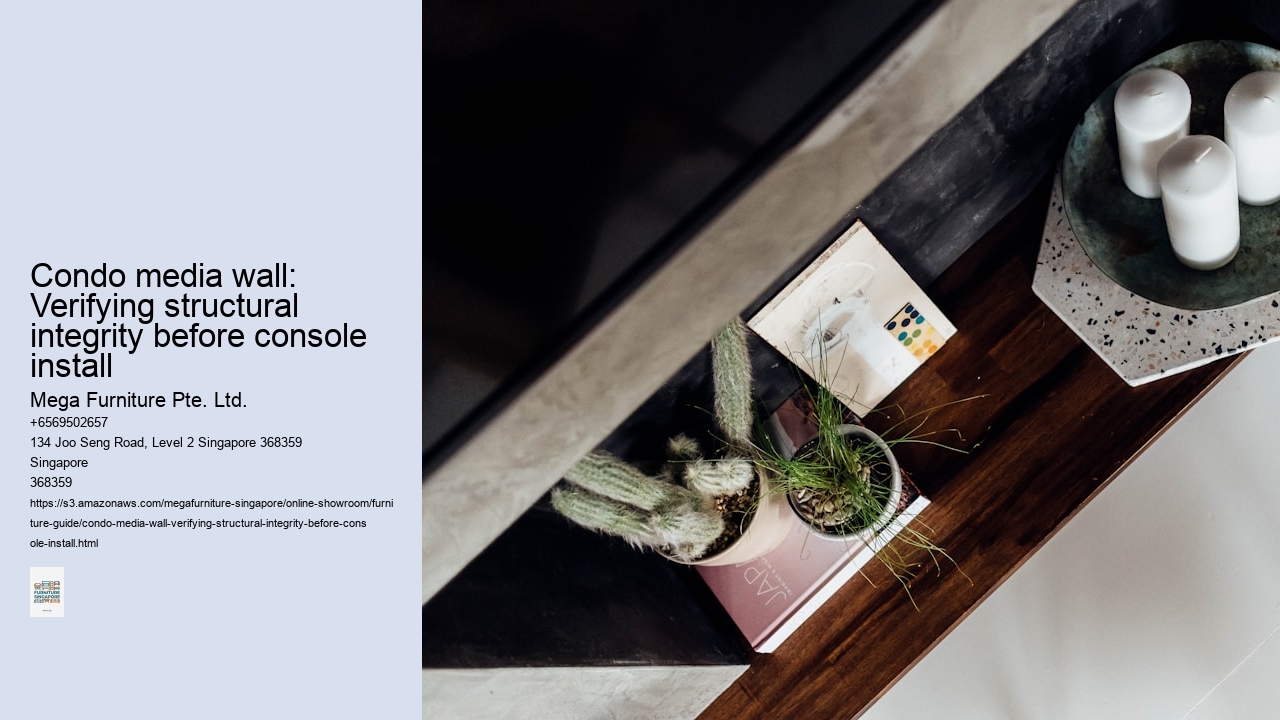
A 240-centimetre media console loaded with an AV receiver, gaming consoles, and a few decorative stone bookends can easily exceed 100 kilograms—a weight that demands more consideration than the wall’s paint colour. That’s a small adult’s worth of mass hanging on your living room wall, and the primary failure point isn’t the console itself, but the fixings into the substrate behind the plaster. In many Singapore homes, that substrate is a gamble; BTO and resale flat walls might be concrete, brick, or simply plasterboard fixed to timber battens, and you’ll need to verify which you’re dealing with before a single bracket goes up.
Start by locating the wall studs, the vertical timber or metal frames behind the plasterboard. Use a reliable electronic stud finder, as the old knock-and-listen method is notoriously unreliable in local construction where batten spacing can be irregular. The goal is to align the console’s mounting brackets directly with these studs, as plasterboard alone cannot support significant long-term load—it’s only meant to hold its own weight and a few picture hooks. For a console spanning 240cm, you’ll typically need to secure it into at least three studs to distribute the weight evenly and prevent a dangerous centre sag over time.
If your wall is solid concrete or brick, the process shifts to selecting the correct mechanical fixings. Plastic wall plugs and standard screws won’t suffice for this load; you’ll need heavy-duty chemical anchors or sleeve anchors designed for masonry. These expand within the drilled hole to create a secure, permanent hold. It’s a more involved installation, often requiring a hammer drill and a bit of dust, but it’s the only method that guarantees the console won’t gradually work itself loose from the wall under its own considerable heft.
For plasterboard-on-batten walls, the fixings must penetrate the plaster and bite deeply into the timber frame behind. Even then, consider adding supplementary support like a discreet vertical cleat or a French cleat system along the console’s entire length—this transfers the load downwards along the studs rather than relying purely on the shear strength of a few screws. It’s a detail often overlooked in the showroom, where consoles are displayed on solid floors, but it’s what separates a secure installation from a ticking time bomb in a family living room.
That glossy laminate surface often hides a particleboard heart, and that's the problem. Singapore's humidity doesn't just warp cheap board; it makes it swell, turning a once-straight console into a permanent wavy eyesore in your Tampines living room. A solid wood core—typically rubberwood or acacia—provides dimensional stability, resisting the moisture that seeps through even the best-sealed edges over years. It's the unseen foundation that keeps drawers sliding smoothly and doors aligned when everything else in the flat feels damp. This internal integrity is non-negotiable for a piece that's meant to support a 75-inch TV and expensive electronics; you're buying quiet confidence, not just a facade.
A standard lacquer takes days to cure fully, leaving microscopic pores that humidity and pet claws exploit. UV-cured acrylic or polyurethane, however, is hardened instantly under ultraviolet light, creating a surface closer to sintered stone than traditional wood. The result is a near-impervious shield against water rings from condensation, the oily smudges from curious fingers, and the determined scratching of a bored cat. This finish won't cloud or soften in our climate, maintaining its sheen in a Bedok condo where the afternoon sun blasts the media wall for hours. It's a technical specification that sounds minor on a tag but defines the console's lifespan.
Every cut edge on a laminate or veneer panel is a potential ingress point for moisture. In a 4-room BTO, that means the back panel against the wall, the underside near the floor, and all those internal shelf edges you never see. Fully sealed means a thick, continuous band of matching finish or a dedicated PVC edge banding that's thermally fused, not just glued on. Run your finger along a sample's raw edge in a showroom; if you feel a ridge or a different texture, that seam will be the first to fail. Proper sealing turns the console into a single, monolithic unit, effectively locking the engineered materials inside a protective shell.
Painted metal legs in a humid environment are a rust gamble—you'll see the first bubble appear near the floor contact point within a couple of years. Powder coating electrostatically applies a dry polymer that's then baked on, fusing it to the metal in a layer far thicker and more adhesive than any wet paint. It resists chipping from vacuum cleaner bumps and won't corrode from mopping spills, which is crucial for a floor-standing unit in a family-heavy household. The finish feels textured to the touch, offering a slight grip that also helps mask minor scratches from pet activity or stray toys.
The top surface of a console endures the most direct abuse: spilled drinks during movie nights, the scrape of a relocated soundbar, the constant patrol of a dog's nails. A high-pressure laminate with a melamine wear layer or a thermally fused foil won't just stain less; it creates a harder surface that forces a scratching paw to slide rather than dig in. This isn't about being indestructible, but about introducing enough friction and resistance that most daily incidents become mere wipe-away events. In a practical sense, it's the difference between a piece that looks lived-in and one that looks prematurely ruined after the first year.
The most expensive mistake in a Singaporean media wall installation isn't the console itself — it's the assumption that your wall can hold it. Buyers often select a 240cm console to match their new 75-inch TV, only to discover the wall studs behind their plasterboard are spaced at 600mm centres; that leaves the console's ends, and the weight of your television, hanging over empty space. The result is a slow sag, then a catastrophic pull-out, because those fancy floating units aren't levitating — they're trusting a few screws in timber that might not be there. Material mismatch is another silent killer. Using standard plastic wall plugs for a floor-standing console on a concrete bomb shelter wall is a recipe for dust and disappointment. Concrete requires a proper hammer-drill and concrete anchors; the plastic plugs that work in partition walls will simply spin uselessly in the drilled hole, leaving your expensive storage unit leaning like a tired commuter at Tanah Merah. It's a fix that costs an extra $50 in tools and anchors, versus hundreds in damaged furniture. Then there's the cable chaos. In an 85 sqm flat, a media console is the central nervous system for your router, streaming boxes, and gaming consoles, yet many installations treat cable management as an afterthought. You'll end up with a nest of black wires visible from the sofa, a tangle that traps dust and blocks ventilation for your PlayStation 5. The clean look you paid for is ruined, and the heat buildup in that enclosed HDB space isn't doing your electronics any favours. Planning for a grommeted hole, some Velcro straps, or even a simple clip channel behind the unit makes the difference between a showroom feature and a permanent eyesore. A good rule is to treat the wall as the first component you're buying. Verify its structure, know its material, and organise the routing for every wire before the console even arrives at your doorstep. That upfront legwork — checking studs, buying the right fixings, mapping cable paths — transforms a risky installation into a permanent, clean centrepiece. For those considering their options, a thorough browse of
Megafurniture's TV console collectionshould start with measuring your wall, not just your television.
A 200-centimetre TV console is a commitment, not just in budget but in living room real estate. Photos online can’t convey the subtle bowing a cheaper engineered wood shelf might develop under a 75-inch television’s weight, or the slight warp in a long timber panel that wasn’t properly seasoned. You’ll want to press on surfaces, test drawer slides, and confirm that what looks solid in a catalogue doesn’t feel hollow in person. This tactile verification is precisely why a trip to a showroom like Megafurniture’s Joo Seng outlet is non-negotiable for such a key purchase.
At the Joo Seng showroom, you can scrutinise the joinery up close. Run a finger along the mitred corners of a sintered stone top to check for seamless alignment, or inspect the dovetail construction on a solid rubberwood drawer. The heft of the materials becomes apparent when you attempt to shift a floor-standing unit slightly; a well-built console should have a satisfying, planted weight that whispers stability. It’s the difference between a piece that merely holds your media gear and one that anchors your entire media wall.
Consider the finish under showroom lighting, which is far more honest than the perfect studio shots used online. You might notice that the ‘matte oak’ laminate has a slightly cooler tone than you envisioned, or that the ‘charcoal grey’ lacquer shows fingerprints more readily than a satin finish. These are decisive details for a focal piece that will live in your condo’s living area for a decade. Assessing them in a physical space allows you to match the console’s true colour and texture to your existing flooring and wall treatments.
For families in a 4-room BTO, where the living room also functions as a play area and thoroughfare, construction integrity is paramount. A floating console mounted on seemingly insubstantial brackets might cause anxiety; in the showroom, you can give it a firm push to gauge its rigidity. This hands-on test prevents the common post-installation surprise of a unit that wobbles when someone walks past or a drawer that sticks in Singapore’s humidity. It’s due diligence that online reviews can’t fully replicate.
Ultimately, you’re investing in a piece that must perform daily. Taking the time to visit lets you move beyond pixel-perfect imagery and engage with the furniture as an object you’ll live with. You can browse the full range of console options at Megafurniture’s showrooms, from wall-mounted variants for tight spaces to substantial media walls, and make a choice grounded in physical fact rather than digital promise.
Delivery for a 240cm solid wood console to a fourth-floor walk-up in a Joo Seng resale flat can cost an extra $150 to $250 — that’s the stair-climbing premium, and it’s almost never included in the advertised free delivery. It’s a line item that only appears at checkout or in a follow-up call from the logistics team, a practical surprise for buyers in older estates where the lift stops three floors short. Confirm this directly before ordering; the total often hinges on the unit’s exact floor, the number of flights, and whether the item is delivered flat-packed or requires a two-person carry for an assembled behemoth.
Assembly itself is typically straightforward for flat-pack units, but that warranty document deserves a much closer look. Many cover only obvious manufacturing defects — a door hinge that snaps in week two, a drawer runner that jams — which is fine for minor faults. What you need is confirmation that the policy extends to structural integrity over time, especially for wall-mounted or floating consoles holding a 75-inch TV and all its peripherals. Will it cover sagging in the centre shelf after a year, or the gradual fading of a walnut veneer facing your east-facing condo window? That’s less common.
The fading clause is particularly relevant in our climate. A console positioned in a bright living room in a Bedok flat, bathed in afternoon sun, will show colour changes within months if the finish isn’t properly UV-stabilised. A warranty that dismisses this as ‘natural wear’ isn’t much use; you want one that acknowledges the specific environmental stress of a Singaporean home. It’s a distinction that separates a promotional assurance from genuine, long-term protection for a central piece of your living room.
For comprehensive options that detail these service terms upfront, you can browse Megafurniture’s collection. Their warranties often explicitly list coverage for load-bearing structures and finish integrity, which provides a clearer benchmark. Still, the final responsibility rests with the buyer to parse the fine print — because the true test of a console isn’t just its first week in a showroom, but its fifth year in your home, holding everything together without complaint.
Singaporean homeowners often ask the same few questions about media walls, their concerns shaped by HDB regulations, tight spaces, and a preference for clean lines. The answers hinge on local specifics — the type of wall you’re dealing with, the weight it can bear, and whether you’re willing to let trunking show.
Can I mount on an HDB feature wall? It depends entirely on what’s behind that plaster. A true structural brick or concrete feature wall can typically support a floating console, provided you use the correct anchors and locate the studs. Many feature walls, however, are just decorative drywall partitions; drilling into one risks damaging plumbing or electrical runs hidden within. For absolute certainty, consult your BTO’s original floor plan or ask your building manager — it’s a ten-minute check that prevents a costly repair.
How to hide trunking? In a 4-room resale flat with existing conduit runs, the simplest solution is to choose a console with a deep back panel or a full cabinet design that sits flush to the wall, swallowing the trunking behind it. For new installations in condos, consider routing cables through the media wall’s built-in cavities before final plastering, or use a low-profile, paintable trunking channel that runs vertically behind the console’s side panel. It’s an extra day of work for your contractor, but the result is seamless.
What’s the weight limit for a floating console? A well-installed floating console, using steel brackets anchored into concrete, can hold around 80 to 100 kg distributed across its length — enough for a 65-inch TV, a soundbar, and some decorative items. The risk isn’t the console failing; it’s mounting it onto a hollow feature wall that can’t take the load. Always verify the wall’s composition first, then choose a console with a reinforced internal frame.
Is a contractor needed for install? For a simple floor-standing unit, no. But for any floating installation, especially one involving drilling into unknown walls, hiding trunking, or integrating lighting, hiring a professional is wise. A good contractor will assess structural integrity, use the correct hardware, and ensure everything is flush and level — a job that takes half a day but guarantees your media wall doesn’t become a liability. You can browse console options designed for such installations, focusing on those with specified mounting systems and clean silhouettes.
That last tape measure check before you drill feels like a formality, but it’s where most media wall projects get saved from disaster. You’re not just confirming a console fits the wall; you’re verifying the wall itself can handle the plan.
First, identify your wall type. A solid brick wall in a pre-2000s resale flat can hold a serious load, but the drywall partitions in many newer condos require specific hollow-wall anchors. Don’t guess—tap it. A solid thud versus a hollow sound dictates your entire hardware strategy. Use a stud finder to map the timber or metal studs behind; that stud map is your blueprint for securing a floating console or a heavy, loaded-up unit. The goal is to anchor directly into studs wherever possible, distributing weight across the frame, not just the plasterboard.
Then, do the real math on total load. A 65-inch TV can weigh 25kg on its own. Add a soundbar, a gaming console, books, and decorative items on the shelves, and you’re easily pushing 50–70kg. That’s a substantial static load for a wall-mounted piece. For floor-standing consoles, the calculation shifts to floor pressure and stability, especially on polished porcelain tiles. Secure the appropriate mounting hardware from the start—don’t assume the pack-in brackets are sufficient for your specific wall. It’s a one-time job; over-spec the hardware.
Finally, step back and consider the console’s scale in the room. A 240cm console might fit the wall in a 4-room BTO living room, but it could overwhelm the space, making the 3-metre wall-to-wall distance feel cramped. The console’s depth matters, too; a 45cm deep model leaves better walkway space than a 60cm one. This isn’t just about measurements—it’s about proportion. The right console should anchor the TV wall without making the room feel like a showroom corridor.
Get these checks right, and the installation becomes a straightforward task. Miss one, and you’re patching holes or, worse, dealing with a costly repair.
That satisfying thud of a drill hitting concrete is a sound of relief in a condo, but in a BTO, it's often a warning. A TV console anchors the wall opposite the sofa in the same way a tall bookshelf anchors a corner — long horizontal piece, mix of open and closed storage, defines the visual weight of one whole side of the room. Megafurniture's TV Console range covers floating wall-mounted designs, low-profile freestanding consoles, and modular feature-wall configurations. Most pieces sit at 40-50cm height, sized for screens up to 75 inches.. Singapore's housing types dictate entirely different wall realities, and getting it wrong isn't just about a wobbly bracket - it's about water pipes and structural integrity. The 120cm to 240cm span of a typical TV console distributes weight, but the mounting point is only as good as the wall it's fixed to.
In a new BTO flat, most internal walls are lightweight drywall partitions, not structural concrete. You can't just sink a wall anchor anywhere and expect it to hold a heavy, loaded console; you'll need to locate the metal studs behind the plasterboard, which are often spaced 600mm apart. This dictates where your console's key mounting points must be, a constraint that can override pure aesthetics. Many homeowners discover this the hard way, when a poorly anchored floating unit sags or pulls free under the weight of a 65-inch TV and media equipment.
Resale HDB flat owners face a different, murkier challenge: legacy renovations. Previous owners might have rerouted plumbing or electrical conduits inside walls, turning a seemingly straightforward drill point into a potential flood zone. It's a prudent, if tedious, step to invest in a professional stud and pipe finder - the few hundred dollars is cheap insurance against a leak behind your custom media wall and the subsequent repair bill. That solid *thunk* you're listening for isn't just stud; it's the absence of a water pipe.
Condo walls, particularly those separating units, are often reinforced concrete structural partitions. They'll hold virtually anything, but drilling into them requires a hammer drill and proper concrete anchors; a standard wall plug will spin uselessly in the hole. The real consideration here is often the finish - you're committing to a permanent fixture on a wall you can't easily patch or modify. Once you've drilled into that structural spine, you're locked into that console's footprint.
The choice between a floor-standing, wall-mounted, or floating console then becomes less about style and more about your wall's literal composition. A solid timber floor-standing unit sidesteps the issue entirely, offering stability and generous storage without a single drill hole, a pragmatic favourite for many resale flat renovations where wall conditions are unknown. For those set on a built-in look, verifying what's behind the plaster is the non-negotiable first purchase, long before you browse the options.
A Bookshelf earns its place in Singapore homes through dual function — book and decor storage in the open shelves, soft visual division when placed mid-room in open-plan condominium layouts. Megafurniture's combined display unit and bookshelf hub covers tall book racks, cubby-hole designs, ladder shelves, modular cube systems, and glass-door pieces in oak, walnut, and MDF veneer finishes. Solid-wood pieces typically start around $425, with most heights spanning 120cm to 220cm to fit standard 2.6m HDB ceilings..That satisfying thud of a drill hitting concrete is a sound of relief in a condo, but in a BTO, it’s often a warning. Singapore’s housing types dictate entirely different wall realities, and getting it wrong isn’t just about a wobbly bracket — it’s about water pipes and structural integrity. The 120cm to 240cm span of a typical TV console distributes weight, but the mounting point is only as good as the wall it’s fixed to.
In a new BTO flat, most internal walls are lightweight drywall partitions, not structural concrete. You can’t just sink a wall anchor anywhere and expect it to hold a heavy, loaded console; you’ll need to locate the metal studs behind the plasterboard, which are often spaced 600mm apart. This dictates where your console’s key mounting points must be, a constraint that can override pure aesthetics. Many homeowners discover this the hard way, when a poorly anchored floating unit sags or pulls free under the weight of a 65-inch TV and media equipment.
Resale HDB flat owners face a different, murkier challenge: legacy renovations. Previous owners might have rerouted plumbing or electrical conduits inside walls, turning a seemingly straightforward drill point into a potential flood zone. It’s a prudent, if tedious, step to invest in a professional stud and pipe finder — the few hundred dollars is cheap insurance against a leak behind your custom media wall and the subsequent repair bill. That solid *thunk* you’re listening for isn’t just stud; it’s the absence of a water pipe.
Condo walls, particularly those separating units, are often reinforced concrete structural partitions. They’ll hold virtually anything, but drilling into them requires a hammer drill and proper concrete anchors; a standard wall plug will spin uselessly in the hole. The real consideration here is often the finish — you’re committing to a permanent fixture on a wall you can’t easily patch or modify. Once you’ve drilled into that structural spine, you’re locked into that console’s footprint.
The choice between a floor-standing, wall-mounted, or floating console then becomes less about style and more about your wall’s literal composition. A solid timber floor-standing unit sidesteps the issue entirely, offering stability and generous storage without a single drill hole, a pragmatic favourite for many resale flat renovations where wall conditions are unknown. For those set on a built-in look, verifying what’s behind the plaster is the non-negotiable first purchase, long before you browse the options.