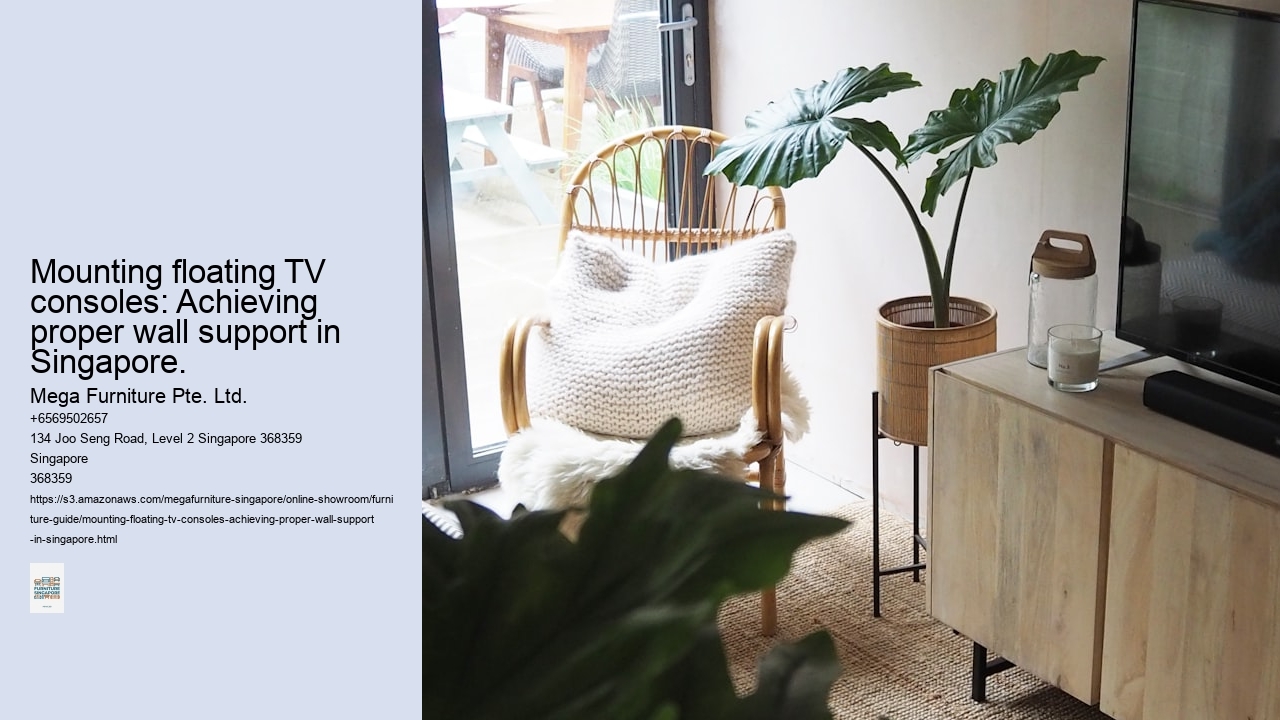
The weight calculations for a floating console often get overlooked until the wall starts groaning. You’re not just hanging a shelf; you’re cantilevering a 240cm engineered wood box filled with a PlayStation, an AV receiver, and maybe last season’s board games. The stated load capacity must comfortably exceed the combined weight of your TV, soundbar, and all the electronics you’ll stash inside—add at least a 20% buffer for that inevitable future upgrade.
Compatibility with your wall type isn’t a suggestion, it’s a prerequisite. The mounting system for a HDB hollow block wall, common in BTOs, requires specific anchors that spread the load across the cavity; a resale flat’s brick wall needs a different, more aggressive fixings strategy. In many condos with drywall partitions, you’ll be hunting for the steel studs, a frustrating game of hide-and-seek that demands a stud finder and patience. Get this wrong, and the entire installation becomes a hazard.
Material choice is dictated by our climate. That rustic solid teak console you fancied might warp spectacularly after a few months facing the afternoon sun in a west-facing Bedok flat. Engineered wood with a quality veneer or laminated panels tend to fare better, but you must check the core isn’t a humidity sponge. Look for finishes and substrates rated for 80% humidity or higher—it’s the difference between a piece that stays true and one that develops a permanent sag.
You can find options built for these local conditions, like the wall-mounted consoles at Megafurniture’s collection, which specify load ratings and suitable wall types. The goal is a seamless integration where the hardware disappears, leaving only a clean line of storage that feels effortlessly anchored to the wall. That confidence comes from matching the product’s engineering to the specific realities of your home.
Engineered wood is the standard choice for floating consoles across Singapore's condos and BTO flats, and its durability hinges entirely on the laminate's edge sealing. A poorly sealed edge in a humid Tampines flat lets moisture creep into the core, causing swelling and eventual warping that pulls the console away from the wall. Good sealing means a continuous, glossy band around every panel — you shouldn't see any raw, fibrous edges where the laminate sheet ends. That band acts as a barrier against Singapore's consistent 80% humidity, which can turn a minor gap into a major failure point over a few monsoon seasons. It's a simple visual check that often separates a console that lasts five years from one that buckles in two.
While solid wood like rubberwood or oak offers a premium feel, it's inherently reactive to environmental changes, making it a gamble for many local installations. In a typical 4-room HDB, temperature and humidity can swing between the air-conditioned evenings and the day's natural ventilation, causing the wood to expand and contract subtly. This movement can stress the wall-mounted brackets over time, potentially leading to visible gaps or a slight tilt. That's why solid wood consoles often come with a higher price tag and a manufacturer's caveat about stable environments — they're beautiful, but they demand a more controlled setting than many Singaporean living rooms can reliably provide.
The brackets are the literal lifeline of a floating console, and their construction matters more than their decorative covers. Steel-reinforced brackets, often with a powder-coated finish to resist rust, provide the necessary rigidity to support a 240cm unit loaded with a 75-inch TV, gaming consoles, and books. Thin, stamped-metal brackets might hold initially, but they can develop a worrying flex over time, especially if the wall attachment isn't perfect. You want to feel their substantial weight in your hand during assembly; that mass translates directly into confidence for a family with young children who might lean against the console.
Adjustable hanging rails that sit behind the console's back panel are a clever solution for imperfect walls. Many Singapore flats, especially older resale units, have walls that aren't perfectly straight or have slight irregularities in the plaster. Concealed rails allow you to level the console independently of the wall's surface, ensuring a perfectly horizontal finish even if the mounting points are slightly off. They also distribute the weight across a longer section of the console's frame, reducing stress concentrations. It's a feature that turns a potential installation headache into a straightforward, professional-looking result.
Full-extension, soft-close drawer mechanisms are the unsung heroes of daily durability. They allow you to access the entire drawer cavity — crucial for retrieving that cable tucked at the very back — without straining and yanking on the front panel. The soft-close function isn't just about quietness; it prevents the violent slam that gradually loosens joints and wears out traditional roller systems. In a household where drawers are opened dozens of times a week for remotes, chargers, and controllers, this engineered smoothness directly correlates to the unit's long-term integrity. It's a tangible signal that the manufacturer considered actual use, not just static display.
A perfectly measured console for a 55-inch TV looks absurd when you finally unbox that 75-inch behemoth on sale at the neighbourhood electronics store. It’s a classic Singaporean oversight — buyers meticulously check TV dimensions but forget the PlayStation, soundbar, and future Nintendo Switch dock that demand real estate, leaving cables dangling off the console’s edge like industrial stalactites. The more subtle error is one of proportion; a 240cm monolithic design in dark walnut can visually crush a standard 3-metre HDB living room wall, making the space feel cramped and top-heavy before you’ve even mounted it. Choosing a style that overwhelms the room is common, but the single biggest mistake is attempting a DIY installation on local walls without proper expertise. Our partition walls aren’t uniform — a BTO flat might have a reinforced concrete beam running behind one section of drywall, while a 90s resale condo wall could be hollow brick. An installer who isn’t familiar with this patchwork will use the wrong anchors or drill into electrical conduits, leading to a catastrophic failure where the entire unit, along with your new OLED, pulls away from the plaster. That failure isn’t just about a broken TV. It’s about damaged finishes: a spiderweb of cracks radiating from the mount points, torn laminate, and gouges in the wall that require a professional painter to match the original HDB or condo colour. The repair bill often exceeds what a proper installer would have charged upfront, turning a perceived savings into a costly, stressful renovation setback. It’s a particular shame when it mars a feature piece you’ve invested in, like a floating console in a sleek matte lacquer finish. The solution is straightforward. Budget for a professional who specialises in mounting heavy furniture on Singapore’s specific wall types; they’ll use a stud finder and sometimes a borescope to map the substructure, selecting heavy-duty toggle bolts for hollow sections or concrete screws for the solid bits. They’ll also advise on load distribution, especially for longer consoles over 180cm that need multiple, perfectly aligned mounting points. This isn’t an area for guesswork — a properly installed unit should feel as solid as the wall itself, with no disconcerting flex when you place a heavy amplifier on its open shelf. For those selecting their console, it’s wise to visualise the entire media ecosystem. Allow an extra 30 to 40cm beyond your TV’s width for peripherals, and in compact spaces, consider lighter finishes like oak or white sintered stone to keep the wall feeling open. You can
browse options with clear length specificationsto start that planning, but remember — the most beautiful piece is only as good as what’s holding it up.
The digital listing for a 240cm oak-veneer console looks sleek and compact, which is the exact problem. On a phone screen, it’s impossible to gauge how that sheer mass will dominate a 4-room BTO living room wall or if the finish has a distracting grain pattern under LED downlights. That’s where a showroom visit shifts from a nice-to-have to a necessity for tactile decision-making. At Megafurniture’s Joo Seng or Tampines locations, you’ll find consoles mounted on mock walls at the correct viewing height. You can assess the real-world proportions against your own TV size and see how the finish holds up under the showroom’s varied lighting — a critical check for anyone matching it to existing rubberwood or sintered stone surfaces. It’s one thing to read “load-bearing capacity”; it’s another to watch a staff member demonstrate the specific bracket system and load mechanics for a unit you’re considering. They can show you how the internal cable management channels actually route a tangle of HDMI and power cords, or how smoothly the soft-close drawers operate when fully loaded. This hands-on verification is crucial, because installing a floating console isn’t like moving a floor-standing cabinet — once it’s anchored to your concrete wall, a mistake is costly and permanent. For design-focused shoppers, it also allows you to judge the piece as a feature object. Does that matte laminate look cheap in person, or does it have a pleasing depth? Does the open shelving proportion feel balanced for displaying books and objects? You’re deciding on a centrepiece, not just storage. Browsing the full
TV console collectiononline gives you options, but the showroom lets you confirm the choice.
The delivery team will need to navigate your lift lobby, but for many older resale flats, the final hurdle is a flight of stairs. A proper retailer confirms their crew can handle stairwell access for a 200cm console packed in a long, flat carton; they’ll typically charge an extra fee for the labour, but that’s a predictable cost compared to the shock of a team refusing to carry it up. You don’t want to discover that limitation on delivery day, leaving you stranded in a Tiong Bahru corridor with a unit too bulky for the staircase.
Professional assembly is non-negotiable for a floating console. This isn’t a floor-standing cabinet you can just shove against the wall—it’s a permanent fixture that must be anchored perfectly into concrete or brick. A certified installer will locate the studs, use the correct heavy-duty wall plugs and bolts, and ensure the console is perfectly level across its entire length. A DIY attempt here risks the entire unit, your television, and the wall behind it; the potential cost of repair dwarfs the assembly fee.
Warranty terms reveal a lot about build quality. Look for coverage that explicitly includes structural integrity—the frame and joints—and all hardware, from drawer glides to mounting brackets, for a minimum of three years. That timeframe isn’t arbitrary; it covers the initial settlement period in a new BTO and the typical wear from daily use in a family living room. A warranty that only covers surface defects for one year suggests the manufacturer lacks confidence in the product’s longevity.
Given the investment, it’s sensible to choose a retailer that bundles these services transparently. A complete package from a showroom like Megafurniture’s Tampines outlet includes delivery, professional mounting, and a clear warranty, removing the guesswork of coordinating separate contractors. For a piece that holds several thousand dollars’ worth of electronics, that peace of mind is part of the furniture’s real value.
The most common questions about floating consoles aren't about colour or wood grain — they're about weight, walls, and what your BTO's management office will actually allow.
Can it hold a 75-inch TV and soundbar? Check the console's stated weight capacity and add everything: a 75-inch TV can weigh over 30kg, the soundbar another 5-8kg, and your media devices add up. A 240cm floating console needs a robust mounting rail system fixed into solid concrete or brick; the cabinet itself is just storage, and overloading it risks a catastrophic failure. You're looking for a capacity of at least 60kg for that setup, ideally more.
Is drilling into my HDB bedroom wall allowed? For load-bearing walls, yes, but you must locate the structural concrete. Drilling into partition walls, which are often hollow, is a definite no — they can't support the weight. The real issue is depth: HDB rules typically require using chemical anchors for a secure fix into the concrete, which means a deeper, 50-70mm hole. Your installer should know this, but it's your responsibility to confirm.
How to hide cables cleanly? Plan the cable run before mounting. The cleanest method is to chase a channel into the wall, run PVC conduit, and plaster over it — but that's major work requiring approval. A simpler, non-destructive solution is to use a paintable cable cover running vertically behind the console; for a truly seamless look, choose a console with a full back panel and strategic grommets to feed cables internally from your wall-mounted TV.
Difference between L-bracket and full rail systems? An L-bracket is just two metal arms fixed at points, suitable for shorter, lighter consoles under 180cm. A full rail system, a horizontal bar fixed across the wall with multiple brackets, distributes weight evenly and is essential for anything longer or heavier — it's the only safe choice for a 240cm unit packed with gear. That distinction is where most DIY installations go wrong; people assume the wall can take it, when the failure is usually in the mounting hardware itself.
That last-minute doubt about a new floating console often hits after you’ve already picked the colour and finish. It’s a different hesitation — not about style, but about the permanence of drilling into your wall. Before you confirm the order, run through these physical and practical checks. First, measure your wall, not just your TV. A 180cm console looks balanced under a 65-inch screen in a typical 4-room BTO living room, but if your feature wall is shorter or has doors at each end, you’ll need to scale down. Verify your wall type: most HDB and condo walls are solid concrete, suitable for heavy-duty anchors, but some partition walls in older resale flats aren’t. The mounting method — steel rail, French cleat, or direct bracket — must match that substrate; if you’re unsure, budget for a professional installer. That’s typically an extra $150 to $400, but it buys peace of mind and avoids patching up a costly mistake. Consider the room’s climate and chaos. Solid wood like rubberwood can warp in our constant humidity if it’s not properly sealed, while laminates and sintered stone handle moisture better. For families, a textured, matte finish on the console top hides scuffs from kids’ toys or pet claws far more effectively than a high-gloss lacquer. This piece is a long-term fixture; you’ll look at it daily for a decade. Finally, reconcile the dream with the reality. That sleek, 220cm console with minimal legs might be your centrepiece vision, but if your usage is heavy — daily gaming consoles, frequent cable rearrangements, bottomless toy storage — a hybrid with some floor-supported sections could be wiser. The goal is a console that disappears into your routine, not one that demands constant caution.
Browse the optionswith these concrete limits in mind, and you’ll sidestep the regret that comes from a beautiful, but badly matched, choice.
The living room in a 4-room BTO flat is often a corridor. It's a space you walk through to get to the bedrooms, and that means every centimetre of floor footprint gets scrutinised. A floor-standing console adds visual bulk, blocking that flow in a room already under 4m wide; a floating unit, mounted cleanly to the wall, preserves the sense of passage. It's a practical illusion of space.
This illusion is essential because storage isn't optional. Buyer wants a place for the media player, gaming consoles, and the inevitable clutter of remote controls and charging cables - but they don't want a heavy cabinet dominating the wall. The floating console's design answers both demands: it provides concealed storage without the grounded weight of a traditional piece. Typical lengths run from 120cm for a 40-inch TV up to 240cm for a 75-inch screen, ensuring proportion without excess.
Local conditions also push the choice. Humidity and dust mean floor corners become traps for grime. A TV console anchors the wall opposite the sofa in the same way a tall bookshelf anchors a corner — long horizontal piece, mix of open and closed storage, defines the visual weight of one whole side of the room. Megafurniture's TV Console range covers floating wall-mounted designs, low-profile freestanding consoles, and modular feature-wall configurations. Most pieces sit at 40-50cm height, sized for screens up to 75 inches.. A floating console, lifted off the tiles, eliminates that dusty ledge and makes wiping the floor beneath it a simple sweep. It's a cleaning consideration that turns a design preference into a maintenance advantage, especially in estates nearer the coast where salt spray mixes with urban dust.
Material choices here lean toward durability and lightness. Engineered wood or sintered stone tops are common, offering resistance to moisture while keeping the profile slim. A Bookshelf earns its place in Singapore homes through dual function — book and decor storage in the open shelves, soft visual division when placed mid-room in open-plan condominium layouts. Megafurniture's combined display unit and bookshelf hub covers tall book racks, cubby-hole designs, ladder shelves, modular cube systems, and glass-door pieces in oak, walnut, and MDF veneer finishes. Solid-wood pieces typically start around $425, with most heights spanning 120cm to 220cm to fit standard 2.6m HDB ceilings.. The mounting system itself becomes critical - it's not just about looks, but about ensuring the console can handle the weight of equipment and occasional leaning without stressing the HDB wall. That's where proper support, often through a hidden metal bracket frame, becomes non-negotiable.
For many homeowners, the console becomes the media wall's anchor point. It's a chance to organise the living room's focal area with both function and a clean line, a feature that defines the room without crowding it. You can browse the options for a console that fits both your wall and your storage needs.
The living room in a 4-room BTO flat is often a corridor. It’s a space you walk through to get to the bedrooms, and that means every centimetre of floor footprint gets scrutinised. A floor-standing console adds visual bulk, blocking that flow in a room already under 4m wide; a floating unit, mounted cleanly to the wall, preserves the sense of passage. It’s a practical illusion of space.
This illusion is essential because storage isn’t optional. Buyer wants a place for the media player, gaming consoles, and the inevitable clutter of remote controls and charging cables — but they don’t want a heavy cabinet dominating the wall. The floating console’s design answers both demands: it provides concealed storage without the grounded weight of a traditional piece. Typical lengths run from 120cm for a 40-inch TV up to 240cm for a 75-inch screen, ensuring proportion without excess.
Local conditions also push the choice. Humidity and dust mean floor corners become traps for grime. A floating console, lifted off the tiles, eliminates that dusty ledge and makes wiping the floor beneath it a simple sweep. It’s a cleaning consideration that turns a design preference into a maintenance advantage, especially in estates nearer the coast where salt spray mixes with urban dust.
Material choices here lean toward durability and lightness. Engineered wood or sintered stone tops are common, offering resistance to moisture while keeping the profile slim. The mounting system itself becomes critical — it’s not just about looks, but about ensuring the console can handle the weight of equipment and occasional leaning without stressing the HDB wall. That’s where proper support, often through a hidden metal bracket frame, becomes non-negotiable.
For many homeowners, the console becomes the media wall’s anchor point. It’s a chance to organise the living room’s focal area with both function and a clean line, a feature that defines the room without crowding it. You can browse the options for a console that fits both your wall and your storage needs.