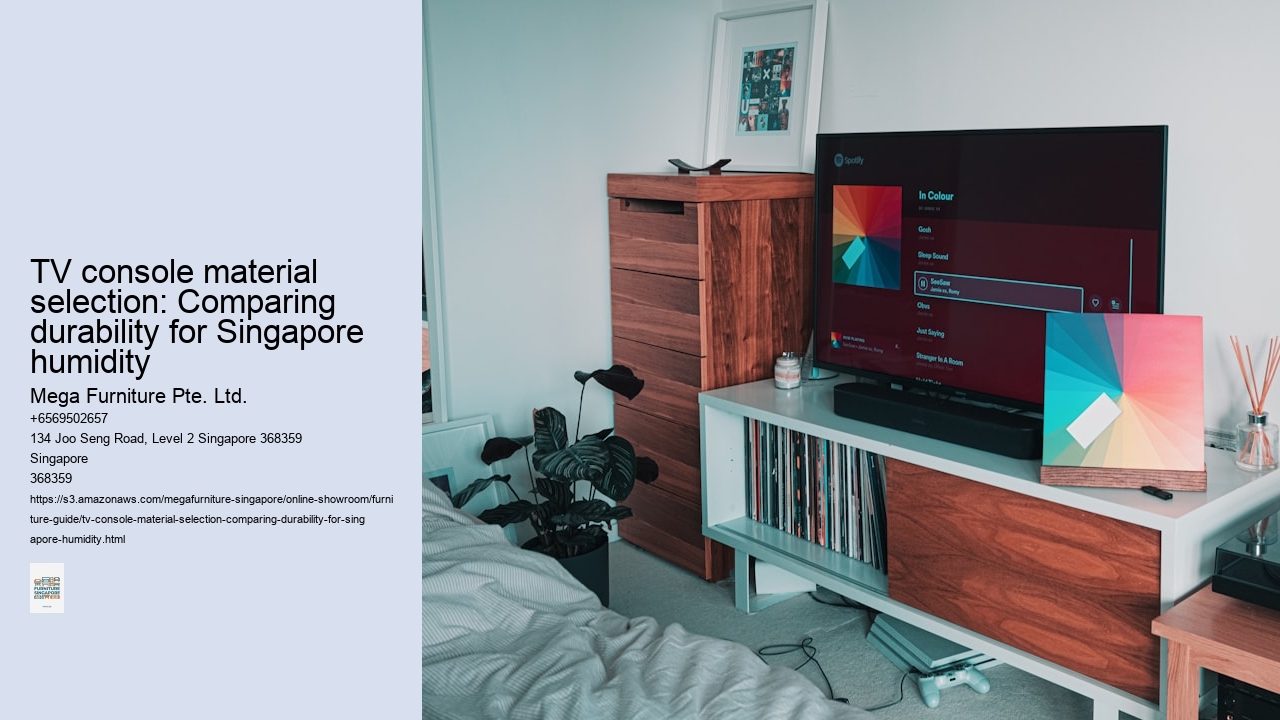
Singapore’s 80% humidity isn’t just a weather report—it’s a material test. That beautiful solid wood console you saw online can warp within a year in a non-air-conditioned HDB living room; the veneer might peel, the joints loosen. Prioritise engineered materials built for this climate: moisture-resistant MDF with a good laminate, sintered stone tops, or powder-coated metal frames. It’s less about chasing a particular look and more about ensuring the piece you buy in January doesn’t buckle by the June holidays.
Surfaces matter just as much, especially for families. A console in a home with pets or young children will see more than just dust; it’ll encounter paw prints, spilled drinks, and the occasional crayon mark. Easy-clean, non-porous finishes like high-pressure laminate, lacquered wood, or ceramic-based sintered stone become practical necessities, not luxuries. A quick wipe-down restores order, which in a compact 4-room flat where the living room is the main hub, is the difference between a feature piece and a constant annoyance.
Then there’s the console’s depth, a dimension that trips up many buyers upgrading to a larger screen. Singapore’s standard 55-inch TV has a depth, but that’s only half the story. You need to account for the set-top box, a gaming console, perhaps a soundbar, and the inevitable tangle of cables and power bricks behind it all. A shallow 30cm-deep console might force equipment to the front edge, creating a cluttered look and a hazard in a tight space. Aim for a cabinet depth of at least 40cm to 45cm; this allows everything to sit properly recessed, with cables managed out of sight.
That extra depth also translates to more usable storage inside, which is critical when you lack a dedicated utility room. Deep drawers can swallow board games and controllers, while enclosed compartments hide router boxes and spare chargers—the visual clutter that makes a small room feel even smaller. It’s a functional compromise that pays off daily.
Finally, consider the console’s relationship to your flooring and walls. A heavy, floor-standing unit on vinyl plank flooring in a humid flat can trap moisture and cause discolouration over time; a wall-mounted or floating design improves air circulation and makes floor cleaning simpler. Just ensure the mounting is secure, because our partition walls in newer BTOs don’t always forgive a poor installation.
Acrylic-faced laminates dominate the budget end of TV console builds, typically costing $25 to $45 per linear foot. Their primary draw for a 4-room BTO living room is their resilience against Singapore's relentless humidity; the non-porous surface won't warp or swell, making them a practical default. You'll find them applied over particleboard or MDF cores, which keeps the overall unit cost down but limits long-term durability. The finish can feel cold and plasticky to the touch, a trade-off many accept for a clean, wipeable surface. For a straightforward 180cm console in a condo media wall, this is often the starting point.
Genuine wood veneers, like teak or oak, signal a clear step up in quality and price, often landing between $60 and $100 per linear foot. That thin layer of real timber over a stable core provides the warmth and grain variation that laminates simply mimic poorly. It's a material choice that quietly communicates investment, something buyers in a landed property or larger resale flat might prioritise for a feature piece. The cost isn't just for the material itself but for the more skilled craftsmanship required to bookmatch and finish it properly. You're paying for character, not just function.
The material beneath the surface is where real cost differentiation happens, and particleboard is the ubiquitous budget core. It's affordable, stable for flat-packing, and perfectly adequate for a lightweight console in a child-friendly home. That stability falters, however, if it gets wet or if you're repeatedly anchoring a heavy 75-inch TV to it. Moving to a medium-density fibreboard (MDF) core adds marginal cost but improves screw-holding strength for wall-mounted units. It's a sensible upgrade that many local workshops recommend for longevity, even with a laminate top.
Choosing a solid timber frame, perhaps of rubberwood or nyatoh, adds significant cost and heft, easily pushing a console over $120 per linear foot. This isn't just a surface treatment; the entire structural skeleton is hardwood, which resists racking and can support substantial weight across a 240cm span. The console becomes a piece that can genuinely last through multiple home moves, developing a patina rather than just showing wear. That longevity justifies the premium for families who view furniture as a long-term purchase, not a disposable item. It's a very different proposition from a flat-pack box.
In a Tampines or Bedok showroom, the price per linear foot tells a silent story about material honesty and expected lifespan. A $30 per foot console is almost certainly laminate-over-particleboard, built for a five-year horizon in a humid climate. Jump to the $80 range, and you're likely looking at a quality veneer over a better core, aimed at the design-conscious condo owner. The highest quotes are for solid timber construction, where the material cost is transparent and the piece is built like a tank. Savvy buyers learn to decode these signals, balancing upfront budget against the nuisance of replacement in a few years' time.
The quote for a sleek, wall-mounted console often looks complete until you realise it’s just for the unit itself. Professional installation is a separate line item, and for good reason—especially in HDB flats with hollow-block walls. A floating console loaded with a soundbar and media equipment needs proper anchoring; a DIY job here risks more than just a crooked shelf. That’s an extra $150 to $300 you’ll need to factor in, a cost that surprises many first-time buyers. Then there’s the visual maths of a large television. A 75-inch TV is a dominant presence in a typical 4-room BTO living room, and a console that’s too short makes the whole wall look unbalanced. The common mistake is measuring just the TV’s width, which is around 167cm. For a proportional look, you’ll need a console at least 2 metres long, often pushing you into the 200cm to 240cm range. That jump in length means a jump in material cost, whether it’s a full rubberwood frame or a sintered stone top. Budgets get strained when these two elements collide. You’ve allocated for a 180cm laminate console, but now need a 220cm one in a sturdier engineered wood to support the scale. The installation quote arrives separately. Suddenly, a project you’d pencilled in at $800 is nudging $1,500. It’s a classic Singaporean renovation story: the hidden costs aren’t in the finishes, but in the practical adjustments for how we actually live. You can mitigate this by measuring your wall first, not just your dream TV. Leave at least 30cm of breathing space on each side of the TV for that anchored, intentional look. And treat professional mounting as non-negotiable for any floating design—it’s the cost of peace of mind in a neighbourhood where the downstairs neighbour will certainly let you know if something goes wrong. For a sense of the scale and options available, browsing a comprehensive
TV console collectioncan help visualise what those longer lengths actually entail.
A spec sheet lists laminated particleboard as 18mm thick, but it won’t tell you if the edge banding feels sharp or if the veneer pattern repeats unnervingly every 80 centimetres. That’s the core reason to visit a showroom — to run a hand across a surface and judge the material for yourself. At Megafurniture’s Joo Seng outlet, you can assess samples of everything from the cool, non-porous finish of sintered stone to the grain variation in solid rubberwood, feeling the texture and inspecting the tightness of mitred joints or drawer dovetails in person. It’s a tactile check that online galleries simply can’t replicate. Seeing full-scale consoles in a room-set context is perhaps more critical for HDB planning. A 240-centimetre unit might look proportionate in a warehouse, but in a 4-room BTO living room — with its typical 3.2-metre wall and need for walking space around a sofa — that same console can dominate everything. The Joo Seng showroom arranges its 180cm and 240cm models in layouts that mirror these common flat configurations, letting you visualise how much wall remains for shelving or art, and whether a floating design really opens up the floor or just leaves an awkward cleaning shadow. You’ll also get a clearer sense of practical details. Does the cable management system at the back actually fit a multi-plug adapter and a tangle of HDMI cords? Can the drawers, when fully extended, still clear your floor-standing speaker or plant stand by 15 centimetres? These are the spatial quirks that only become apparent in a three-dimensional setting. For a project where the console anchors the entire media wall, this in-person verification is invaluable. It turns abstract dimensions and material names into a concrete sense of quality and scale, helping to prevent a costly mismatch in your actual living space. You can explore the full range of options, from compact wall-mounted units to substantial floor-standing pieces, on their
TV console collection pageafter your visit.
The delivery truck’s arrival and your renovation contractor’s schedule rarely align by chance. For a project where a new TV console anchors a freshly built media wall, you’ll want to confirm the delivery slot with your HDB permit timing — a mismatched schedule leaves a large, flat-packed box blocking the corridor for days, much to your neighbours’ dismay.
Self-assembly is the obvious route to save cost, often shaving $80 to $150 off the final price. That’s a practical choice for straightforward, floor-standing designs in a condo with level flooring. For wall-mounted or floating consoles, especially across the uneven concrete floors common in older resale flats, professional assembly isn’t just a convenience; it’s a necessity for proper levelling and secure mounting. An unlevelled unit isn’t just an eyesore — it stresses joints and can cause doors to stick.
Warranties offer peace of mind, but their scope is typically narrow. The standard one-year coverage from most retailers protects against structural defects in workmanship, like a cabinet joint splitting or a drawer runner failing. It won’t, however, cover the slow warping of solid wood in a persistently humid living room, or water rings from a carelessly placed plant pot. Humidity damage is a frequent exclusion, which makes your choice of material for Singapore’s climate a form of long-term insurance.
Consider the timeline holistically. A buyer coordinating a full living room overhaul might schedule console delivery for the week after painting is complete, ensuring the centrepiece arrives when the space is ready for it. There’s a quiet satisfaction in that kind of project management — it turns a logistical task into the final step of your vision.
The best TV console FAQ isn't about the usual dimensions or wood types; it’s the hyper-local, slightly anxious query typed into a search bar at 2 a.m., right after a toddler’s sticky handprint is discovered or a PlayStation 5 starts humming like a jet engine.
Can a console handle PlayStation 5 heat? It’s a common worry. Modern consoles need active ventilation, which means an enclosed cabinet is a recipe for thermal throttling — and a shorter lifespan for your hardware. Look for designs with a dedicated open bay at the rear, or at minimum, a generously perforated back panel. A console with solid timber sides and a tempered glass front might look sleek, but it’ll trap heat; you’re better off with a model that prioritises airflow around the media unit.
What’s the right length for a 65-inch TV on a 3.5m wall? A 65-inch TV is roughly 145cm wide. The golden rule is a console that’s at least as wide as the TV, often 10–20cm longer for visual balance. In a 3.5m wall, you’ve got decent space. A console around 180–200cm leaves breathing room on either side for a floor plant or a slim display cabinet, preventing that cramped, wall-to-wall look. Just remember to account for your door swing or air-con unit.
Best material for resisting toddler fingerprints? Glossy laminates and clear acrylic are fingerprint magnets. Matte finishes, especially on sintered stone or textured wood veneers, hide smudges far better. For the cabinet doors, a light-coloured oak or ash with a satin lacquer is forgiving; dark, high-gloss walnut shows every trace. Some performance laminates now have anti-fingerprint coatings, which are worth the slight premium in a family-centric living room.
Is wall-mounting allowed in an HDB resale flat? Generally, yes, but with strict caveats. You can’t drill into structural beams or columns, and for heavier floating consoles, proper expansion bolts into the reinforced concrete wall are non-negotiable. The real issue isn’t permission but execution — a poorly installed unit risks pulling away from plasterboard or hollow-brick partitions. In many homes, a floor-standing console with a clean-lined, legless design gives the ‘floating’ look without the mounting anxiety.
The best-laid TV console plan often falters in a 4-room BTO living room, where a mismeasured wall leaves a 10cm overhang that ruins the entire media wall’s symmetry. Measure your allocated wall space twice — once for width, once for the console’s intended footprint — and bring that tape measure to the showroom. It’s the only way to visualise how a 180cm oak console will actually look between your door frame and air-con trunking; the proportions on a warehouse floor are always deceptive.
Singapore’s relentless humidity is a silent killer for furniture warranties. Verify explicitly that the manufacturer’s guarantee covers warping, swelling, or veneer peeling in our tropical climate — many imported units carry fine print that voids coverage for ‘extreme environmental conditions’. That solid wood console you love won’t feel so solid if its panels bow after one rainy season and you’re left with the repair bill.
Think practically about what lives inside the unit. Plan specific compartments for the Starhub TV box, a soundbar, and gaming consoles, mapping out cable management routes for power strips and HDMI cords before you buy. A common regret is choosing a console with only a small rear cable port, which forces you to leave the back panel open in a tangled, dusty mess — defeating the purpose of a clean media wall.
Your final trade-off is typically between storage priority and a minimalist floating design. A floor-standing console with full-height cabinets and drawers can swallow board games, spare cushions, and toy bins, which is a genuine asset in a compact flat. The floating variant, mounted cleanly off the floor, creates an airy feel and makes mopping effortless, but you’ll sacrifice substantial concealed space for that sleek look. Decide which your household needs more: a utility workhorse or a design statement. You can explore functional options across styles at Megafurniture’s collection.
The 2.4-metre media wall has become a standard feature in four-room BTO flats, its length dictated by the precise width between two structural columns. A TV console anchors the wall opposite the sofa in the same way a tall bookshelf anchors a corner — long horizontal piece, mix of open and closed storage, defines the visual weight of one whole side of the room. Megafurniture's TV Console range covers floating wall-mounted designs, low-profile freestanding consoles, and modular feature-wall configurations. Most pieces sit at 40-50cm height, sized for screens up to 75 inches.. Display cabinets sit between bookshelf and storage cabinet in function — closed glass-front protection for the items you want visible but not collecting dust. Megafurniture's Storage Cabinet range covers glass-front, curio, wall-mounted, and freestanding configurations in solid wood, MDF, and metal-framed constructions. Average pricing for glass-front variants sits around $271, with LED-lit and motorised-shelf models commanding the higher tier.. It's a neat solution, but it assumes your living room layout is the template - and in many resale HDBs or condos, it isn't. Console dimensions aren't just about TV size; they're a negotiation with your dwelling's architecture and its hidden logistical quirks.
For a landed home with a generous 4-metre feature wall, a console shorter than 3.5 metres can look underwhelming, like a single dining chair placed at a six-seater table. A Bookshelf earns its place in Singapore homes through dual function — book and decor storage in the open shelves, soft visual division when placed mid-room in open-plan condominium layouts. Megafurniture's combined display unit and bookshelf hub covers tall book racks, cubby-hole designs, ladder shelves, modular cube systems, and glass-door pieces in oak, walnut, and MDF veneer finishes. Solid-wood pieces typically start around $425, with most heights spanning 120cm to 220cm to fit standard 2.6m HDB ceilings.. The opportunity here is for a substantial statement piece, perhaps in a full-grain leather or a bold sintered stone, that anchors the entire space. Conversely, in a compact condo living room that opens directly to a balcony, a shallower, floating console often works better, preserving precious floor space for traffic flow.
Delivery logistics quietly dictate what you can actually get through the door. A wide, panel-based console that fits perfectly in a landed property's driveway might be impossible to manoeuvre up a narrow HDB corridor or into a condo lift with tight 90-degree turns. It's worth measuring your lift's internal dimensions and your corridor's width at its narrowest point - typically around 1.2 metres in older blocks - before committing to a large, pre-assembled unit.
Material choices follow this spatial logic. A compact console in a humid, sun-exposed resale flat facing Bedok Reservoir might benefit from moisture-resistant engineered wood over solid timber, which could warp. The console becomes a functional response to its environment, not just a display shelf. You'll find that considering these constraints first simplifies everything else; browsing the options with your room's actual measurements and access routes in hand filters the possibilities effectively.
The 2.4-metre media wall has become a standard feature in four-room BTO flats, its length dictated by the precise width between two structural columns. It’s a neat solution, but it assumes your living room layout is the template — and in many resale HDBs or condos, it isn’t. Console dimensions aren’t just about TV size; they’re a negotiation with your dwelling’s architecture and its hidden logistical quirks.
For a landed home with a generous 4-metre feature wall, a console shorter than 3.5 metres can look underwhelming, like a single dining chair placed at a six-seater table. The opportunity here is for a substantial statement piece, perhaps in a full-grain leather or a bold sintered stone, that anchors the entire space. Conversely, in a compact condo living room that opens directly to a balcony, a shallower, floating console often works better, preserving precious floor space for traffic flow.
Delivery logistics quietly dictate what you can actually get through the door. A wide, panel-based console that fits perfectly in a landed property’s driveway might be impossible to manoeuvre up a narrow HDB corridor or into a condo lift with tight 90-degree turns. It’s worth measuring your lift’s internal dimensions and your corridor’s width at its narrowest point — typically around 1.2 metres in older blocks — before committing to a large, pre-assembled unit.
Material choices follow this spatial logic. A compact console in a humid, sun-exposed resale flat facing Bedok Reservoir might benefit from moisture-resistant engineered wood over solid timber, which could warp. The console becomes a functional response to its environment, not just a display shelf. You’ll find that considering these constraints first simplifies everything else; browsing the options with your room’s actual measurements and access routes in hand filters the possibilities effectively.