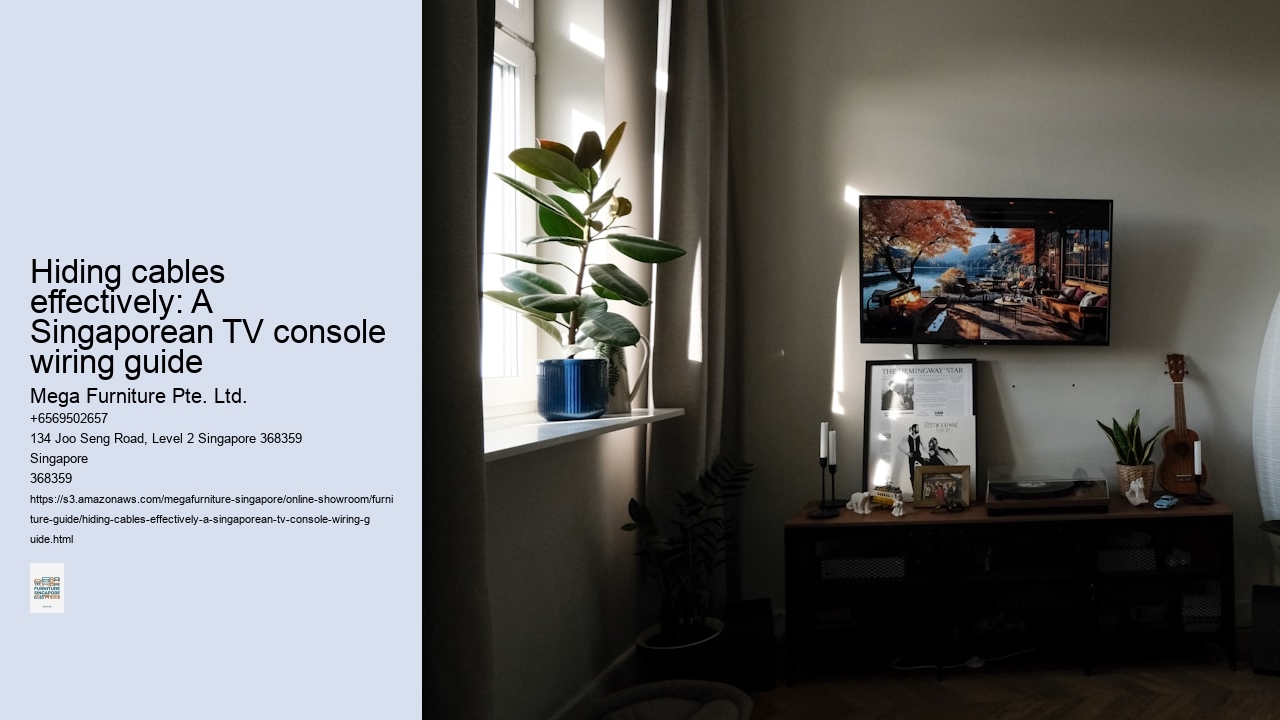
The particle board console that survived your university dorm in Manchester won't last a year in a Bedok flat. Singapore's average humidity sits above 80%, and that invisible dampness is a slow, relentless warping agent for engineered wood—you'll see it first as a subtle bow along the front edge, then as drawers that won't quite shut. The solution isn't complicated: opt for solid timber like rubberwood or oak, or seek out moisture-resistant laminates and thermally-fused melamine finishes that can handle the climate.
Space is the next non-negotiable, and it's about depth, not just length. A modern setup isn't just a TV; it's a Soundbar plus a PlayStation 5, and that combination needs around 35cm of clear depth from the wall face. A shallow 30cm console forces everything to the front edge, turning your clean media wall into a precarious ledge. Measure your gear first, then find a cabinet that gives you a 5cm buffer behind for cable slack and airflow.
Then there are the living conditions. A family with a terrier or an inquisitive kitten needs a console that fights back. Scratch-resistant finishes—think textured laminates, sintered stone tops, or properly sealed wood—are essential for paw traffic. More critically, look for designs with fully enclosed bottom shelves or solid plinths; an open gap is an invitation for a puppy to find that HDMI cable, with expensive and dangerous results.
Finally, match the console to your wall and TV. The old rule of a console longer than your TV still holds. For a typical 65-inch screen, which is around 145cm wide, you'll want a console at least 180cm to achieve visual balance and prevent that 'floating island' look in a 4-room BTO living room. A 120cm unit under a 75-inch TV looks comically undersized, like a small hat on a large head—it throws the entire room's proportion off.
Take your tape measure to the wall, note the permanent damp spot from the air-conditioner condensate, and be honest about the household chaos. That's how you'll find a piece that actually lasts.
Full-extension runners are the quiet workhorse of a good console. Side rollers feel cheap and jam easily, especially when loaded with game controllers or media players. That smooth, silent glide you want for accessing things at the back? It's a direct result of proper ball-bearing mechanisms. They'll handle years of daily use in a family living room, where a console is essentially a high-traffic drawer system. Skip anything that feels gritty or only pulls out halfway — it's a sign the unit won't age well.
HDB and condo floors are rarely perfectly flat, and a wobbling console is infuriating. Adjustable feet let you stabilise the unit on uneven tiles or parquet, preventing strain on joints and that annoying rock every time you lean on it. It's a small feature that makes installation in a Tampines BTO or a Bedok resale flat significantly less fussy. You'll typically find them as threaded plastic or metal screws hidden beneath the baseboard, a detail worth checking before you commit to a purchase.
Paper laminates can bubble and peel in Singapore's humidity, leaving edges vulnerable. A real oak or walnut veneer, though more costly, offers a durable surface that resists moisture and minor impacts far better. The difference is tactile — run your hand across it and you'll feel the grain, not a flat, plasticky sheet. Over a five-year period in a humid living room, that thin layer of real wood makes all the difference in maintaining a polished look.
Floating consoles demand a steel frame anchored directly into structural concrete or brick, never just the plasterboard of a partition wall. The weight of an AV receiver, a centre channel speaker, and assorted electronics adds up quickly. An installer hitting a hollow sound is your cue to stop them — proper mounting requires a stud finder and often concrete anchors. Getting this wrong isn't just a stability issue; it's a genuine safety hazard in a family home.
Manufacturers often underspec this, and a centre shelf buckling under a 15kg amplifier is a common disappointment. Check the stated weight limit for each shelf, particularly the middle one where your heaviest gear usually sits. A robust console should handle at least 20-25kg per linear foot without sagging over time. That peace of mind is worth the minor premium, ensuring your investment doesn't literally collapse under the weight of your home theatre ambitions.
A common scene in many Singaporean living rooms: a sleek floating console mounted against a feature wall, with a tidy cluster of HDMI and power cables snaking visibly down to the nearest skirting board. The buyer wanted a clean, minimalist look, but they didn’t account for the solid back panel—there’s simply no way to route cables through it after installation. This oversight turns what should be a seamless media wall into a lesson in visible clutter, forcing owners to resort to unsightly cable sleeves or raceways they never budgeted for.
Planning for future devices is another frequent misstep. You might install a console with just enough ports for your current soundbar and game console, but what about the streaming device you’ll add next year, or the upgraded PlayStation 6? Homeowners often find themselves having to drill new holes in expensive sintered stone or laminate panels, or worse, leaving new devices perched awkwardly on top because the enclosed compartments are full. It’s wiser to install a recessed media box with spare conduits during renovation, or at least choose a console with a removable back panel and generous cable management channels.
Heat buildup is a silent killer in our climate. Enclosing a Wi-Fi router, game console, and media player in a poorly ventilated compartment is a recipe for throttled performance and shortened lifespans. In a 4-room BTO living room, where the console might sit in a corner without strong air circulation, internal temperatures can soar. Opt for models with strategic ventilation slats or mesh panels at the rear, and never pack devices so tightly that hot air has nowhere to go.
Then there’s the mismatch between console style and wall readiness. Choosing a floating console for a wall with no pre-chased conduits is the most obvious error—you’re guaranteed a dangling cable trunk. But even with floor-standing units, underestimating the distance from power points can leave you with exposed extension cords running across the floor. The fix involves either careful pre-planning with your electrician or selecting a console design, like many in Megafurniture’s collection, that incorporates built-in cable ports and management systems to mask these inevitable connections.
A TV console that wobbles on a slightly uneven floor—it’s a common nuisance in many HDB flats, where old floor tiles or new screed can have subtle dips. You won’t notice that instability from a product photo, but you’ll feel it immediately when you test the unit in person. That’s precisely why a showroom visit matters; you can press down on corners, open drawers on the spot, and check for any rocking that would drive you mad in your own living room. The staff at these locations are used to buyers doing exactly this, and they’ll often point you toward models with adjustable feet or more robust bases that handle imperfect floors. Beyond stability, the physical details of cable management are notoriously hard to judge online. A grommet might look generous in a diagram, but can it actually accommodate a thick HDMI cable, a power brick, and a network cable all at once? At the showroom, you can inspect the rear cut-out panels yourself, sliding your hand behind to feel how much clearance there is for plugs and wires. It’s the difference between a clean, flush installation and a frustrating gap where cables bunch up and force the console away from the wall—a particular headache for achieving that coveted floating media wall look. Their collections are also calibrated to Singapore’s common build-out dimensions. You’ll find specific models designed to fit the standard 120cm or 240cm HDB feature wall, which saves you the hassle of custom carpentry or awkward overhangs. For families in newer BTOs, where lift lobby doors can be a narrow 80cm, the staff can walk you through delivery logistics; they’ve seen every tricky access scenario and can clarify whether a larger console comes in modules or requires specific manoeuvring. Ultimately, buying a console this large is a tactile decision. You need to assess the finish under showroom lights, judge the practicality of the storage, and confirm the proportions work for your space. It’s a chance to move beyond the catalogue and ask pointed questions—like whether that sleek, wall-mounted unit actually requires a contractor to install, or if the oak veneer on the display model is the same as the one you’ll receive. A quick trip to
their showroomoften settles debates that weeks of online browsing can’t.
The delivery driver will call you from the void deck, and that's when you find out your new TV console costs an extra $80. Third-storey walk-up charges still apply in older resale blocks, particularly those in neighbourhoods like Eunos or Bedok that haven't had lift upgrading — a reality check for many buyers expecting kerbside drop-off. During the year-end renovation peak, especially from November to January, delivery timelines can stretch from the promised two weeks to over a month; some consignments for condos even require you to book a specific lift landing time slot with the MCST, adding another logistical step to your move-in.
Assembly in Singapore often means you're on your own with an Allen key. While some retailers offer paid assembly services, many flat-pack units arrive with an instruction booklet and a bag of hardware, leaving you to figure out the cam locks and dowels in your 4-room BTO living room. It's a trade-off: you save on cost, but you'll need a decent power drill and about ninety minutes of focused time to get that 180cm floating console securely on the wall.
Then there's the warranty, which you must read with a sceptical eye for local conditions. The high humidity here is a silent killer for certain materials; you'll want explicit verification that the warranty covers laminate peeling or veneer lifting, not just structural defects in the frame. A one-year warranty is common, but it's rarely comprehensive — it typically covers manufacturing faults, not the scuff from your robot vacuum or the water ring from a forgotten glass.
For a straightforward process, consider retailers with in-house logistics. Megafurniture's collection, for instance, includes delivery and can simplify coordination, especially for bulkier items that need careful manoeuvring into narrow HDB corridors. Still, even then, buyer vigilance is key. Confirm the delivery window in writing, check all panels for damage before the crew leaves, and keep that warranty document filed, not tossed.
The best console can still leave you with a StarHub Fibre termination point blinking on the wall like a stubborn eye. Practical questions about daily living in Singapore's flats are what truly determine if a purchase works or just looks good.
Can I hide the StarHub termination point behind the console? Yes, if it's designed with a rear cable management duct. Look for models with a hollow channel running the console's length; you can feed the fibre optic cable and its bulky connector through there, keeping it accessible but completely out of sight.
What about protecting marble or engineered stone flooring? Felt pads are non-negotiable. Screw them into the base of every leg or foot—the dense, adhesive-backed kind, not the thin stick-on dots. They prevent scratches and allow for slight adjustments without grinding stone dust into your floor.
Is there a real difference between 18mm and 25mm board thickness? It's about sag, especially over a 2.4-metre span. The 25mm board substantially reduces bending under the weight of a centre channel speaker, game consoles, and media boxes. For consoles with long, unsupported shelves, the thicker board is worth the slight premium.
How do I run cables neatly to a wall-mounted TV above? You've got two clean options. A PVC trunking, painted the same colour as your wall, creates a discreet vertical raceway from console to TV. For a truly seamless look, an in-wall conduit requires chasing the wall—a more involved process best done during renovation or with a handyman's help.
The moment between selecting a console and the delivery truck arriving is when most wiring headaches are born. Don't just imagine your setup—sketch it. Grab a notepad and draw the wall, your 65-inch TV, the soundbar, and that game console you finally convinced your partner about. Then, plot every cable: HDMI from console to TV, optical from TV to amplifier, and the power strip’s umbilical cord snaking to the wall outlet. This isn’t about aesthetics yet; it’s a logistics exercise that reveals you’ll need two 2-metre HDMI cables, not the 1-metre ones you have bundled in a drawer.
That sketch becomes your shopping list and your reality check. Most critically, confirm the internal height of the console’s main compartment clears your amplifier or AV receiver by at least 5cm—not just for fit, but for airflow to prevent that low hum of overheating electronics on movie night. For those embarking on a BTO renovation or a serious living room revamp, this is also the time to decide on concealed trunking. Once you’ve painted that feature wall in Ocean Depths, you won’t want to chase walls for cable channels. Decide if you’re routing everything through the console and up a single, neat trunking channel behind the TV, or using a more elaborate in-wall system; that decision needs to happen before the first coat of paint dries.
Arm yourself with two things for the showroom visit: the room dimensions for your wall and, oddly specific but crucial, a photo of your wall outlet and its surrounding skirting board. That photo lets you visualise the final, messy connection point that furniture brochures never show. Then, measure the actual unit on the floor. A console listed as 180cm can sometimes be 181.5cm with decorative end caps, and that extra 1.5cm is the difference between a perfect fit and a frustrating return. Check the rear panel, too—some designs have a solid back that forces all cables out a single grommeted hole, which dictates your entire cable management strategy.
It’s a tedious process, but this final audit separates a seamless installation from a weekend of muttered frustrations. You’ll know you’ve done it right when the only thing left to organise is your streaming service subscriptions. For a comprehensive range of sizes and styles to match your plan, from compact 120cm units for cosy rooms to expansive 240cm media walls, browsing the options at a retailer like Megafurniture can provide the physical reference points your sketch lacks.
The concrete walls in a 40-year-old resale flat in Queenstown often come with a single, pre-drilled cable port behind where the TV goes-a legacy of a simpler era that now dictates your entire media layout. A TV console anchors the wall opposite the sofa in the same way a tall bookshelf anchors a corner — long horizontal piece, mix of open and closed storage, defines the visual weight of one whole side of the room. Megafurniture's TV Console range covers floating wall-mounted designs, low-profile freestanding consoles, and modular feature-wall configurations. Most pieces sit at 40-50cm height, sized for screens up to 75 inches.. You'll work around that fixed point, threading HDMI and power cords through a hollow wall cavity to a console below, a straightforward concealment job. It's a common scenario where the architecture of older HDB blocks, with their thick structural walls, makes retrofitting new channels a major renovation headache.
Contrast that with a new BTO living room, which typically measures a constrained 12 to 16 square metres. Here, every centimetre counts, and the wiring strategy is less about hiding and more about intelligent routing. You're likely dealing with drywall partitions, which allow for cleaner, DIY-friendly solutions like in-wall cable kits that drop cords directly from a wall-mounted TV into a floating console. The goal isn't just to tidy cables; it's to reclaim precious floor space in a room that can't afford visual clutter from trailing wires.
Condo media walls demand a different approach entirely. They're built as integrated feature elements, often with layered backdrops of laminate or sintered stone, and they expect all wiring to disappear completely. This isn't mere cable management; it's a pre-construction mandate requiring electricians and AV specialists to embed conduits before the first sheet of cladding goes up. Display cabinets sit between bookshelf and storage cabinet in function — closed glass-front protection for the items you want visible but not collecting dust. Megafurniture's Display Cabinet range covers glass-front, curio, wall-mounted, and freestanding configurations in solid wood, MDF, and metal-framed constructions. Average pricing for glass-front variants sits around $271, with LED-lit and motorised-shelf models commanding the higher tier.. The console here becomes a seamless component of a built-in unit, designed to house equipment without a single visible cord-a significant upgrade from simple concealment.
For landed properties, the scale shifts again. A Bookshelf earns its place in Singapore homes through dual function — book and decor storage in the open shelves, soft visual division when placed mid-room in open-plan condominium layouts. Megafurniture's combined display unit and bookshelf hub covers tall book racks, cubby-hole designs, ladder shelves, modular cube systems, and glass-door pieces in oak, walnut, and MDF veneer finishes. Solid-wood pieces typically start around $425, with most heights spanning 120cm to 220cm to fit standard 2.6m HDB ceilings.. Console runs can easily exceed three metres to match a large-format TV, and the cable runs from source points are correspondingly long. This introduces challenges with signal degradation over distance, often necessitating active fibre-optic HDMI cables and dedicated trunking within false walls or under floorboards. The strategy moves from hiding a few short cords to organising a professional-grade, high-bandwidth wiring loom that needs to remain accessible for future upgrades.
Each housing type, then, presents a distinct wiring philosophy-from working with legacy ports to planning for fully integrated disappearance. The console you choose must accommodate not just your gear, but the specific constraints and opportunities of your walls.
The concrete walls in a 40-year-old resale flat in Queenstown often come with a single, pre-drilled cable port behind where the TV goes—a legacy of a simpler era that now dictates your entire media layout. You’ll work around that fixed point, threading HDMI and power cords through a hollow wall cavity to a console below, a straightforward concealment job. It’s a common scenario where the architecture of older HDB blocks, with their thick structural walls, makes retrofitting new channels a major renovation headache.
Contrast that with a new BTO living room, which typically measures a constrained 12 to 16 square metres. Here, every centimetre counts, and the wiring strategy is less about hiding and more about intelligent routing. You’re likely dealing with drywall partitions, which allow for cleaner, DIY-friendly solutions like in-wall cable kits that drop cords directly from a wall-mounted TV into a floating console. The goal isn’t just to tidy cables; it’s to reclaim precious floor space in a room that can’t afford visual clutter from trailing wires.
Condo media walls demand a different approach entirely. They’re built as integrated feature elements, often with layered backdrops of laminate or sintered stone, and they expect all wiring to disappear completely. This isn’t mere cable management; it’s a pre-construction mandate requiring electricians and AV specialists to embed conduits before the first sheet of cladding goes up. The console here becomes a seamless component of a built-in unit, designed to house equipment without a single visible cord—a significant upgrade from simple concealment.
For landed properties, the scale shifts again. Console runs can easily exceed three metres to match a large-format TV, and the cable runs from source points are correspondingly long. This introduces challenges with signal degradation over distance, often necessitating active fibre-optic HDMI cables and dedicated trunking within false walls or under floorboards. The strategy moves from hiding a few short cords to organising a professional-grade, high-bandwidth wiring loom that needs to remain accessible for future upgrades.
Each housing type, then, presents a distinct wiring philosophy—from working with legacy ports to planning for fully integrated disappearance. The console you choose must accommodate not just your gear, but the specific constraints and opportunities of your walls.