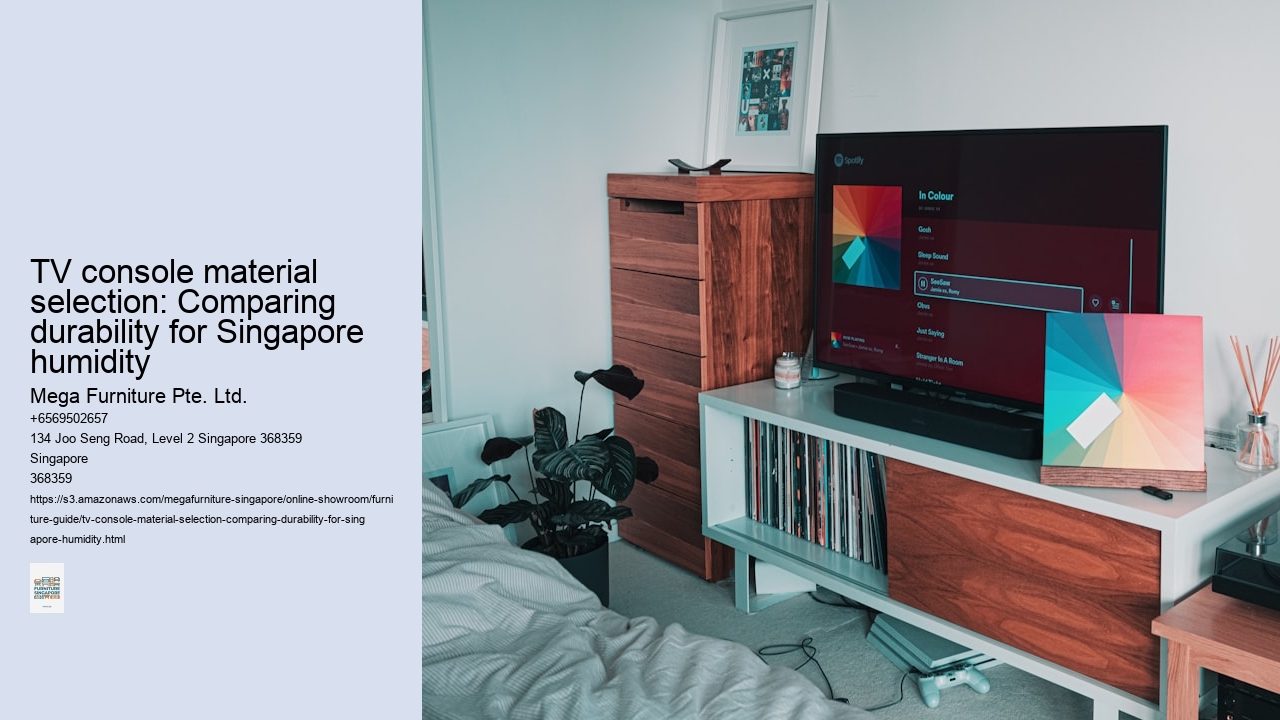
In a compact 4-room BTO living room, that 180cm TV console isn't just furniture; it’s a moisture sink, a toddler’s racetrack, and the home’s entire media archive. The material choice becomes a non-negotiable first filter. Real wood veneers and engineered wood panels, while affordable, are a notorious gamble here—they’ll swell around the edges in our 80% humidity, leaving cabinet doors that won’t shut by year two. You’re better off with laminates, properly sealed solid wood like teak, or sintered stone tops; they wipe down without warping and can handle the occasional forgotten tumbler of water.
Scale it visually against the room’s permanent fixtures. A queen-sized bed is about 150cm wide, so a console stretching 180cm to 210cm will dominate one wall without overwhelming it. That length also dictates storage capacity, which needs to be absolute. Open shelving collects clutter and dust; instead, prioritise consoles with full-height doors or deep drawers that swallow everything from gaming consoles to board games, keeping the visual lines clean and the floor plan feeling open.
Consider the domestic havoc. A medium-sized dog’s claws scrambling for traction or a child’s sticky fingers tracing patterns aren’t minor threats—they’re daily wear. A matte or textured laminate finish hides scuffs far better than a high-gloss lacquer, which shows every single mark. Similarly, rounded corners aren’t just a design feature; they’re a safety essential in a tight space where people constantly brush past.
Concealed storage solves two problems at once. It tucks away the visual chaos of routers and charging cables, and it creates a landing zone for items that otherwise have no home in a limited floor plan. Look for designs with cable management ports at the back and adjustable interior shelves; they let you organise vertically, turning that long, low silhouette into a serious utility player. For a focused selection built around these practical needs, you can browse the TV console options at Megafurniture. The goal is a piece that disappears in function while holding its own as a quiet, durable anchor for the room.
Solid teak’s natural oils give it a genuine resistance to Singapore’s humidity, a trait no engineered material can truly replicate. You’ll pay for it, with prices for a 180cm console easily reaching $1,200 to $2,400, but the wood won’t warp or swell in a typical 4-room BTO living room. That stability means you can place it near an air-conditioner without worrying about seasonal movement or gaps appearing at the joints. It’s a long-term investment piece, with a patina that deepens over years, not a disposable item. The weight alone signals permanence, anchoring a media wall in a way lighter materials simply can’t. For many condo owners, that sense of enduring quality justifies the premium.
High-pressure laminate is the pragmatic champion for moisture defence, especially in ground-floor resale flats where dampness can creep in. Its plastic-fused surface forms an impervious seal, shrugging off spills and condensation that would stain or swell cheaper particleboard. The real cost advantage is stark; you’ll find a robust 200cm console in laminate for around $400 to $800, a fraction of solid wood. Quality hinges on the edge banding—inspect it. A poorly applied strip will peel within a year, letting humidity into the core substrate and causing irreversible bloating. Full, seamless banding is the non-negotiable signal of a console built to last.
Powder-coated steel legs are the unsung heroes for structural integrity in our climate, completely avoiding the rust that plagues untreated metal. They provide a clean, industrial contrast to warmer wood or laminate tops, a look favoured in many Tampines or Bedok condos. The coating isn’t just paint; it’s a baked-on polymer layer that resists chipping from vacuum bumps or children’s toys. This makes metal frames ideal for floating console designs, where hidden brackets need absolute reliability to support a 65-inch TV and all its peripherals. You’re buying peace of mind, knowing the foundation won’t corrode silently behind closed storage doors.
Material choice often collapses into a straightforward budget calculation for families upgrading their TV setup. Laminate delivers the required performance for most, allowing a longer 240cm unit to fit a new 75-inch screen without breaking the bank. The saved funds can then be redirected towards better media equipment or acoustic treatment for the same living room wall. Teak becomes a conscious splurge, a centrepiece purchase where the material itself is the decorative feature. There’s no right answer, only a clear trade-off between upfront cost and perceived longevity that every HDB homeowner must weigh.
Look past the primary material to the finishing touches, which betray a console’s true quality faster than any sales tag. Drawer runners should glide silently under load, a test you can perform with a handful of Blu-ray cases in the showroom. Check the underside of the top panel and the interior of cabinets; unfinished edges or raw particleboard here indicate cost-cutting. For laminate consoles, that full edge banding should wrap tightly around every corner without gaps or bubbles. These are the details that determine whether a console feels like a considered piece of furniture or just a long, low box after six months in your flat.
The back of a new console is a tangle of HDMI, power, and LAN cables within a week—buyers consistently underestimate the volume, and the chaos spills onto the floor when there’s no dedicated rear channel or cable management tray. That’s a particular headache for families in 4-room BTO layouts, where the living room console sits against the main traffic artery to the kitchen; stray wires become a tripping hazard and collect dust bunnies in the humid air. Planning for double the cable bulk you think you’ll need isn’t overcautious, it’s simply practical for any setup involving a soundbar, gaming console, and fibre TV box.
Scale is another frequent misstep. A 75-inch TV on a 120cm console looks precarious and top-heavy, its edges dramatically overhanging the sides—the visual imbalance makes the entire wall feel unsettled. The rule of thumb is a console length matching or slightly exceeding the TV’s width, which for larger screens pushes you toward the 200cm to 240cm range; that longer footprint also provides essential surface area for centre channel speakers and decorative elements that anchor the display.
Then there’s the silent killer: heat. Tucking an AV receiver into an enclosed cabinet without factoring in ventilation is a recipe for premature failure, especially in our climate where ambient room temperature already sits around 30°C. These components need substantial clearance at the sides and, critically, an open back or active exhaust to shed heat; a fully sealed sintered stone or solid wood cabinet might look sleek, but it’ll quietly cook your electronics during a three-hour movie marathon.
Opting for a floor-standing design with proper perforated panels or a recessed plinth can solve both the airflow and cable issues in one go. It’s a lesson in measuring the entire ecosystem, not just the screen—because a great media wall fails on the details you can’t immediately see.
A spec sheet lists engineered wood; it doesn’t tell you how the laminate will feel under a damp cloth after six months in a Bukit Panjang flat. That’s the primary argument for a trip to a showroom — you’re not just confirming dimensions, you’re stress-testing the product against Singapore’s specific realities. Humidity warps cheap particle board, and a poorly sealed edge can bubble. In person, you can press on panels, inspect joinery, and assess the true heft of a 250cm solid wood console meant to anchor a landed home’s entertainment wall. The structural confidence you get from lifting a corner is irreplaceable. This hands-on evaluation extends to function. Online videos make every drawer glide sound silent, but the reality often depends on the weight inside. At the showroom, you can load a drawer with your own bag and test the action repeatedly. Do the door hinges on a media unit feel substantial, or do they have a tinny, hollow click when they close? For a piece that will house thousands in electronics, these mechanical details are critical — they’re what separates a console that sags in a year from one that remains level and quiet. The physical range on display is another key advantage. A collection that spans from sleek, 140cm floating units for condo media walls to those substantial 250cm consoles illustrates scale in a way a webpage filter cannot. You’ll see how finishes interact with different room lighting, and how the proportions of a low, wide design actually work with a 75-inch TV. It turns abstract measurements into a concrete sense of presence in your own space. Ultimately, for a major purchase like this, a showroom visit is about mitigating regret. You’re buying a centrepiece, not a disposable item. Seeing the grain variation on an oak veneer or the depth of a matte finish helps you commit. It’s the difference between hoping a piece will suit your
TV consoleneeds and knowing it will.
That final click on "checkout" often comes with a quiet dread — not about the console itself, but whether it’ll actually make it through the front door. In Singapore, delivery logistics are a first-line defence against buyer’s remorse. Before committing to a 200cm solid wood behemoth, measure your HDB lift’s diagonal depth and your own doorway clearance; many modern BTO lifts can handle long items, but older resale blocks in neighbourhoods like Bedok or Queenstown might have tighter 1.8m doors. A professional delivery team will navigate these constraints, but you’ll save everyone a headache by confirming the critical path from kerbside to living room centre.
Assembly is where particle board and MDF consoles are most vulnerable to Singapore’s humidity. That internal swelling starts not with the weather, but with a misaligned cam lock or an over-tightened screw during a rushed DIY job. Professional assembly isn’t just a convenience — it’s a form of pre-emptive damage control. A trained installer uses the right tools and sequence, ensuring panels align without forcing them, which prevents the micro-fractures that let moisture in and lead to that tell-tale chipboard bulge. For floor-standing units with integrated cable management or soft-close drawers, correct initial setup is non-negotiable.
Then there’s the warranty fine print. A standard one-year guarantee might cover faulty hinges, but it’s the climate-specific failures you need to watch for. Seek explicit coverage for "humidity-related defects" — veneer peeling, laminate edges lifting, or particle board core expansion. Many warranties quietly exclude "environmental factors," which in our context is everything. A robust policy will acknowledge the reality of a non-air-conditioned living room in Tampines or a ground-floor condo near the coast, where salt air compounds the moisture load.
Your recourse is only as good as the retailer’s local service framework. A warranty that requires you to ship a damaged 180cm console back to an overseas warehouse is effectively worthless. Prioritise suppliers with a clear, Singapore-based service team that can dispatch a technician for assessment or arrange a practical replacement for a single warped door, not just the entire unit. It’s a logistical buffer that turns a manufacturing promise into a real-world solution. You can explore options with comprehensive local service at Megafurniture’s TV console collection.
Ultimately, the most durable material can be compromised by a single rainy-day delivery or a poorly worded guarantee. These logistics aren't mere admin; they're the final, critical checks ensuring your chosen console survives its first year in a 4-room BTO as well as its showroom display.
A homeowner in a Tampines BTO will measure for their new 65-inch TV, then realise the old 150cm console won't hold the soundbar without blocking the screen. They’re right to worry — that’s the first of several localised puzzles.
Can a console fit a PS5 and a soundbar? Easily, but you need to check the shelf cavity. A typical media unit’s central compartment is around 50cm wide and 20cm high, which accommodates both. The real issue is depth; a PS5 needs about 39cm, so look for a cabinet with a full 40cm internal depth, not a slimmer floating design. Soundbars sit best in an open top recess or on the surface itself, provided there’s still 5–7cm clearance below the mounted TV.
What’s the best colour for an east-facing living room? Lighter finishes reflect heat and fight fading. For that morning sun in Bedok or Pasir Ris, avoid dark walnut or black stained wood — they’ll show bleaching faster. Go for oak, light grey wash, or white laminate. If you want colour, greens and blues in a satin finish hold up better than warm reds or oranges, which can look tired after a few years of intense light.
How do you anchor a console to HDB drywall? You don’t. Drilling directly into the drywall partition for a top-heavy, floor-standing unit is a safety risk. The proper method is to locate the concrete structural column or beam behind the wall, use a masonry drill bit, and secure a metal anti-tip bracket directly into that. For a truly secure fit in a family home, it’s worth the extra effort and dust.
Is rattan suitable for Singapore’s humidity? As a decorative accent, yes; as a primary structural material, no. Woven rattan or cane on cabinet doors adds texture but it’s porous and can become brittle or mouldy in constant 80% humidity. If you love the look, choose a console where rattan is used only as an inset panel on sealed timber doors, and keep it away from direct AC airflow or splash zones. For a low-maintenance option in a humid neighbourhood like Eunos, sealed solid wood or laminate will simply last longer.
That final click on ‘add to cart’ often comes after a month of scrolling, but it’s the fifteen minutes of old-school verification in your actual living room that prevents a costly mismatch. Start with the wall, not the website: use painter’s tape to mock up the exact dimensions of your chosen console on the floor and up the wall. For a 180cm unit in a 4-room BTO living room, this reveals whether you’ll still have comfortable walkway space to the balcony door or if it awkwardly crowds the air-con ledge. This physical outline also lets you visualise TV placement and sightlines from your favourite armchair—a 65-inch TV on a too-short console can feel like you’re perpetually craning your neck.
Balance the material’s longevity against its upfront cost with Singapore’s climate as the deciding factor. A solid teak console might stretch your budget to $2,400, but it’s a one-time purchase that will withstand decades of humidity without warping; a laminate MDF option around $800 frees up cash for a soundbar, yet you’ll need to be militant about wiping off condensation and may face swelling at the edges within a few years. That’s the real trade-off—pay more for passive durability, or pay less and commit to active maintenance.
Think past the immediate setup. If you’re planning to add a PlayStation 6 or a larger sound system next year, ensure the console’s cable management can handle more ports and that interior shelves are adjustable to fit taller components. Deep drawers are perfect for board game storage now, but will they accommodate a future subwoofer? This forward-looking approach stops your media wall from becoming obsolete the moment you upgrade your AV gear.
Finally, revisit any notes from showroom visits regarding material care. A salesperson’s casual advice to “keep it dry” isn’t enough—ask specifically about oiling schedules for solid wood in a neighbourhood like Bedok, or whether sintered stone tops near a window will develop a haze from constant afternoon sun. This localised maintenance plan, tailored to your flat’s specific orientation and airflow, is what preserves the finish long after the delivery crew has left.
In a typical 4-room BTO, the living room's width dictates the console's length before you even consider the TV size. You'll find yourself measuring the wall between the main door and a bedroom corridor, a space often just over two metres. That's why standard console lengths cluster between 180 and 240 centimetres-they're cut to fit these pre-determined bays while accommodating a 65-inch screen, which has become the default for many new setups. Go beyond that, and the unit starts jutting into walkways, making a 12 sqm room feel like a cluttered showroom aisle. Condo developments, particularly newer ones, present a different puzzle. They often feature dedicated media walls with built-in niches or false columns that demand a custom fit. Here, the console isn't just furniture; it's an architectural anchor meant to visually ground the entire feature wall. The design priority shifts from mere storage to creating a seamless, integrated look, where the console's finish might need to match cladding or complement a stone accent. That oversized, 3-metre reclaimed wood console might look stunning in a showroom, but it'll overwhelm a resale flat's living room in Toa Payoh or Queenstown. In these older layouts, where living areas are frequently subdivided and square footage is precious, proportion is everything. A console that's too long doesn't just look awkward-it steals usable floor space for years. The practical compromise for most HDB flats is a console around 200cm, offering enough surface for a large TV and sufficient closed storage for routers, game consoles, and the inevitable clutter of cables. It's a balancing act between the screen you want and the room you actually have. For those navigating this, browsing a dedicated
TV console collectionfiltered by dimensions can save considerable headache. Material choices get pulled into this spatial equation, too. A glossy, monolithic sintered stone top can visually widen a narrow BTO wall, while a warm rubberwood frame might soften the hard lines of a condo's media niche. The room' context silently vetoes half your options before you've even considered humidity or style.
In a typical 4-room BTO, the living room’s width dictates the console’s length before you even consider the TV size. You’ll find yourself measuring the wall between the main door and a bedroom corridor, a space often just over two metres. That’s why standard console lengths cluster between 180 and 240 centimetres—they’re cut to fit these pre-determined bays while accommodating a 65-inch screen, which has become the default for many new setups. Go beyond that, and the unit starts jutting into walkways, making a 12 sqm room feel like a cluttered showroom aisle. Condo developments, particularly newer ones, present a different puzzle. They often feature dedicated media walls with built-in niches or false columns that demand a custom fit. Here, the console isn’t just furniture; it’s an architectural anchor meant to visually ground the entire feature wall. The design priority shifts from mere storage to creating a seamless, integrated look, where the console’s finish might need to match cladding or complement a stone accent. That oversized, 3-metre reclaimed wood console might look stunning in a showroom, but it’ll overwhelm a resale flat’s living room in Toa Payoh or Queenstown. In these older layouts, where living areas are frequently subdivided and square footage is precious, proportion is everything. A console that’s too long doesn’t just look awkward—it steals usable floor space for years. The practical compromise for most HDB flats is a console around 200cm, offering enough surface for a large TV and sufficient closed storage for routers, game consoles, and the inevitable clutter of cables. It’s a balancing act between the screen you want and the room you actually have. For those navigating this, browsing a dedicated
TV console collectionfiltered by dimensions can save considerable headache. Material choices get pulled into this spatial equation, too. A glossy, monolithic sintered stone top can visually widen a narrow BTO wall, while a warm rubberwood frame might soften the hard lines of a condo’s media niche. The room’ context silently vetoes half your options before you’ve even considered humidity or style.