That laminate panel you’re considering for its scratch resistance might warp within a year if it’s set against a wall near your kitchenette or bathroom. Singapore’s average 80% humidity isn’t just a comfort issue—it’s a material warping one, and a floating console in a 4-room BTO living room faces a daily barrage of moisture, accidental spills, and pet claws. For the carcass and legs, solid teak or oak with a proper moisture-resistant lacquer finish is the pragmatic choice; it won’t swell or discolour in the damp air common in older resale flats near Eunos or Bedok. Engineered wood with a sealed, waterproof veneer is a more budget-conscious alternative that still holds up, provided the edges are properly capped. You’ll want to avoid any MDF or particleboard in the floor-skirting area, especially in homes where floor mopping is frequent—that splash zone is a fast track to a bloated, crumbling base. Laminate surfaces, particularly those with a textured finish, resist the fine scratches left by a cat scrambling across the top or a gaming controller being dragged back and forth. The real vulnerability is often underneath, where metal legs offer a distinct advantage over wood: they won’t attract the subterranean termites that still plague some older estates, and a quick wipe down prevents any moisture buildup. It’s a balance of priorities—you might choose a laminate-topped console for its durability against daily wear, then pair it with powder-coated metal legs to sidestep ground-level rot entirely. For a comprehensive look at options built for these conditions, you can browse the
floating TV console rangeto compare constructions. Ultimately, the best console for a humid, active household isn’t always the most expensive one, but the one whose material specifications honestly account for Singapore’s climate and your family’s rhythm.
An AV receiver or PlayStation 5 won't fit in a console that's less than 35 centimetres deep, and that's a measurement too many buyers forget until the delivery truck arrives. The problem isn't just the console itself; it's the bundled cables and required ventilation space behind the unit, which in a cramped HDB media wall can add another five to eight centimetres. You'll need to measure from the wall outward, accounting for any skirting boards, and then subtract a few centimetres for the floating console's own back panel. That final internal clearance is the number that matters, not the furniture's external dimensions. It's a simple check that prevents the expensive headache of a brand-new, wall-mounted unit that can't actually store your most important gear.
Mounting a heavy, loaded console onto drywall or partition walls common in BTO flats requires specific hardware, not just any screw from the neighbourhood hardware store. Standard wall plugs will pull straight out under the sustained load, leading to a catastrophic failure that damages both the console and your flooring. You need proper toggle bolts or anchors rated for the substrate, which often means drilling into the concrete beam behind the plasterboard for at least two of the mounting points. A professional installer will use a stud finder and a healthy dose of scepticism about what's actually inside your wall. Getting this wrong is more than a nuisance—it's a safety hazard for families.
Choosing a dark walnut or wenge finish for a north-facing living room in a Tampines or Sengkang BTO is a common regret, as the space can feel perpetually dim and cavernous. Light from that orientation is cooler and less intense, which means dark surfaces absorb what little illumination there is instead of reflecting it around your 4-room flat's layout. Lighter finishes like bleached oak or ash visually expand the space and work with the ambient light, reducing the need for additional lamps during the day. It's a subtle point of flat orientation that many resale buyers overlook, too, especially in older blocks with smaller windows. The right console colour can lift the entire room's mood without a single renovation hack.
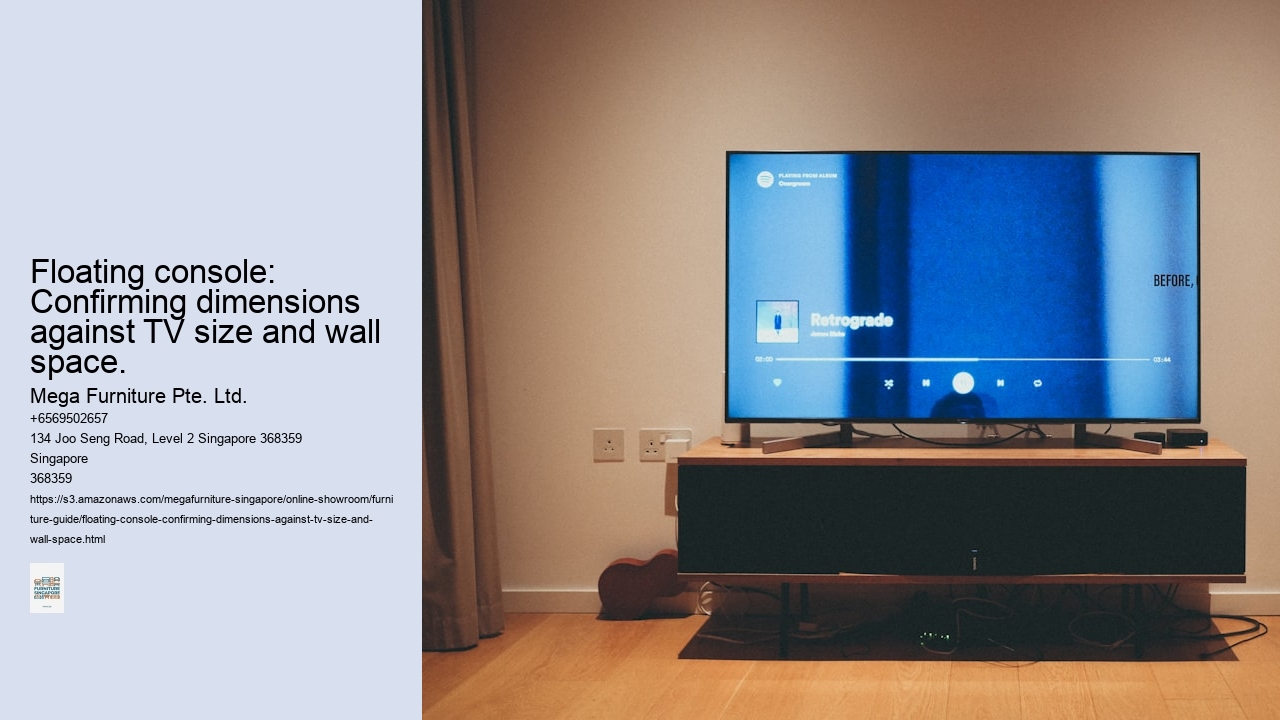
A 75-inch TV above a 120-centimetre console looks absurdly top-heavy, like a hat three sizes too small—it's a visual mismatch that undermines your entire media wall design. The console should be at least as wide as the television, with a common rule suggesting an extra 20 to 30 centimetres on either side for a balanced, anchored appearance. In a typical HDB living room, that often means committing to a unit around 200 to 220 centimetres long, which immediately dictates your sofa placement and traffic flow. Buyers focusing only on storage capacity forget that the console's primary job is to be a visual plinth; its proportions are non-negotiable.
Floating consoles reveal a tangled nest of wires if their design lacks integrated solutions, turning a sleek installation into an eyesore. The best units have dedicated vertical channels behind the back panel, grommeted holes in the shelves, and a central cavity to gather power strips, which is essential for setups with a soundbar, gaming console, and media streamer. In many flats, the nearest power point is frustratingly off-centre, requiring a plan to discreetly route an extension cord before the first bracket is even levelled. It’s the finishing detail that separates a professional-looking install from a DIY job, and it’s impossible to retrofit neatly once the console is secured to the wall.
The showroom floor is the only place to see if a floating console’s advertised load capacity holds up under the weight of a Sonos Arc, a PlayStation 5, and a stack of vinyl records you’ll probably never play. You can press down on the open ends of display units to check for flex, a common failure point in cheaper flat-pack designs that online reviews often miss. Singapore’s specific daylight—harsh and direct through a west-facing window, then flat and cool under LED strips—changes how a walnut veneer or matt laminate finish reads entirely; what looks warm online can appear washed-out or clinical in a typical HDB living room. Cable management is another practical test. Bring a photo of your Starhub router and modem setup, then see if the console’s rear grommets and internal channels can realistically organise the tangle without forcing you to buy a dozen extra zip ties. Staff at the Joo Seng showroom frequently advise on BTO-friendly assembly, knowing which wall types in newer estates might require specific anchors and how to work around service ducts that protrude from feature walls. They’ll also help you visualise scale. Standing between a 180cm and a 210cm model placed against their sample TV wall immediately clarifies proportions—that extra 30cm isn’t just more storage, it’s the difference between a console that complements a 65-inch TV and one that properly grounds it. For many homeowners, that spatial confirmation saves a costly wrong turn; you’ll know if you need the breathing room for floor-standing speakers or if a shorter unit leaves space for a plant stand in the corner. It’s a pragmatic step that moves the decision from screen to reality. You can assess the true clearance underneath for a robot vacuum, or confirm that the floating height doesn’t awkwardly cut the wall. Browse the
floating console rangeonline first, but finalise your choice only after you’ve seen it in three dimensions, with your own hands testing its sturdiness.
The lift lobby in your 20th-storey Tanah Merah condo is pristine, quiet, and about to cost you an extra $80. That’s a typical high-floor access fee, a line item that surprises many first-time buyers when the delivery crew arrives with a 200cm console box. It’s a standard charge for condominium and HDB block deliveries above a certain floor—often around the 10th—so factor it into your final budget alongside the delivery fee itself. For walk-up apartments, you’ll face a per-flight stair charge instead; either way, confirming these logistics with the retailer before your delivery date saves last-minute frustration.
Assembly here is almost always a two-man job, a necessity in tight spaces like a 4-room BTO living room where navigating a large flat-pack around existing furniture is a practised dance. A competent team will have your floating console mounted and levelled within an hour, but you need to be specific about your expectations beforehand. Crucially, you must confirm whether they’ll haul away the packaging and, more importantly, your old L-shaped sofa or bulky entertainment unit. Most standard services only remove the new item’s cartons; old furniture disposal usually requires a separate arrangement and fee, a detail too often discovered mid-job.
Where the real value lies, however, is in the warranty documentation. Singapore’s relentless humidity is a silent enemy to furniture, particularly for the laminated surfaces and mechanical parts of a TV console. The moisture can cause laminate to peel at the edges over time, and it quietly corrodes the internal mechanisms of soft-close hinges until they fail. A one-year warranty is essentially useless here; you should be seeking a minimum five-year coverage that explicitly lists these climate-induced failures. Don’t just accept “warranty included”—scrutinise the terms to ensure laminate integrity and hinge function are covered, not just structural frame defects.
That long-term coverage turns a purchase from a short-term solution into a proper investment for your home. It’s the difference between a console that looks tired after two annual monsoon cycles and one that holds its line and function against the climate. For options backed by comprehensive service, you can review the specific warranties offered in Megafurniture’s TV console collection.
The most common question about a floating console isn't about TV size—it’s whether there’s enough room to walk past it. A shopper in a Pasir Ris 4-room BTO, measuring the gap between their shoe cabinet and living room wall, wants to know if a 200cm unit will fit. They’re right to ask. You’ll need at least 90cm clearance for a comfortable walking path; in many flats, that leaves space for a console around 180cm. Always measure the wall, then subtract your required passageway.
Can it hold a 65kg OLED? That depends entirely on the mounting system and wall material. Most floating consoles are engineered for distributed weight—think media players and books, not a concentrated load. Check the product’s stated weight limit, which should account for the TV’s weight plus your equipment. Proper installation into solid brick or reinforced concrete is non-negotiable; a stud-finder is your best friend here.
For west-facing living rooms in Tampines or Clementi condos, where afternoon sun is relentless, colour choice matters. Lighter greys and warm walnuts tend to resist yellowing better than stark whites or certain blond woods. It’s a practical consideration that beats fleeting trends.
Material durability often trumps aesthetics. A console finished in a laminate or veneer with UV protection will outlast one in a sun-drenched spot. You’re not just buying a TV stand; you’re anchoring your media wall for a decade.
Browse the options with these real-world constraints in mind. A console that fits, holds, and lasts is the one that disappears into daily life, which is the whole point.
A floating console’s clean lines vanish the moment you realise its back panel is covering the living room’s only convenient power point. That’s a common, frustrating discovery—one that usually happens after delivery, when you’re trying to plug in a soundbar and realise the cord can’t reach the now-obscured socket. Before committing to a purchase, physically confirm the locations of all essential outlets and data ports against the console’s exact dimensions; a console that’s 180cm long might perfectly fit your wall, but its solid back panel could easily block the LAN point you need for the gaming console you intended to hide inside it.
For a true sense of scale, use painter’s tape to outline the console’s exact footprint on your wall. Live with that outline for at least 48 hours. You’ll notice if it feels too imposing for a narrow 4-room BTO living room wall, or if its planned height awkwardly bisects a window view from your sofa in a District 15 condo. This simple, reversible step also reveals traffic flow issues—a corner of the taped outline might jut into the natural walkway to the balcony, becoming a shin hazard in the evening.
In landed homes, an additional consideration is the floor-standing aircon unit often positioned along the same feature wall. A console mounted at the standard 40–50cm height might create a visually cluttered, stacked effect with the aircon unit beneath it; sometimes, adjusting the mounting height a few centimetres up or down can create a more harmonious, intentional alignment between the two functional pieces.
Ultimately, these final checks are about avoiding costly assumptions. You’ve already measured for the TV and chosen a material—say, a matte walnut laminate or a textured sintered stone—that fits your scheme. Now, verify the practicalities. Browse options with precise dimensions in mind, as a well-chosen console should marry form with the unglamorous realities of your room’s wiring and circulation.
The HDB living room's standard 3.6-metre wall, flanked by doors and windows, leaves a precise footprint. That's why a 240-centimetre console feels like the absolute ceiling for most BTO layouts-anything longer starts to crowd the space, making the room feel more corridor than living area. It's a simple geometry problem, but one that trips up many buyers who order online without taping out the dimensions first.
Scale is just as critical with the television itself. For the popular 75-inch sets, the console should extend 10 to 20 centimetres beyond the screen's width on either side; this visual anchor prevents the TV from looking top-heavy and precarious. A console that's exactly the same width or, worse, narrower creates an unsettling, top-heavy silhouette against your feature wall.
Condo media walls introduce a different set of proportions. Here, the console is often an integrated element within a built-up feature, demanding a more tailored fit. In a study nook or a secondary bedroom media corner, a 120-centimetre console can perfectly frame a 40-inch television without overwhelming the limited square footage. A TV console anchors the wall opposite the sofa in the same way a tall bookshelf anchors a corner — long horizontal piece, mix of open and closed storage, defines the visual weight of one whole side of the room. Megafurniture's TV Console range covers floating wall-mounted designs, low-profile freestanding consoles, and modular feature-wall configurations. Most pieces sit at 40-50cm height, sized for screens up to 75 inches.. The goal is balance, not bulk.
Material choices follow this logic of constraint. In these tight, humid spaces, sintered stone or laminated MDF tops offer durability against condensation and stray coffee cups, while closed cabinets hide the inevitable cable chaos. Sideboard . Open shelving needs to be curated-a single, long shelf of decorative items can look organised, but cramming it full turns the console into a cluttered catch-all.
Ultimately, the right length isn't just about fitting the wall; it's about commanding the room without consuming it. You can explore various proportions and finishes to suit your specific wall and television in Megafurniture's collection.
The HDB living room’s standard 3.6-metre wall, flanked by doors and windows, leaves a precise footprint. That’s why a 240-centimetre console feels like the absolute ceiling for most BTO layouts—anything longer starts to crowd the space, making the room feel more corridor than living area. It’s a simple geometry problem, but one that trips up many buyers who order online without taping out the dimensions first.
Scale is just as critical with the television itself. For the popular 75-inch sets, the console should extend 10 to 20 centimetres beyond the screen’s width on either side; this visual anchor prevents the TV from looking top-heavy and precarious. A console that’s exactly the same width or, worse, narrower creates an unsettling, top-heavy silhouette against your feature wall.
Condo media walls introduce a different set of proportions. Here, the console is often an integrated element within a built-up feature, demanding a more tailored fit. In a study nook or a secondary bedroom media corner, a 120-centimetre console can perfectly frame a 40-inch television without overwhelming the limited square footage. The goal is balance, not bulk.
Material choices follow this logic of constraint. In these tight, humid spaces, sintered stone or laminated MDF tops offer durability against condensation and stray coffee cups, while closed cabinets hide the inevitable cable chaos. Open shelving needs to be curated—a single, long shelf of decorative items can look organised, but cramming it full turns the console into a cluttered catch-all.
Ultimately, the right length isn't just about fitting the wall; it's about commanding the room without consuming it. You can explore various proportions and finishes to suit your specific wall and television in Megafurniture’s collection.