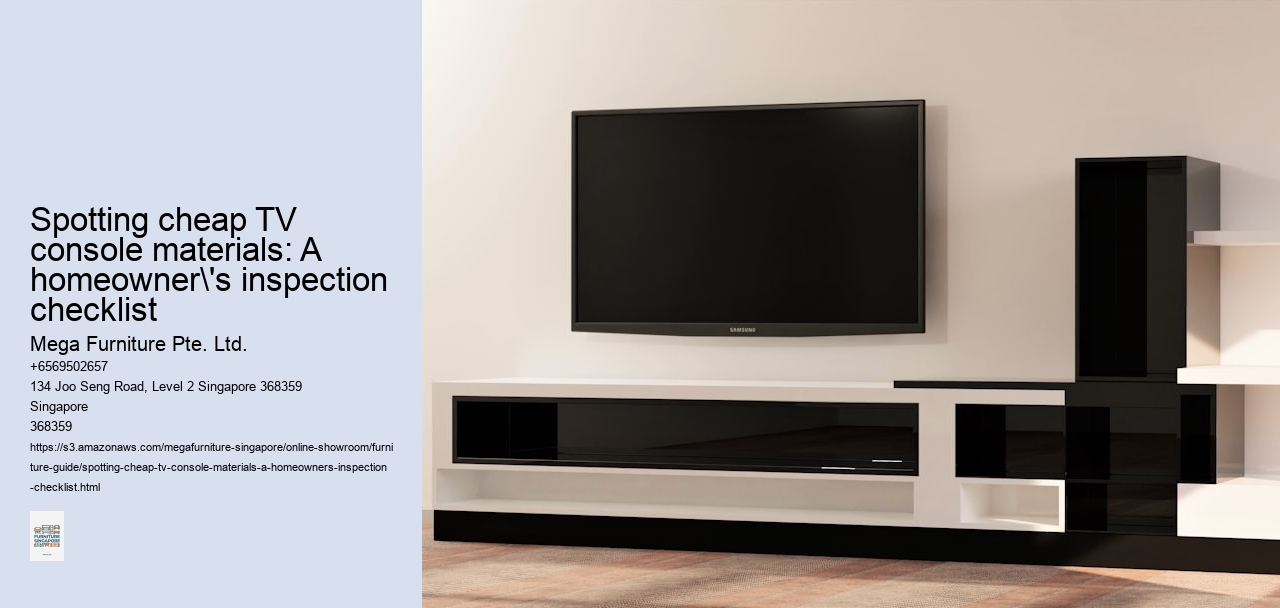
That veneer peeling at the corner isn’t just a cosmetic flaw—it’s the first sign of a TV console that won’t survive Singapore’s humidity. Start your inspection at the edges; cheap units often use a paper-thin laminate that bubbles or lifts at seams and corners, especially on the side panels you see daily. Run your hand along the surface; solid wood should feel substantial, with a grain pattern that continues convincingly around doors and drawers. If it feels suspiciously light or the grain looks like a repeating sticker, you’re likely looking at a thin veneer over particleboard or MDF. Give it a firm knock—a hollow, cardboardy sound from what’s advertised as a solid wood door is a dead giveaway.
Pay equal attention to the back. Many budget consoles use flimsy, fibreboard back panels that bow under minimal pressure, or worse, that brown corrugated cardboard you’d find on a packing crate. A proper back panel, even if it’s not solid wood, should be a rigid sheet of engineered board, properly fastened. This isn’t just about looks; that back panel provides crucial structural rigidity, preventing the whole unit from racking sideways over time.
Singapore’s climate is particularly harsh on engineered wood. Particleboard and MDF swell and warp when they absorb moisture from our consistently high humidity. In a Tampines or Bedok flat near the coast, that warping can start within a single monsoon season. Look for any mention of moisture-resistant seals or boards; better manufacturers will use these, and you can sometimes spot a green-tinged edge on cut panels at a showroom. If you’re considering a painted finish, check inside drawers and doors—cheap paint jobs stop at the visible surfaces, leaving raw, absorbent edges exposed.
The real test is often in the details you don’t immediately see. Open every drawer and door. Check the underside of shelves and the interior of cabinets; consistent finishing and proper edging banding here indicate a manufacturer that isn’t cutting corners. For a long, 240cm console meant to anchor a 75-inch TV, these material choices aren’t trivial—that’s a lot of surface area for potential failure. A well-made unit, even in engineered wood, should feel like a single, coherent piece of furniture, not an assembly of disparate boards. You can assess a lot of this firsthand by examining the construction of display units in a Megafurniture showroom, where the difference between a veneer edge and a solid wood lip becomes a tangible lesson in longevity.
Don't just trust the stated capacity. A wall-mounted unit's real test comes when it's loaded with a 55-inch OLED, a soundbar, and a stack of game consoles—that's easily 40kg or more, concentrated on a few anchor points. In many 4-room BTO flats, the partition walls aren't true masonry; they're hollow blocks or plasterboard over a metal frame. Standard plugs will pull straight out under that sustained load. You need to simulate the full weight during inspection; press down firmly on the console's front edge and listen for any creaking or see if the wall anchors visibly strain.
Solid masonry anchors are non-negotiable for anything heavier than a picture frame. The telltale sign of a cheap fix is seeing ordinary plasterboard plugs or, worse, no specification for anchors at all. Proper units specify high-grade toggle bolts or concrete screws, often with a guide for drill bit size and depth. In older resale flats around Tampines or Bedok, you might hit a crumbly brick core that requires chemical anchors. If the installation manual doesn't discuss wall types, that's a major red flag—it means the design wasn't engineered for Singapore's varied construction.
Open frame joints are where poor joinery can't hide. Run your hand along the corners of an assembled unit, especially where the vertical supports meet the horizontal spans. Any lateral movement or a visible gap means the dowels, cam locks, or mortise-and-tenon joints are undersized or poorly fitted. That wobble won't stabilise over time; it'll worsen as the MDF or rubberwood core degrades in our humidity. A well-made frame feels monolithic, even before it's secured to the wall—the joinery should take the load, not just the brackets.
Floating designs live or die by their hidden support system. A robust console won't just have a thin metal rail; it'll incorporate a full-length steel spine or a pair of substantial L-brackets, engineered to cantilever the load back into the wall. Ask to see the bracket before you buy, or at least a detailed technical drawing. In a showroom, you can often feel its presence by the unit's rigidity—if the entire span deflects when you push up on it, the bracket is likely too thin or mounted too shallowly.
Always request documented load certification. A reputable supplier should have test reports from a certified lab, not just a marketing claim on a website. This certification details the exact wall type used in testing, the point load limits, and the safety factor applied. For a family upgrading to a 75-inch TV in a condo media wall, that paperwork is your insurance. Without it, you're relying on guesswork—and the repair bill for a torn-out section of your feature wall will far exceed the console's cost.
The most common living room regret in a 4-room BTO isn’t colour choice—it’s realising your brand-new 65-inch TV dwarfs the sleek, 140cm console you ordered online. That visual mismatch, where screen overhangs cabinet on both sides, feels unstable and cheapens the entire media wall. Buyers chasing a minimalist silhouette often pick a console shorter than their TV width, forgetting that proportion is foundational; a good rule is to add at least 10cm to each side of the TV’s stated dimensions for balance, which pushes many families toward the 180cm to 200cm range.
That same pursuit of a curated look leads to another misstep: installing open shelving in estates along the East-West Line, where construction dust and traffic particulates are a constant battle. A display of books and ornaments in Tampines or Bedok becomes a weekly dusting chore. Enclosed storage with glass or solid doors isn’t just for hiding set-top boxes and game consoles—it’s your primary defence against the grime that settles faster than you can organise it.
Cable management is typically an afterthought, until you’re faced with a tangle of wires for the StarHub box, PlayStation, and soundbar. That clean, floating console design loses all impact when a nest of black cords spills onto the floor. The functional solution isn’t glamorous—it’s a cabinet with a dedicated cable port at the back, paired with a simple set of Velcro straps or a cable channel fixed to the wall.
Perhaps the most costly aesthetic preference is forgetting to measure your lift and staircase clearance before delivery. That beautiful, one-piece 220cm solid wood console might fit perfectly in your high-floor HDB living room, but if it can’t pivot into the lift at Eunos or navigate the final flight of stairs, you’re stuck with a return fee or an expensive professional disassembly. The obsession with a seamless, unbroken front panel can blind you to the practical realities of HDB delivery; sometimes, a two-section design is the smarter buy for the 14th floor.
You can browse a range of options designed for these real-world constraints in Megafurniture's collection.
A buyer can stare at a product image for ten minutes and still have no idea if the drawer will stick on its second use. That’s the core limitation of online shopping for a piece like a TV console, where material integrity and mechanical function are everything. The glides for those long, weighted drawers—or the hinges on a cabinet door meant to hide gaming consoles—need a physical test. You can’t judge a soft-close mechanism by a video; you need to feel its resistance, hear its silence, and check for any immediate lateral wobble. Showroom lighting, particularly the bright, neutral tones at a Megafurniture outlet, reveals what your phone screen can’t. A laminate finish listed as ‘oak’ online might skew yellow or grey under your own living room’s warm LEDs. Seeing real samples of rubberwood, sintered stone, or melamine panels in person lets you verify colour and, more importantly, texture. A matte finish might feel reassuringly solid, while a glossy one could show fingerprint smudges you hadn’t considered. Singapore’s humidity makes these tactile checks non-negotiable. A salesperson’s claim about moisture-resistant board means little until you run a hand over a seam or edge in the showroom. You’re looking for any slight warping, bubbling in the veneer, or gaps in the joinery that could signal future problems in a non-air-conditioned living room. It’s a preventative inspection. For BTO layouts, where an odd column or a pre-wired media point can throw off standard console dimensions, a five-minute chat with showroom staff often clarifies assembly needs. They can visualise how a 180cm floating unit might fit around your specific electrical trunking, or whether a wall-mounted model is feasible for your partition wall. This practical advice, tied to the exact product you’re examining, is impossible to get from a generic FAQ page. Ultimately, you visit to move from speculation to certainty. Browsing the
TV console collectiononline gives you options, but the final call happens when you physically interact with the piece you’ll live with for a decade.
The delivery crew will ask if you’re in a lift-access block or walk-up flat before they schedule—and that’s the moment to confirm it’s a proper two-man team. A single delivery person wrestling a 180cm laminate console up five flights of HDB stairs is a recipe for scuffed corners and dented edges before it’s even in your living room. For walk-ups in neighbourhoods like Tiong Bahru or Joo Chiat, insist on the two-man service; it’s typically included, but you don’t want any assumptions.
Professional assembly isn’t just a convenience. Laminate panels, especially on longer units over 200cm, are surprisingly easy to damage during DIY assembly—a misaligned cam lock can chip the melamine surface, and overtightening a screw can cause the particleboard core to bubble. In a humid climate, that minor damage becomes an entry point for moisture. Let the installers handle it; they’ll have the right tools and a practised sequence to avoid stressing the materials.
When reviewing the warranty, look beyond structural failure. You need explicit coverage for laminate blistering and hinge corrosion, two issues that plague furniture here. The constant 80% humidity in a non-dehumidified living room can cause laminated surfaces to peel at the edges, while cheaper zinc-alloy hinges will show white rust within a year. A robust warranty should cover these as manufacturing or material defects, not as environmental wear and tear.
Keep the original packaging. It’s bulky, but stashing the flat cardboard and foam corner protectors in your bomb shelter or under the bed is a smart move for future movers. Local moving companies often lack specialised furniture blankets, and that same 180cm console is vulnerable in the back of a lorry during your eventual upgrade to a condo or larger resale flat.
For a straightforward selection of consoles with clear service terms, you can browse the options at Megafurniture. Just remember that the real test of a purchase often happens after the sale, in the details of how it arrives, gets built, and withstands the first year of Singapore’s climate.
The most common questions about TV consoles don't come from showroom brochures; they're typed into WhatsApp groups at midnight, after a third trip to the neighbourhood hardware store for more wall plugs. They're specific, slightly desperate, and usually about whether your new purchase will actually survive your actual life.
What's a good console length for a 65-inch TV in a 4-room BTO? You'll want something around 180cm to 200cm. That gives you a bit of visual breathing room on either side of the TV — a 150cm unit under a 65-inch screen looks pinched and top-heavy, like a hat that's too small. The extra length also means more storage for that inevitable second router, the PlayStation, and all the charging cables that migrate to the living room floor.
Best material with two cats who scratch everything? Skip the glossy laminates and thin veneers; every paw swipe will show. Engineered wood with a textured, matte finish or sintered stone are far more forgiving. The real trick is the profile — choose a design with squared-off, solid corner legs or a full plinth base, because a cat will use a tapered, thin leg as a full-body scratching post.
Why does a solid wood console cost $2,400 and a wood veneer one $800? You're paying for the mass. A solid rubberwood or oak console is essentially a single, heavy block of material, milled and joined — that's labour, weight, and inherent stability. A veneer piece uses a core of plywood or particleboard, topped with a thin sheet of real wood; it's a surface treatment, not a solid object. The solid piece will handle dents and moisture better over a decade, but the veneer option is the practical choice for a five-year BTO timeline.
Can a wall-mounted unit hold a Sonos Arc and a PlayStation 5? It can, but you must know the weight limit and mounting system. A typical floating console might have a load capacity of 30kg. A Sonos Arc is about 6kg, a PlayStation 5 is 4.5kg — that's fine. The problem is the hidden weight of games, controllers, and that subwoofer you'll add later. Use the provided metal bracket and fix it into the concrete wall or reinforced studs, not just the plasterboard. A floor-standing unit avoids the anxiety altogether, which is why many homeowners in Tampines or Bedok flats default to them. Browse the options for both types to compare.
The final step before you commit to a TV console isn't about aesthetics; it's a set of practical confirmations for Singapore's specific living conditions. Start with your wall — measure its exact length, then subtract at least 20cm from your chosen console's length. That buffer prevents a cramped, wall-to-wall look in a 4-room BTO living room and accounts for uneven plastering or skirting boards you might have missed.
Confirm the material core and finish with your own eyes, not just a product description. A laminate finish over particleboard behaves very differently from a solid rubberwood frame with a lacquered top, especially in our humidity. Press down on open shelving and give the unit a firm shake in the showroom; stability isn't just about wobbles, but whether drawers will still glide smoothly after a year of AC cycling and occasional floor mopping.
Plan your cable routing before delivery day. Many modern consoles have tidy grommets or back-panel cut-outs, but you’ll need to know if they align with your power points and whether you’re hiding a power strip, a gaming console, or a soundbar’s rear ports. It’s a detail often forgotten until a nest of black cables spoils the clean lines.
Then, check the warranty length — it’s a tangible signal of how a retailer expects their product to hold up. You can review Megafurniture's collection for their specific terms, which often cover structural integrity for a defined period. Finally, schedule the delivery for after any renovation or painting is completely finished; the fine dust from sanding walls settles into every joint and veneer, becoming a permanent abrasive grit you’ll never fully clean out.
The first measurement you take isn't for the TV, but for the wall itself. In a 12 sqm HDB living room, a 160cm console typically fills the visual space without overwhelming it; go longer, and you'll crowd the walkway to the kitchen. Condo owners with a dedicated media wall, however, can easily accommodate a 240cm unit, turning the console into a low-slung anchor for the entire entertainment zone.
That length also dictates depth, especially when you factor in Singapore's standard bed sizes. A TV console anchors the wall opposite the sofa in the same way a tall bookshelf anchors a corner — long horizontal piece, mix of open and closed storage, defines the visual weight of one whole side of the room. Megafurniture's TV Console range covers floating wall-mounted designs, low-profile freestanding consoles, and modular feature-wall configurations. Most pieces sit at 40-50cm height, sized for screens up to 75 inches.. A king-size bed in many master bedrooms leaves a narrow corridor of space-a console deeper than 45cm starts to feel like an obstacle course. Shallow, floating designs around 35cm deep can create a crucial few inches of breathing room in these tighter layouts.
Material choice becomes non-negotiable once you account for our climate. Annual humidity that regularly spikes over 80% warps particleboard and delaminates cheap veneers. It's why solid wood like rubberwood or acacia, properly sealed, or engineered options like laminated sintered stone hold up better; they resist the moisture that causes swelling and musty smells inside cabinets.
Your housing type subtly steers the entire decision. BTO living rooms often demand modular, space-efficient pieces that can be reconfigured later. Resale flats might have awkward alcoves or feature walls that require custom sizing, while condos with open-plan living encourage longer, statement-making consoles. The right proportion balances the screen above with the storage you need below, without turning your living room into a showroom corridor.
You'll find that balancing act-between wall length, living space, and material durability-laid out in the practical options at Megafurniture's collection.
The first measurement you take isn’t for the TV, but for the wall itself. In a 12 sqm HDB living room, a 160cm console typically fills the visual space without overwhelming it; go longer, and you’ll crowd the walkway to the kitchen. Condo owners with a dedicated media wall, however, can easily accommodate a 240cm unit, turning the console into a low-slung anchor for the entire entertainment zone.
That length also dictates depth, especially when you factor in Singapore’s standard bed sizes. A king-size bed in many master bedrooms leaves a narrow corridor of space—a console deeper than 45cm starts to feel like an obstacle course. Shallow, floating designs around 35cm deep can create a crucial few inches of breathing room in these tighter layouts.
Material choice becomes non-negotiable once you account for our climate. Annual humidity that regularly spikes over 80% warps particleboard and delaminates cheap veneers. It’s why solid wood like rubberwood or acacia, properly sealed, or engineered options like laminated sintered stone hold up better; they resist the moisture that causes swelling and musty smells inside cabinets.
Your housing type subtly steers the entire decision. BTO living rooms often demand modular, space-efficient pieces that can be reconfigured later. Resale flats might have awkward alcoves or feature walls that require custom sizing, while condos with open-plan living encourage longer, statement-making consoles. The right proportion balances the screen above with the storage you need below, without turning your living room into a showroom corridor.
You’ll find that balancing act—between wall length, living space, and material durability—laid out in the practical options at Megafurniture’s collection.