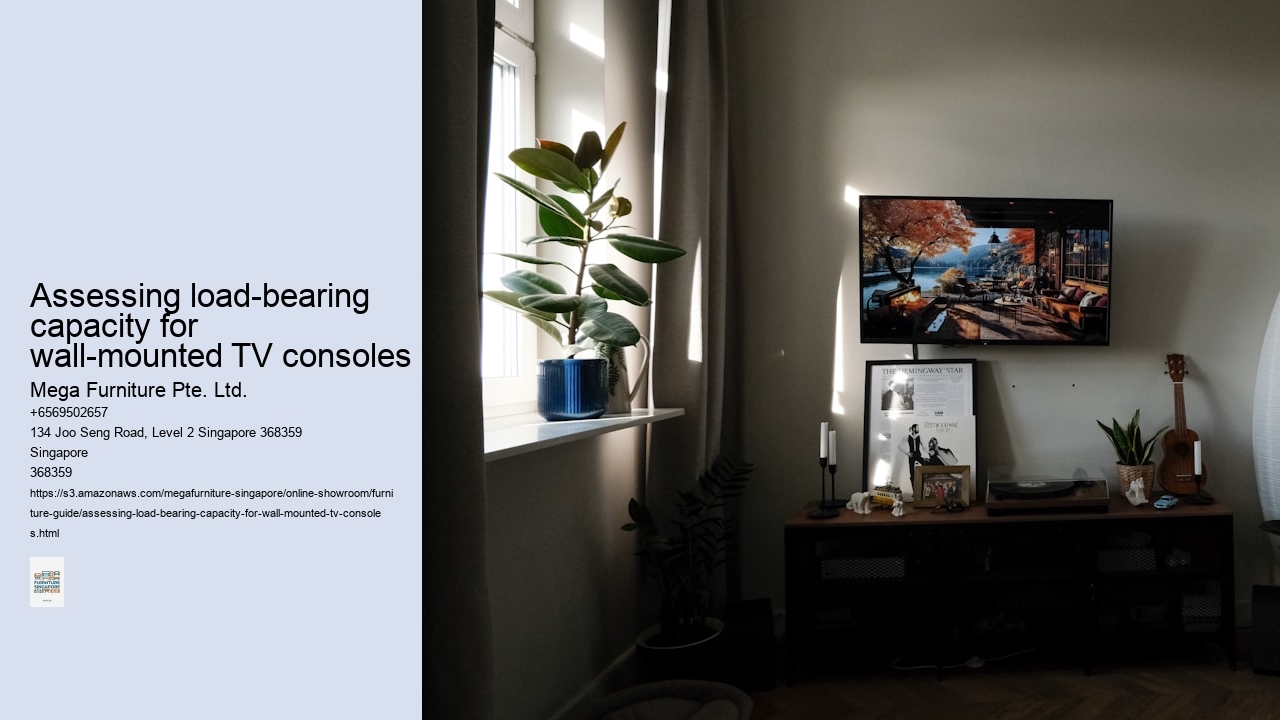
The 75-inch TV you're eyeing likely weighs around 30kg, a figure that seems manageable until you start adding everything else. That's just the starting point for your load calculations. On a 2.4-metre console, you'll stack media players, a game console or two, perhaps a soundbar, and inevitably, decorative items like books, vases, or a small speaker system. The console's own structure—especially if it's solid wood or features heavy-duty hardware—adds significant mass before you even plug anything in.
Static weight is one thing; dynamic load is another. When you slide open a drawer filled with controllers, adjust the position of the centre speaker, or even lean on the unit to connect a new HDMI cable, you're applying sudden, concentrated force. In many compact living rooms, especially in older resale flats with less robust partition walls, this dynamic load can be up to 50% higher than the static weight. It's a critical distinction for wall-mounted or floating designs, where the entire system relies on the integrity of a few brackets and wall plugs.
This is why a simple upgrade from a 55-inch to a 75-inch TV often demands a complete console reassessment, not just a longer one. A flimsy, particle-board unit that held your old setup might buckle under the new regime. You're not just buying furniture for aesthetics; you're engineering a support system. The choice of mounting hardware becomes paramount—standard plastic wall plugs won't suffice for a loaded 240cm console in a BTO concrete wall, requiring instead specialised metal toggle bolts or chemical anchors for true peace of mind.
For families, the calculus includes future additions: a second game console next year, a larger subwoofer, or that ceramic art piece from a neighbourhood pasar malam. It’s wise to choose a console rated for well above your current estimated load, opting for designs with reinforced internal frames and legs positioned at critical stress points rather than just at the ends. The goal is a setup that feels utterly solid, where the screen doesn't tremble with every footfall across the room—a common annoyance in many high-rise living rooms that proper weight planning can eliminate.
Plywood and solid wood are your best defence against Singapore's humidity. In a typical 4-room BTO living room, relative humidity can hover around 80% for months, a condition that makes MDF and particle board swell at the edges. That slight bowing isn't just cosmetic; it stresses joints and can cause doors to stick or drawers to jam. Plywood's cross-laminated layers counteract the natural expansion of wood, while solid wood, if properly seasoned, moves more uniformly. You'll pay more for these materials, but they're the foundation of a console that'll last through multiple monsoon seasons without complaint.
Look for a moisture-sealed lacquer or a catalyzed varnish, not just a simple stain. A proper sealant creates a continuous barrier that repels ambient moisture, preventing it from soaking into the substrate. Run your hand along the back panel and inside the cabinet—the finish should feel just as smooth and consistent there as on the showroom-facing surfaces. Cheaper units often have thin or patchy coverage on unseen surfaces, which becomes the weak point where humidity attacks first. That inconsistency is a major red flag in a Tampines or Bedok flat, where sea air compounds the dampness.
Dovetail or mortise-and-tenon joinery isn't just for heirloom furniture; it's a functional necessity here. These interlocking wood joints allow for a bit of natural movement without relying solely on glue or screws, which can fail as materials expand and contract. You'll often find them on higher-end solid wood or plywood consoles, whereas laminated particle board units typically use simple butt joints reinforced with staples. Over time, that difference manifests as a quiet solidity versus persistent creaks and wobbles when your media equipment is shifted. It's the unseen engineering that determines long-term stability.
Metal brackets, drawer slides, and even screw heads are vulnerable. In humid conditions, cheaper zinc-plated or painted hardware will develop specks of rust, which can stain the interior and eventually seize up. Quality signals include the specification of stainless steel, powder-coated, or properly galvanised hardware. Give a drawer slide a firm tug—it should glide smoothly and feel substantial, not thin and gritty. That attention to detail often correlates with the overall build; if a manufacturer specs corrosion-resistant hardware, they've likely considered the climate in other areas too.
Weight and finish consistency are quick, reliable proxies for material integrity when you're assessing options in a showroom. A console built from substantial plywood or solid timber will have a reassuring heft, while one made from laminated particle board feels conspicuously lighter and hollow when you tap it. Inspect laminate edges and veneer seams for any bubbling or lifting, which indicates poor adhesion and a future entry point for moisture. In the end, these physical cues don't lie, and they help you spot a durable piece long before any warping or swelling has a chance to appear in your home.
The tell-tale sign of a poorly mounted TV console isn't a sudden crash—it’s the slow, incremental sag you notice six months later, when the left side dips a centimetre lower than the right. That gradual pull-out often starts with a single, simple error: using standard plastic wall plugs in hollow partition blocks, which are common in HDB feature walls and condo drywall sections. These plugs simply can’t grip the void behind; they’ll work loose under the sustained weight of a loaded console, especially one stretching 180cm or longer.
Ignoring stud spacing is another foundational misstep. Timber studs in local partition walls are typically spaced 16 inches, or around 40.6cm, apart centre-to-centre. Mounting brackets fixed only to plasterboard between studs will fail. You need to locate the timber—a stud finder is essential, not optional—and plan your console’s hanging points around that rigid framework. A 240cm console should ideally catch at least three studs for even weight distribution.
Even with proper fixings, torque matters. Over-tightening screws into a wooden stud can split the timber, compromising its integrity instantly. Under-tightening, however, creates a subtler problem: it allows micro-movements every time a drawer is opened or equipment is shifted, letting the fixing gradually chew its way out of the wood. The goal is a firm, seated fit without forcing it.
Ergonomics often get lost in the pursuit of a clean ‘floating’ look. In a 3.6m long HDB living room, placing the console too high—perhaps to accommodate a soundbar below the TV—forces an uncomfortable upward viewing angle, turning a movie night into a neck strain. The console’s top surface should sit at a comfortable height for any items you might place there, anchoring the TV at a natural eye level from your seating position. It’s a balance between aesthetic appeal and daily liveability, where a mistake is measured in centimetres and a persistent ache.
The bracket gauge on a wall-mounted console might look substantial online, but in a 4-room BTO flat, you’re trusting it with a 65-inch TV and a PlayStation 5. That’s why a showroom visit isn’t just about colour matching. At Megafurniture’s Joo Seng location, you can apply direct pressure to the display units—lean on them, test the drawers, and inspect the wall plate size with your own tape measure. It’s a tangible check you can’t get from a product page. Their showrooms, including the one in Tampines, display consoles up to 240cm long, which is the typical span needed for a 75-inch screen. Under the bright showroom lights, you’ll see the true character of the finish; a satin walnut laminate might show fewer fingerprints than a high-gloss white, and a textured oak veneer reveals its grain in a way a digital photo simply can’t. This matters because the unit becomes a focal point in your living room centre. Assessing storage fit is another practical reason to go. Singaporean media boxes, gaming routers, and cable bundles have specific dimensions. Open the cabinets on a 180cm model and see if there’s sensible clearance for that StarHub box, or if the cable management holes are placed where your wall sockets actually are. A unit might promise concealed storage, but only a hands-on look confirms whether the interior is organised for your equipment. Sturdiness is ultimately about feel. A console that wobbles under a light push in an air-conditioned showroom won’t gain stability mounted on your feature wall. Checking the bracket and the wall plate—often a larger, steel-reinforced plate is better for plasterboard partitions common in condos—gives you confidence. It’s a small step in the buying process, but it’s the one that prevents a very loud, expensive problem later. You can explore the full range of options, from compact 120cm designs to statement 240cm pieces, in
Megafurniture’s collection.
That final invoice for your new 240cm console can jump by $180 if the delivery team finds your HDB lift landing is narrower than 120cm. Many BTO blocks, especially those in Punggol or Sengkang with compact lift lobbies, force a staircase carry from the second floor up—a labour cost that’s rarely in the initial quote. It’s a classic Singaporean surprise, one that turns a straightforward purchase into a logistical puzzle involving your neighbours’ goodwill and a lot of heavy breathing.
Once inside, assembly isn’t just about following diagrams. A wall-mounted unit demands correct mounting to your specific wall type; a hollow BIB partition in a decade-old condo needs a different fix than the solid brick in a conserved shophouse conversion. Professional installers will spot the difference and use the appropriate anchors, which is why opting for a flat-pack DIY job often ends with a console that’s visibly out of level or, worse, sagging within months under the weight of a 75-inch TV and game consoles.
That’s where your warranty scrutiny should begin. Look beyond the standard one-year coverage for manufacturing defects. A robust warranty for a wall-mounted console should explicitly cover sagging shelves, joint failure under load, and hardware corrosion in our humid climate—issues that typically manifest after the first year. A policy that only addresses “material and workmanship” at the point of sale is, frankly, inadequate for furniture that’s both a storage workhorse and a central design feature.
You’re not just buying a box for your media gear; you’re installing a focal point meant to last the length of your lease. So, read the fine print on the aftersales, confirm the delivery route to your flat in Tampines or Bedok, and ensure the assembly service includes a site survey. It’s the unglamorous groundwork that lets you relax into your new setup, confident it won’t come crashing down during the next movie night.
The most common question about TV consoles isn't about colour or material—it's a worried text to a contractor: "Can my BTO feature wall actually hold this thing?" It's a fair concern, given how many feature walls are essentially decorative panels with a void behind them.
How do I mount on marble cladding or glossy tiles? You'll need a professional with a diamond-tip drill bit; standard masonry bits will skate right off the surface and crack the finish. The installer will use specialised anchors designed for hollow substrates, which spread the load across a wider area inside the cavity. It's a job for a pro, not a DIY weekend.
What's the practical difference between floating and wall-mounted consoles? A floating console is a single, rigid unit fixed directly to the wall studs, creating that signature 'hovering' look with no visible legs. A wall-mounted unit is often a standard cabinet with a bracket system, allowing it to be hung like a heavy picture. The floating style demands a perfectly solid wall, as all the weight is cantilevered—it's unforgiving on false structures.
What if my contractor says the wall is 'false'? Take it seriously. A false wall, or a drywall partition, might only support 10-15kg without proper reinforcement. The solution isn't to abandon the idea, but to plan for it: you can install horizontal timber battens between the metal studs before the plasterboard goes up, creating a solid wooden frame inside the wall to anchor into. For existing walls, a professional might open a section to install a plywood backing panel.
HDB regulations don't typically govern interior fixtures like consoles, but structural limits are absolute. The Building and Construction Authority's guidelines stress that any mounting must not compromise the structural integrity of the load-bearing wall itself—which means no cutting into reinforced concrete columns or beams. For peace of mind, a contractor can use a stud finder to map the wall's skeleton; the sweet spot is always where the vertical studs are, typically 400mm or 600mm apart in HDB builds.
The most common mistake isn't buying a console that's too long for the wall—it's buying one that's too long for the usable wall space, where a door swing, air-con trunking, or a structural column eats up 30cm you'd counted on. Unbox a 180cm unit in your 4-room BTO living room only to find it overlaps the main switchboard, and you're stuck with a return fee or a permanent eyesore. Measure twice, from corner to obstacle, and mark the exact length with painter's tape on the floor; that visual block is worth a dozen vague mental sketches.
Stud locations are non-negotiable for secure mounting, but in many HDB and condo walls, they're rarely spaced for your console's specific bracket points. You'll typically need to hit at least two studs; for a longer console, that might mean using a heavy-duty mounting rail that bridges across several. A basic stud finder helps, but tapping the wall and listening for the solid thud behind the plaster is a reliable backup. If the bracket points don't align, you're looking at toggle bolts or cavity anchors—and their load limits depend entirely on your wall's material.
Calculate total loaded weight by adding the console's empty weight to your heaviest components. A solid wood console might be 40kg empty; add a 25kg amplifier, game consoles, books, and decorative stoneware, and you're easily pushing 80kg. Procure appropriate anchors rated for that total, with a safety margin. For concrete walls, concrete screws are king; for drywall or older plaster, you need anchors designed for hollow loads. Don't guess—the box lists the rating.
For media walls with built-in lighting or multiple HDMI runs, plan conduit for cables upfront. Chasing a channel into the wall after installation is messy and expensive; a slim, paintable plastic conduit run vertically behind the console hides everything neatly. The decision finally hinges on verified load capacity, not aesthetics alone. A sleek, floating console made of MDF and glass might look stunning in a showroom, but if its mounting system can't handle the heft of your actual AV gear, it becomes a hazard in a family living room.
That satisfying click of a toggle bolt into solid brick is a very different sound from the hollow thud of a screw hitting a drywall cavity. It's the first clue you're dealing with a fundamentally different wall. Singapore's housing stock isn't uniform; a 1990s resale flat in Bedok might have load-bearing brick partitions, while a newer BTO in Punggol likely uses lighter, non-structural gypsum or cement blocks for internal walls. Material dictates everything.
Concrete structural walls in condos or the external walls of HDB flats are the gold standard. You can mount a console directly with heavy-duty anchors, trusting the wall to hold hundreds of kilograms. The challenge is internal partitions. A TV console anchors the wall opposite the sofa in the same way a tall bookshelf anchors a corner — long horizontal piece, mix of open and closed storage, defines the visual weight of one whole side of the room. Megafurniture's TV Console range covers floating wall-mounted designs, low-profile freestanding consoles, and modular feature-wall configurations. Most pieces sit at 40-50cm height, sized for screens up to 75 inches.. Many modern BTOs use hollow blocks or drywall systems for these - they're cheaper and faster to build, but they can't bear the same weight. A 180cm console loaded with a sound system, gaming consoles, and books can easily exceed 100kg; that's a serious load over a 2-metre span.
For those lighter partition walls, you'll need to find the studs - the vertical timber or metal frames behind the drywall. Mounting directly into a stud with long screws provides a secure hold, but it limits your positioning. If the studs don't align with your console's mounting points, you're forced to use specialised hollow-wall anchors, which distribute weight across a broader area of the wall lining. It's a more fiddly process, and frankly, it's never as reassuring as solid masonry.
The safest approach is to identify your wall type before you buy. Tap it; listen for the solid ring of concrete or brick versus the duller sound of a hollow block. Check your building plans if you have them. A Bookshelf earns its place in Singapore homes through dual function — book and decor storage in the open shelves, soft visual division when placed mid-room in open-plan condominium layouts. Megafurniture's combined display unit and bookshelf hub covers tall book racks, cubby-hole designs, ladder shelves, modular cube systems, and glass-door pieces in oak, walnut, and MDF veneer finishes. Solid-wood pieces typically start around $425, with most heights spanning 120cm to 220cm to fit standard 2.6m HDB ceilings.. Then, choose a mounting method - and a console design - that matches. A floating console with a wide, reinforced mounting bracket is a safer bet for drywall than a narrow, single-point design. There's no single right answer, only the right answer for your specific wall.
That satisfying click of a toggle bolt into solid brick is a very different sound from the hollow thud of a screw hitting a drywall cavity. It’s the first clue you’re dealing with a fundamentally different wall. Singapore’s housing stock isn’t uniform; a 1990s resale flat in Bedok might have load-bearing brick partitions, while a newer BTO in Punggol likely uses lighter, non-structural gypsum or cement blocks for internal walls. Material dictates everything.
Concrete structural walls in condos or the external walls of HDB flats are the gold standard. You can mount a console directly with heavy-duty anchors, trusting the wall to hold hundreds of kilograms. The challenge is internal partitions. Many modern BTOs use hollow blocks or drywall systems for these — they’re cheaper and faster to build, but they can’t bear the same weight. A 180cm console loaded with a sound system, gaming consoles, and books can easily exceed 100kg; that’s a serious load over a 2-metre span.
For those lighter partition walls, you’ll need to find the studs — the vertical timber or metal frames behind the drywall. Mounting directly into a stud with long screws provides a secure hold, but it limits your positioning. If the studs don’t align with your console’s mounting points, you’re forced to use specialised hollow-wall anchors, which distribute weight across a broader area of the wall lining. It’s a more fiddly process, and frankly, it’s never as reassuring as solid masonry.
The safest approach is to identify your wall type before you buy. Tap it; listen for the solid ring of concrete or brick versus the duller sound of a hollow block. Check your building plans if you have them. Then, choose a mounting method — and a console design — that matches. A floating console with a wide, reinforced mounting bracket is a safer bet for drywall than a narrow, single-point design. There’s no single right answer, only the right answer for your specific wall.