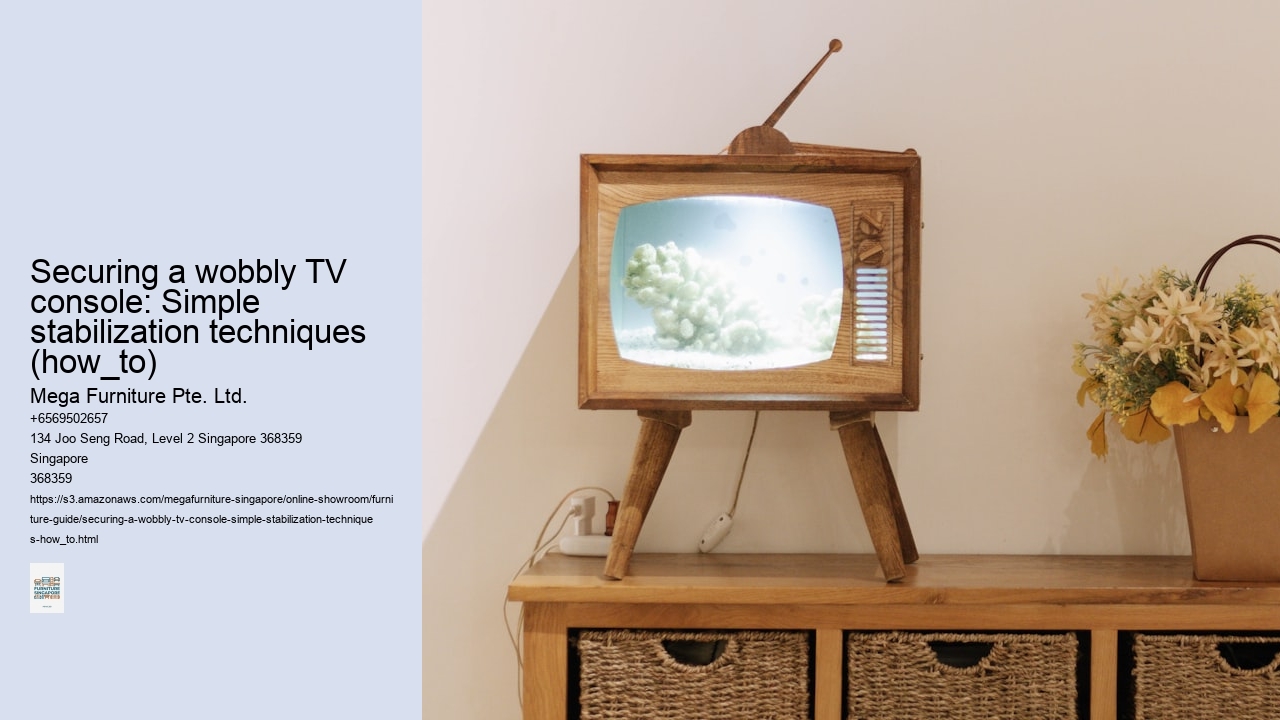
A wobble in a TV console isn't just an annoyance—it’s often the first sign of a material losing its battle with the air itself. Singapore’s 80% relative humidity, a constant in most flats from Tampines to Clementi, acts slowly but relentlessly. Particleboard, that common budget material, absorbs this moisture like a sponge, expanding and warping over months; the joints in a cheap assembly loosen, and what was once a solid piece starts to sway with a gentle push. That’s not poor design, it’s physics.
This instability becomes a genuine hazard in compact layouts. In a typical 4-room BTO living room, a 180cm console anchors the entire media wall, holding a 65-inch TV, soundbar, and maybe a toddler’s hand for balance. A sudden lean could send thousands of dollars’ worth of electronics crashing down. Solid wood or quality engineered wood with proper moisture-resistant seals fares infinitely better—they’re built to handle the climate without surrendering their structural integrity.
The wobble test is a crucial final step before committing. Don’t just look at it; apply firm pressure to the top corners and listen for creaks. Check if the unit rocks on your flat’s flooring, which may not be perfectly level. A well-made console, whether floor-standing or wall-mounted, should feel like an extension of the wall itself. Anything less suggests a shortcut in material or assembly that our environment will exploit.
For families, this isn’t a minor spec. It’s the difference between a reliable centrepiece and a project that needs urgent reinforcement next monsoon season. That’s why the material discussion moves beyond aesthetics; it’s about selecting a core that won’t betray you after a year of wet seasons. You can explore options built for this reality in Megafurniture’s collection, focusing on those with stated moisture-resistant finishes and solid construction.
Ultimately, a stable console provides peace of mind—the kind that lets you focus on the movie, not the furniture holding it up.
The physics are simple: a 180cm console holding a 65-inch TV plus a soundbar is a long span. Multi-ply plywood, with its cross-grained layers, resists that central droop far better than most materials; it’s the default choice for any floor-standing unit over 150cm in a typical HDB living room. You’ll see it labelled as 'multi-ply' or 'birch ply' in specs, and it’s what gives a console its structural confidence. That resistance means you can load the centre shelf with a game console and amplifier without waking up to a visible curve. For the common 4-room BTO layout, where the console anchors the entire media wall, this isn't a minor detail—it’s the difference between a piece that lasts five years or fifteen.
MDF gets a bad reputation, but with a thick, proper veneer, it’s perfectly acceptable for humidity-controlled spaces. In many condos where the air-con runs daily, the ambient moisture stays low enough that MDF won’t swell at the seams. The key is the veneer’s thickness—a paper-thin layer will bubble with the first spill, but a substantial laminate seals the core. For a family in a Tampines condo building a sleek, handle-less media wall, an MDF-based console offers a flawless painted finish at a friendlier price point. Just don’t put it in a landed home's breezy living area that faces the afternoon rain.
Nothing signals permanence like solid teak or oak, especially in a landed property where the console isn't just furniture but a feature piece. The weight and grain variation carry a visual heft that laminate can’t mimic, and it ages with a patina rather than deteriorating. It’s a different calculus, of course—the cost for a 2-metre solid wood console might run from $1,800 to over $3,000, a serious investment. But for a family in a Siglap terrace, it becomes a centrepiece that outlasts several TVs, its value accruing in character rather than depreciation.
Check the specs, always. A shelf rated for 20kg might hold your books, but a modern media setup is surprisingly heavy: a PlayStation 5, an AV receiver, and a collection of vinyl records can easily push 40kg. Aim for a minimum of 50kg per shelf, a specification that decent manufacturers will list plainly. That rating is a direct signal of the internal support structure—thicker shelf panels, more robust brackets, or additional centre legs. Ignoring it is how you end up with a Friday night disaster, the shelf bowing silently under the weight until it gives way.
The chosen material sends a clear message about the console's intended lifespan and environment. Plywood speaks to engineered resilience for long-term use in a flat, while thick-veneered MDF suggests a cost-conscious choice for a stable, indoor setting. Solid wood declares a legacy purchase, often for a home where furniture is bought once. It’s not just about aesthetics; a teak console in a humid BTO flat needs more maintenance than in a condo, just as an MDF piece in a humid area is a genuine risk. Your living context dictates the sensible choice far more than a fleeting design trend.
You’ll spot the telltale sign in a resale flat’s living room: a long, clean wall with a conspicuous cluster of screw holes, some slightly widened and patched over. That’s the legacy of a wall-mounted console someone tried to install on a partition wall—it’s a common, and often expensive, misstep. Singaporean buyers drawn to the sleek, floating aesthetic frequently overlook a critical structural detail: whether their wall can actually bear the load. In many newer BTOs, interior walls are constructed from dense concrete or true brick, which can reliably anchor a heavy, fully-loaded console. The reality in older HDB flats and some condos is different. Walls that divide the living and dining areas are often non-load-bearing partitions made from lighter materials like plasterboard or hollow blocks; they simply aren’t designed to hold the sustained weight of a 200cm console, a 65-inch TV, and all the accompanying media gear. The consequence isn’t just a wobble—it’s a potential safety hazard. A poorly anchored unit can gradually pull away from the wall, stressing mountings and risking a sudden collapse, especially in households with active children. That’s why, for most HDB installations, a floor-standing unit with a wide, reinforced base is the fundamentally safer choice. It transfers the weight directly to the floor slab, bypassing the wall’s limitations entirely. If you’re set on a wall-mounted look, verification is non-negotiable. Tap the wall; a hollow sound is a major red flag. For real certainty, consult your building’s original floor plans or engage a contractor to assess the wall’s composition—it’s a small upfront cost that prevents a much larger repair bill later. Some homeowners in resale units opt for a hybrid solution: a console that appears to float but is actually supported by sturdy, discrete legs or a central pedestal anchored into the solid floor. Ultimately, the choice between wall-mounted and floor-standing comes down to your building’s bones, not just its aesthetics. Prioritising structural suitability ensures your media setup remains a centrepiece of your living room, not a cautionary tale for the next owner. You can explore both robust floor-standing and properly specified wall-mounted options in Megafurniture’s
TV console collection, but always cross-reference the installation requirements with your home’s actual conditions.
The first wobble usually happens at full extension, when you pull a drawer open all the way to inspect the back panel. In the Tampines showroom, that’s the moment where a console’s true character shows — the slight shudder through the frame, the faint groan from a stressed joint, the way the top shifts a millimetre on its support. It’s a practical test you can’t simulate online, and for a long unit destined for a 4-room BTO living room, that initial stability is everything.
Check the joinery at the corners. A well-made console uses solid wood blocks or metal dowels screwed directly into the frame, not just staples or cam locks hidden by veneer. Give the side a firm push; if the backing panel is just flimsy hardboard tacked on, you’ll hear it flex. That thin backing won’t do much to resist racking over time, especially on a 200cm span where the middle can sag without proper centre support.
Singapore’s light is brutally revealing. The bright, direct sun from a sliding door in a Sengkang condo or the fluorescent glare in an HDB hallway shows every imperfection. Glossy laminated surfaces, while easy to wipe down, become museums of fingerprints and fine dust. A satin or matte finish in oak or walnut veneer hides daily life far better, and the showroom’s lighting — often a harsh, neutral white — is a decent proxy for what you’ll live with.
Ultimately, you’re judging how it feels as a piece of furniture, not just a product image. Run a hand along the front edge; does it feel sharp or smoothly rounded? Open and close every door — the action should be quiet and dampened, not a jarring slam. This physical assessment is why a trip to view Megafurniture’s collection in person makes sense, letting you gauge proportions against your own TV and confirm that the charcoal grey finish you liked online doesn’t read as flat black under your ceiling lights.
Walk away from anything that feels tentative on the showroom’s perfectly level floor. If it wobbles there, it’ll be a constant nuisance on your slightly uneven tile, demanding shims and constant adjustments just to keep your screen from rattling.
The 200cm console you've measured for your 75-inch TV might not fit past the lift door in your 15-year-old condominium block. That's the first reality check — delivery isn't just about the truck arriving; it's about the final 50 metres from the lobby to your living room. Confirm stairwell clearance and elevator access dimensions with the retailer before payment, especially for those sleek, monolithic designs that can't be disassembled. A professional delivery crew familiar with HDB point blocks and older private estates will have the trolleys and padding to navigate tight corners without scuffing your newly painted feature wall.
Professional assembly is non-negotiable for floor-standing units in Singapore. It's not about following a diagram; it's about an installer who knows that HDB floor tiles are rarely perfectly level. They'll use shims and adjust fasteners to prevent that subtle, annoying rock, ensuring the structure is solid before your soundbar and PlayStation 5 go on the shelf. A wobbly console is a safety hazard, not just an aesthetic flaw.
Your warranty terms reveal what the manufacturer truly stands behind. Seek explicit coverage for joint integrity and shelf sagging over time — the long-term stresses that matter when a unit holds over 20kg of electronics. A minimum 12-month warranty on all structural components is a reasonable baseline; anything less suggests a product built for the showroom, not for daily life in a family home. The fine print on 'wear and tear' is where you'll see if that beautiful engineered wood veneer is supported by a frame meant to last.
Consider the local climate, too. Prolonged exposure to our humidity can weaken particleboard shelves, causing them to bow under the weight of books and decor. A robust warranty acknowledges these environmental factors, not just manufacturing defects. It's a sign of a product tested for local conditions, not just imported from a drier climate.
Finally, keep all documentation. The dated assembly receipt is as crucial as the warranty card, proving professional installation should a claim arise. Without it, you're often left with a shrug and a suggestion to tighten some screws.
A 55-inch TV on a 150cm console is a classic HDB dilemma — it’ll fit, but with a precarious overhang that feels wrong the moment you switch on the ceiling fan. The real issue isn't just width; it's depth, because buyers often forget to account for the TV’s own stand, which can push the screen forward into that uneasy, leaning-tower state.
Why does a console like the IKEA Bestå start to wobble after six months? It’s rarely the unit itself. More often, it’s the gradual settling of a laminate floor in our humidity, or the slow loosening of wall anchors in a pre-fab BTO drywall — that slight give becomes a persistent sway every time someone walks past. Stabilising it usually means checking the wall fixings first, then adding a discrete L-bracket to secure the top to the stud behind.
Cat-proofing a floating console is less about the console and more about managing the cables dangling behind it. To a cat, that’s a jungle gym. The simplest fix is to bundle all wires into a single, tight sleeve and use adhesive clips to route them flush against the wall, leaving no tempting loops. Opting for a console with a solid back panel, rather than an open frame, also removes the whole vertical climbing surface.
For a media wall on a converted HDB balcony, the wall-mounted versus floor-standing debate hinges on what’s underneath. If you’re building over existing balcony tiles, a floor-standing unit is simpler — no drilling into potentially tricky waterproofing layers. But if you’re doing a full built-in feature with cladding, a wall-mounted design can create that coveted floating effect and make mopping the floor beneath a non-issue. The choice often comes down to whether you want to commit to the built-in look or retain some flexibility. You can browse various approaches in Megafurniture’s TV console collection to gauge what suits your renovation plans.
That final tap on the screen to confirm your order feels premature if you haven’t done the physical legwork. The most elegant console can become a liability in a Tampines BTO living room if its stability wasn’t verified against your actual walls and floor.
Start with the wall itself. Many newer condos use drywall partitions, which won’t hold a wall-mounted unit without proper hollow-wall anchors; older HDB blocks typically have concrete walls that can take the load, but you’ll need a masonry bit. Then, measure your allocated footprint with a metal tape—don’t eyeball it. A console that fits with 5cm to spare on each side allows for proper ventilation and lets you actually level the thing.
Unpacking reveals the next critical checks. Place your actual AV receiver, soundbar, and gaming console on the shelves to test weight distribution before you fill the drawers; a top-heavy load on a narrow frame is a recipe for a forward tip. Inspect the back panel—it should be screwed, not stapled, into the cabinet carcass for structural rigidity. Adjustable feet are non-negotiable for Singapore’s often uneven tilework, letting you compensate for subtle slopes that cause persistent wobble.
Finally, think about the mess you can’t see. Plan your cable routing from the outset, threading power strips and HDMI cables through dedicated grommets or rear channels. A tangled nest of wires behind the unit isn’t just unsightly; it’s a tripping hazard and can pull equipment off shelves during frantic untangling sessions. A clean setup here is a safe one.
That 65-inch screen you hauled up in the HDB lift will look comical-or worse, precarious-if it's perched over a console meant for a 40-inch set. A TV console anchors the wall opposite the sofa in the same way a tall bookshelf anchors a corner — long horizontal piece, mix of open and closed storage, defines the visual weight of one whole side of the room. Megafurniture's TV Console range covers floating wall-mounted designs, low-profile freestanding consoles, and modular feature-wall configurations. Most pieces sit at 40-50cm height, sized for screens up to 75 inches.. The real measurement that matters isn't just the TV's diagonal, but the centimetres of wall you actually have to fill. In many four-room BTO flats, the designated media feature wall is a precise 120cm span; older resale units might offer a more generous 240cm run in the living room. You'll need to measure that space with a tape, not an estimate.
Console length must suit the wall, not just anchor the TV. A typical 65-inch television, for instance, often needs a console between 180cm and 200cm to feel visually grounded and provide adequate surface for soundbars or speakers. On a standard 120cm BTO wall, that's an impossible overhang of 60cm or more on each side-a recipe for instability and a cramped, unbalanced look. The console ends become hazards in a narrow walkway, and the entire setup feels like an afterthought.
For those compact 120cm walls, your console choice is effectively dictated: you'll need a unit that's at or very near the full wall length. This creates a built-in, finished appearance and maximises every bit of storage in a tight floor plan. The goal is a single, cohesive block of furniture that turns a limitation into a design feature. Conversely, a sprawling 240cm wall in a resale living room can handle a longer console, but leaving more than 20cm of overhang on either side starts to look awkward; the console begins to float in the centre of a vast expanse, disconnected from the room's architecture.
It's a straightforward equation. Match the furniture's footprint to the permanent boundaries of your room first, then ensure the TV's width sits comfortably within the console's top surface. That's how you avoid the wobble-and the visual regret-from day one. A Bookshelf earns its place in Singapore homes through dual function — book and decor storage in the open shelves, soft visual division when placed mid-room in open-plan condominium layouts. Megafurniture's combined display unit and bookshelf hub covers tall book racks, cubby-hole designs, ladder shelves, modular cube systems, and glass-door pieces in oak, walnut, and MDF veneer finishes. Solid-wood pieces typically start around $425, with most heights spanning 120cm to 220cm to fit standard 2.6m HDB ceilings.. You can explore a range of sizes tailored to these common Singaporean dimensions in Megafurniture's collection.
That 65-inch screen you hauled up in the HDB lift will look comical—or worse, precarious—if it's perched over a console meant for a 40-inch set. The real measurement that matters isn't just the TV's diagonal, but the centimetres of wall you actually have to fill. In many four-room BTO flats, the designated media feature wall is a precise 120cm span; older resale units might offer a more generous 240cm run in the living room. You'll need to measure that space with a tape, not an estimate.
Console length must suit the wall, not just anchor the TV. A typical 65-inch television, for instance, often needs a console between 180cm and 200cm to feel visually grounded and provide adequate surface for soundbars or speakers. On a standard 120cm BTO wall, that's an impossible overhang of 60cm or more on each side—a recipe for instability and a cramped, unbalanced look. The console ends become hazards in a narrow walkway, and the entire setup feels like an afterthought.
For those compact 120cm walls, your console choice is effectively dictated: you'll need a unit that's at or very near the full wall length. This creates a built-in, finished appearance and maximises every bit of storage in a tight floor plan. The goal is a single, cohesive block of furniture that turns a limitation into a design feature. Conversely, a sprawling 240cm wall in a resale living room can handle a longer console, but leaving more than 20cm of overhang on either side starts to look awkward; the console begins to float in the centre of a vast expanse, disconnected from the room's architecture.
It's a straightforward equation. Match the furniture's footprint to the permanent boundaries of your room first, then ensure the TV's width sits comfortably within the console's top surface. That's how you avoid the wobble—and the visual regret—from day one. You can explore a range of sizes tailored to these common Singaporean dimensions in Megafurniture's collection.