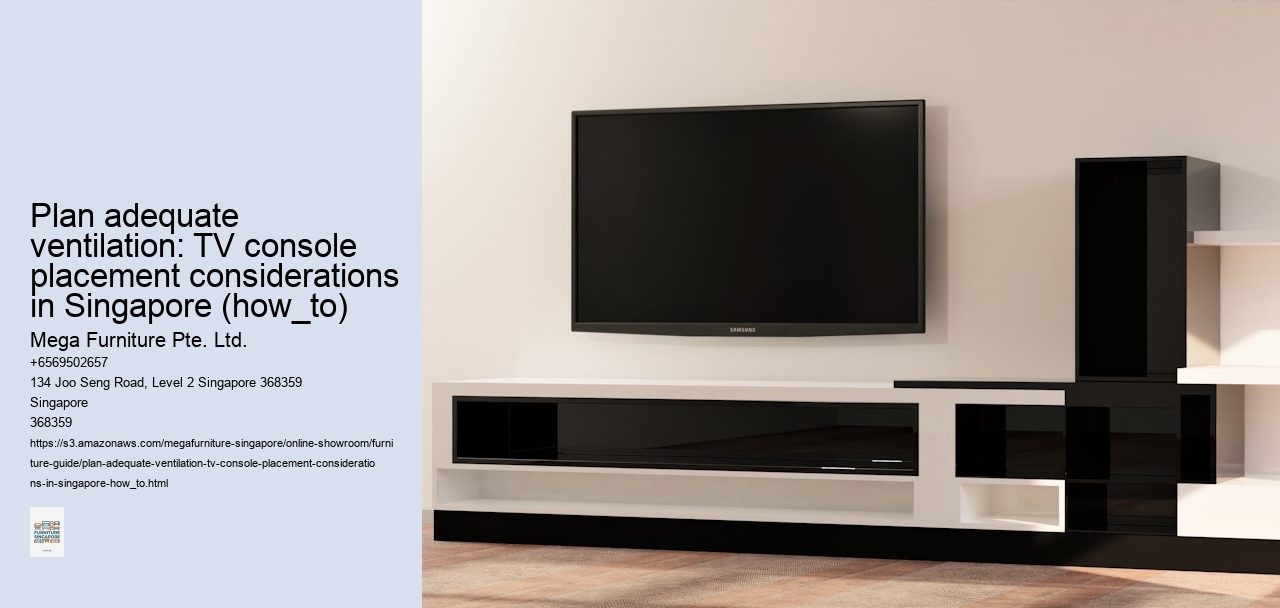
That closed cabinet door you shut after plugging in your PS5 is a slow-motion disaster in Singapore’s climate. Enclosed media consoles act like insulated ovens, trapping heat from AV receivers, gaming consoles, and NAS drives—amplifying failure risk when humidity consistently sits above 80%. It’s not about occasional use; it’s about the cumulative stress of a 55-inch OLED and an Xbox Series X running for hours in a 4-room BTO living room, with heat having nowhere to go but back into the components.
The first line of defence is physical design. Mandate rear cable grommets and a perforated back panel; those small cut-outs for cords are useless if the entire rear is a solid sheet of engineered wood that blocks airflow. A proper perforated panel, often a metal mesh or a board with a grid of holes, allows hot air to exhaust naturally out the back, preventing stagnant, humid air from condensing on circuit boards. Many buyers prioritise a clean look with a solid back, but that’s a compromise that could shorten the lifespan of a $1,200 AV receiver within a few years.
For custom units housing high-wattage components in non-aircon spaces, passive ventilation might not cut it. An active cooling fan system, typically a set of low-noise USB fans mounted internally to create positive airflow, becomes a sensible option. These aren’t the noisy desktop fans you remember; modern units are near-silent and can be thermostatically controlled, kicking in only when the cabinet’s internal temperature climbs past a set point. It’s a practical retrofit for a media wall built around a large format TV, where every component is packed into a dedicated, sealed compartment.
Consider the alternative: that distinctive burnt-dust smell from an overheating amplifier isn’t just unpleasant—it’s a repair bill waiting to happen. While sleek, floating consoles from Megafurniture’s collection offer aesthetic appeal, always verify the ventilation specs before committing, especially for longer units over 200cm designed to accommodate 75-inch screens. The goal is to hide the clutter of cables and boxes, not to suffocate the electronics that make the setup worthwhile.
Solid timber warps and splits here. It's a predictable, slow-motion failure you'll see in a Tampines flat after a year of constant air-con cycling. Engineered cores like MDF or plywood are the pragmatic choice; their cross-laminated layers resist the expansion that wrecks solid wood panels. That stability is non-negotiable for a long console holding a $3,000 TV. You're not buying for a hundred years, you're buying for the next decade in a 4-room BTO.
Check every seam. Particleboard or MDF will swell into a fuzzy, ruined edge if its cut ends aren't perfectly sealed against our 80% humidity. Quality edge-banding or a full PVC wrap is the difference between a clean profile and a console that looks tired in eighteen months. Press on it—if the edge feels soft or you spot a hairline gap, that's where moisture gets in. It's a detail that separates a temporary piece from a proper fixture.
Thin laminates bubble. They separate from the substrate in a humid living room, creating permanent blisters you can feel under a coffee cup. Look for a stated thickness; anything under 0.7mm is risky for a large surface that gets daily use. A good, thick laminate acts as a continuous moisture barrier, and it’s easier to clean when the northeast monsoon brings that sticky, salty air through your Bedok window.
Bare steel legs rust. It's a guarantee, not a possibility, especially in coastal neighbourhoods like Marine Parade or Pasir Ris. The only viable finish is a baked-on powder coating, which fuses to the metal to create a resilient shell. A cheap chrome plating will chip and invite corrosion, leaving ugly orange stains on your floor. That powder coat should feel smooth and even, not tacky or thin.
Construction matters more than material. Even the best plywood will fail if water gets into its screw holes or untreated dowel joints. Look for designs where mechanical fixings are protected or where panels are joined with sealed, interlocking systems. A console that survives Singapore is one where every potential ingress point—every corner bracket, every drawer runner mount—has been considered. It’s the hidden engineering that lets the piece breathe without falling apart.
The most common regret isn't about colour or finish—it's discovering, six months in, that the console is functionally wrong for the room. A unit chosen primarily for its sleek, under-40cm depth might look perfect against a feature wall, but that shallow profile leaves no space behind for an AV receiver's necessary ventilation or for cable management boxes. The heat builds up silently; the tangled cables become a permanent fixture you only address when something finally stops working.
Overlooking rear access is another frequent oversight. Many buyers focus solely on the front appearance, choosing a design with a solid back panel or one that sits flush against the wall. This creates a nightmare for cable routing every time you need to connect a new gaming console, rearrange speakers, or simply tidy up. The result is a mess of wires snaking around the sides, a tripping hazard in a living room and a visual irritant that undermines the clean look you paid for.
Weight limits are a critical, often ignored calculation, especially for wall-mounted or floating consoles. Mounting a heavy unit designed for solid concrete onto a typical HDB partition wall risks a catastrophic pull-out. The calculation isn't just about the console's empty weight; you must add the combined load of your TV, soundbar, game consoles, and media collections. That total often exceeds the safe capacity for standard wall fixings in a BTO flat.
The solution is to measure your actual equipment first, not your ideal aesthetic. Leave a minimum 10cm gap behind the console for airflow and cable runs, and specify open-back designs or units with dedicated rear access panels. For wall mounting, verify the console's weight rating and your wall's construction—then choose hardware rated for that combined load. It's a practical checklist that, done upfront, prevents a cascade of annoyances later. You can browse practical options that account for these needs in Megafurniture's collection.
A photo of a console in a catalogue can’t tell you how the drawer glides will feel after a year of housing game controllers. That’s the kind of detail you need hands and eyes for. At Megafurniture’s showrooms in Joo Seng or Tampines, you can assess build quality directly — test the hinge action on a cabinet door, run a finger along a laminate seam to check for any proud edges, and feel the weight of the construction. It’s a tactile inspection that reveals stability no online review can fully convey. Seeing these units in fully assembled room-set contexts is equally crucial. A 180cm console might look modest on a website, but placed against a mock-up of a 4-room BTO living room wall, its true scale becomes apparent. You can verify proportions with your intended TV size, stepping back to gauge the visual balance; a 65-inch screen can easily overwhelm a console that’s too shallow or appears flimsy under the bright, local light conditions of the showroom. Material finish is another aspect that changes in person. The sheen of a wood veneer or the texture of a sintered stone top looks different under showroom LEDs versus the mixed daylight and warm downlights common in Singapore homes. You’ll notice if a dark laminate shows fingerprints too readily or if a light-coloured surface has a plasticky undertone. This is where you decide if the piece feels like a durable centrepiece or just temporary storage. Ultimately, you’re committing to a piece that will anchor your media space for years. Spending twenty minutes at a showroom to confirm your choice is a prudent step — you’ll leave either confident in your selection or aware you need to
keep browsing the options. It’s about moving beyond pixels and dimensions to the physical reality of the furniture in your life.
The delivery crew will measure your lift’s interior before they even load the truck. That’s the rule for any decent furniture retailer, because a 240cm TV console in a box won’t fit into a standard HDB lift — it’s a simple matter of diagonal clearance. They’ll confirm the dimensions with you, and if the piece is too long, they’ll bring it up unassembled for on-site construction in your living room. This service is common, turning a potential headache into a half-day affair with minimal disruption.
Once assembled, the standard coverage is a one-year warranty against manufacturing defects. This typically handles issues like faulty drawer glides, warping veneers on MDF units, or peeling laminate edges. Longer terms, often stretching to five years, might apply to mechanical parts on motorised lift systems or heavy-duty metal hinges; always check the warranty card for specific inclusions and the required registration process.
Post-assembly, your job begins. Don’t just admire the new piece — test it in situ. Check for adequate wall clearance behind the console for all your cables and that wall-mounted power strips; a flush fit looks clean but can trap heat and crush wires. Use a spirit level across the top to ensure it’s perfectly flat, as an uneven HDB floor can twist the frame and cause doors to swing open. Open every drawer and door to confirm smooth operation without catching, especially in the humidity.
That final check in your actual 4-room BTO living room is crucial, because a console that worked perfectly in a sprawling showroom might reveal flaws when placed on your specific flooring. A slightly warped cabinet door or a drawer that sticks in the humid afternoon isn’t a defect — it’s often an installation or environmental issue, and catching it while the assemblers are still on-site is your best recourse. You can explore various styles and confirm delivery protocols by browsing Megafurniture’s collection online before heading to their Joo Seng or Tampines showrooms to gauge finishes in person.
The search history of a Singaporean homeowner planning a media wall reveals a specific, practical anxiety. It’s less about aesthetics and more about surviving the local climate with your electronics intact.
TV console size for 55 inch TV HDB? You’ll want a console around 160 to 180 centimetres long — that gives the screen some breathing room on either side, which looks proportionally balanced in a typical 4-room BTO living room. For hiding wires, the local solution is a two-part system: adhesive-backed cable raceways along the skirting board to channel cords from the power point, paired with a console that has proper in-built cable management like rear cut-outs and cord organisers inside the cabinet.
Best material for our humidity is a constant concern. Moisture-resistant MDF with a proper sealed finish — think melamine or laminate — handles the damp air better than solid wood, which can warp; just ensure all edges, especially the unseen ones at the back, are properly sealed. That’s a detail worth checking when you browse the options.
Can TV console go against window? It’s possible, but you’re committing to a battle with glare. You’ll need blackout curtains or blinds, and even then, the heat and light exposure might make you reconsider. In many homes, the better compromise is placing it on a perpendicular wall, if the layout allows — it’s a classic HDB furniture puzzle, balancing the TV’s position against the door, the window, and the ever-important sofa sightline.
The tape measure gets put away too early. It's the final walk-through with a laser measure that catches the skirting board you forgot — that extra 2cm depth that pushes a "flush" console out into the walkway of your 4-room BTO living room. Account for it, or you'll be staring at a permanent shadow gap.
Leave a deliberate 5–10cm gap behind the unit, even for floating designs. This isn't wasted space; it's a dedicated channel for power strips, HDMI cables, and that crucial airflow modern electronics demand. A console crammed tight against the wall turns into a heat trap, shortening the life of your AV receiver or PlayStation. Ventilation isn't just about front vents; it's about allowing heat to escape from the rear.
Verify your power point and data port locations against the console's proposed back panel cut-outs. There's little point in a sleek, cable-managed design if your fibre terminal is 30cm to the left of the only cable grommet — you'll end up with a spaghetti junction visible from the dining area. Cross-check these now, while you can still adjust the console's position on your plan.
Finally, take those final dimensions and walk your delivery path. Measure the lift door, the corridor corner, your own front door's clearance. A 220cm console might fit perfectly against your wall, but if it can't pivot into the lift at Tampines Hub or clear the stairwell landing in a walk-up at Joo Seng, you're facing a costly return. That last check is the difference between a smooth installation and a logistical headache.
The living room wall in a typical 4-room BTO is a precise, unforgiving dimension: 3.2 to 3.5 metres of pure reality. That's your canvas, and it's already framed by mandatory doorways and switch boxes. A 65-inch TV demands a console of at least 180cm to look anchored, not like an afterthought perched on a too-short plinth-so your margin for error shrinks to less than a metre on either side. Condo feature walls might promise a more generous 4-metre span, but they often come with the complication of structural columns or recessed areas that carve into that usable space, forcing the entire media setup off-centre.
This arithmetic dictates your first major choice: built-in carpentry or a freestanding unit. Built-ins maximise every centimetre, wrapping awkward protrusions and creating seamless, floor-to-ceiling storage that's a favourite for hiding the clutter of family life. But they're a permanent commitment to one layout and one TV size; future upgrades mean a costly carpentry overhaul. A freestanding console offers flexibility-you can shift it, replace it, or take it with you. Just ensure its length respects the room's proportions and leaves enough breathing room for your speakers and plants.
Ventilation becomes a hidden constraint with each approach. A sleek, full-width built-in with cabinet doors needs integrated venting slats or a raised plinth at the bottom to let your AV receiver and gaming console breathe; sealing them in is a sure way to shorten their lifespans. Freestanding units, especially those with solid backs pushed flush against the wall, can trap just as much heat if not chosen with airflow in mind. The goal is a clean look that doesn't cook your electronics.
For many homeowners, the solution is a hybrid: a substantial, long-line freestanding console that provides the visual weight and storage of a built-in, but with the flexibility of standalone furniture. You'll want to look for designs with open shelving sections or perforated metal back panels behind the central cabinet. This approach sidesteps the permanence of carpentry while still addressing the scale needed for today's larger TVs, a balance that makes sense in our fluid housing landscape. Explore a range of sizes and configurations to find the right fit for your wall.
The living room wall in a typical 4-room BTO is a precise, unforgiving dimension: 3.2 to 3.5 metres of pure reality. That’s your canvas, and it’s already framed by mandatory doorways and switch boxes. A 65-inch TV demands a console of at least 180cm to look anchored, not like an afterthought perched on a too-short plinth—so your margin for error shrinks to less than a metre on either side. Condo feature walls might promise a more generous 4-metre span, but they often come with the complication of structural columns or recessed areas that carve into that usable space, forcing the entire media setup off-centre.
This arithmetic dictates your first major choice: built-in carpentry or a freestanding unit. Built-ins maximise every centimetre, wrapping awkward protrusions and creating seamless, floor-to-ceiling storage that’s a favourite for hiding the clutter of family life. But they’re a permanent commitment to one layout and one TV size; future upgrades mean a costly carpentry overhaul. A freestanding console offers flexibility—you can shift it, replace it, or take it with you. Just ensure its length respects the room’s proportions and leaves enough breathing room for your speakers and plants.
Ventilation becomes a hidden constraint with each approach. A sleek, full-width built-in with cabinet doors needs integrated venting slats or a raised plinth at the bottom to let your AV receiver and gaming console breathe; sealing them in is a sure way to shorten their lifespans. Freestanding units, especially those with solid backs pushed flush against the wall, can trap just as much heat if not chosen with airflow in mind. The goal is a clean look that doesn’t cook your electronics.
For many homeowners, the solution is a hybrid: a substantial, long-line freestanding console that provides the visual weight and storage of a built-in, but with the flexibility of standalone furniture. You’ll want to look for designs with open shelving sections or perforated metal back panels behind the central cabinet. This approach sidesteps the permanence of carpentry while still addressing the scale needed for today’s larger TVs, a balance that makes sense in our fluid housing landscape. Explore a range of sizes and configurations to find the right fit for your wall.