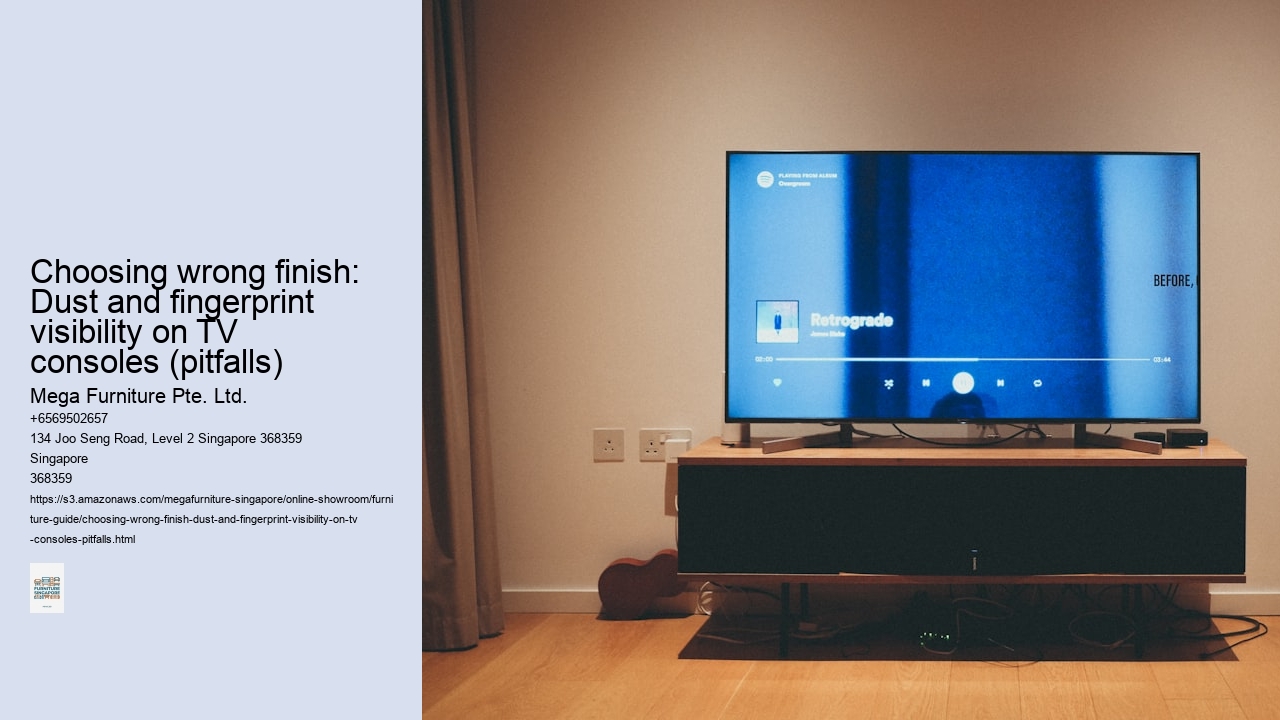
That high-gloss black console you admired in the air-conditioned showroom will look like a forensic exhibit after a weekend with kids in a Toa Payoh flat. Singapore’s humidity doesn’t just frizz hair; it tests furniture integrity in ways a temperate climate never would. Laminated MDF, a common budget option, can warp or swell at the edges once indoor humidity consistently breaches 80%—a regular occurrence during our monsoon months, especially in north-facing HDB blocks. Engineered wood with properly sealed edges performs better, as the sealing locks out moisture; it’s a construction detail worth asking about, not just assuming.
Surface finish is arguably more critical than the material beneath it for daily upkeep. A gloss finish, whether on lacquered wood or laminate, acts like a mirror for every fingerprint, water ring, and dust mote. In a household with children or pets, you’ll be wiping it down constantly. Textured matte laminates or wood veneers with a low-sheen oiled finish are far more forgiving, hiding smudges and fine dust between cleanings.
The choice here isn’t merely aesthetic—it’s about maintenance labour. A family in a 4-room BTO, with a toddler and a dog, will find a pristine gloss console becomes a source of stress, not a feature. A textured, matte finish in a warm oak or grey laminate, however, blends minor imperfections into its character, maintaining its look even when life gets messy around it.
Consider the console’s placement, too. A unit positioned directly under an air-con blower might stay drier, but one against an exterior wall in a ground-floor condo could experience more ambient moisture. For long-term peace of mind, prioritise sealed construction and a practical finish; the most striking piece in the showroom can become the most frustrating one in your living room. You can explore a range of options built for local conditions in Megafurniture’s collection.
That pristine floating console can become a projectile. Singapore's HDB walls, especially in older resale blocks, often feature hollow sections or low-density concrete unsuitable for heavy point loads—a 240cm solid wood unit loaded with a 75-inch TV and a SONOS Arc is a serious test. Buyers frequently drill into a wall cavity, relying on flimsy plastic plugs that won't hold the weight over time. The result isn't just a crooked console; it's a safety hazard in a 4-room BTO living room where children play. Verifying your wall type and using proper steel anchors is a tedious, unseen step, but it's the only thing between your feature wall and a costly repair bill.
Cable management is an afterthought until you need to swap a router or add a PlayStation VR. Choosing a back-panelled console with a single, tiny cord port looks clean during the day-one setup. Months later, you're contorting your arm behind the unit, blindly feeling for a specific HDMI cable in a dense nest of wires for your Apple TV, router, and soundbar. That seamless marble-look laminate facade becomes a permanent barrier to practical maintenance. It's a classic Singaporean compromise: a living room that photographs perfectly for Instagram but requires a minor demolition job for basic tech upgrades.
The mess behind the console isn't just unsightly; it's a functional nightmare. Wires for a PS5, a fibre modem, and a subwoofer inevitably tangle, creating a dust trap and impeding airflow around expensive electronics. In a humid climate, that dust and heat combination can shorten the lifespan of your gear. What starts as a minor inconvenience—a few visible cords—evolves into a rat's nest that makes troubleshooting a network issue a half-day project. You’ll end up unplugging everything, defeating the purpose of having a dedicated media console in the first place.
High-gloss acrylic and jet-black laminate are fingerprint magnets. In a sun-drenched living room in Tampines or Punggol, every smudge from adjusting the soundbar or dusting becomes glaringly obvious. The buyer prioritises a dramatic, reflective surface that matches their feature wall's aesthetic, only to realise they've committed to daily wiping. A matte or textured finish in a neutral tone hides dust and marks far better, but it's often dismissed as too safe or boring. That's a trade-off many regret after the first week of ownership, when the console's surface looks perpetually dirty.
Tech doesn't stand still, but a fixed cabinet does. You might buy a console sized perfectly for today's soundbar, only to upgrade to a beefier Dolby Atmos system in two years that requires more depth. A unit with modular shelving or removable back panels offers flexibility that a rigid, sealed design can't match. It’s worth sacrificing a sliver of that minimalist look for the ability to reconfigure the interior, because your entertainment setup will inevitably change long before you replace the furniture itself. Planning for the next console generation is smarter than designing for the current one.
A showroom floor is a controlled environment—the lighting’s perfect, the drawers are empty, and everything looks solid. That’s why you need to perform your own stress tests. Pull open a drawer fully and press down on the front edge with a firm hand; a quality glide will hold its line without sagging or juddering, even under the weight of a full stack of records or gaming consoles. Then, walk around to the back. A flimsy 3mm back panel with ragged cable holes suggests cost-cutting; a thicker, 5mm or 6mm panel with clean, reinforced grommets shows a builder who considered actual use, not just assembly.
Weight is another silent giveaway. Heft a corner of the console. In Singapore’s humidity, dense particle board or plywood cores resist warping far better than lightweight, hollow alternatives that can feel alarmingly insubstantial. A solid piece for a 180cm console should have a satisfying heft—if you can lift one end easily with a single hand, you’re likely looking at a cardboard-honeycomb internal structure that won’t last the decade.
Finally, get down to eye level with the finish. Run your fingers along every edge, especially the sides and back that face the wall. The laminate or veneer should wrap around corners seamlessly, with no raw particle board showing through. Any inconsistency here—a rough lip, a colour mismatch, a poorly aligned grain pattern—is a clear signal of rushed manufacturing. For a TV console that’s a focal point, these details are constantly on display.
It’s a process that takes five minutes but saves years of regret. While sales brochures talk about style, these physical checks speak to longevity. You can see a range of options, from compact wall-mounted units for BTO living rooms to substantial floor-standing pieces, at Megafurniture’s showrooms, where assessing these details in person is straightforward.
Online photos of a gloss-finish TV console can look pristine, but that sheen is a fingerprint magnet under actual living room light. At Megafurniture's Joo Seng showroom, you can test that reality yourself—run a hand along a lacquered door under the bright, flat LEDs common in HDB corridors and see the smudges accumulate in real-time. It’s a practical check you simply can’t do on a screen, and it often steers buyers toward a more forgiving matte or textured laminate for a family space where the console gets touched daily. Scale is another thing that gets lost in translation. A 220-centimetre console sounds proportionate to a 65-inch TV in theory, but standing it beside a full-size mock-up reveals the true visual weight. In many 4-room BTO layouts, that length can dominate the feature wall, leaving little room for floor lamps or plant stands; the showroom lets you pace out the remaining space, ensuring the piece anchors the room without overwhelming it. You’ll immediately know if a 180cm option provides better balance. For condo owners planning a built-in media wall, the customisation talk moves from abstract to concrete here. You can discuss precise integration—like leaving a 15cm cavity behind the unit for cable management, or extending the top slab to meet existing cladding. Bring your floor plan and the sales team can sketch right over it, translating standard cabinet dimensions into a tailored solution that accounts for Singapore’s common ceiling heights and awkward structural beams. It’s that shift from browsing images to interacting with the physical object that makes the trip worthwhile. You’ll assess drawer glide smoothness, test the weight capacity of open shelves, and see how the
TV console collectionholds up to scrutiny from every angle—decisions that typically lock in a five-figure AV setup deserve that level of due diligence.
The delivery van that can't turn into your narrow landed estate lane is a very specific kind of Monday morning. In Singapore, confirming access isn't just about the unit number—it's about low-hanging tree branches in Serangoon Gardens, or the 15-minute loading bay window at your Tanah Merah condo. A console that fits your 4-room BTO living room is useless if it can't get to your door; reputable suppliers will ask for these details upfront, because their drivers already know which HDB clusters have the tightest ramps.
Assembly here often means working around your existing floor. HDB common bedroom tiles, BTO epoxy coatings, and condo marble all require different tools and care—a team familiar with local builds won't leave marks on that new sintered stone floor. They’ll also know that wall-mounted units in pre-2010 flats need a serious hunt for the concrete behind the plasterboard, a job that demands more than just a standard plug.
Then there’s the warranty, a document that should read like a local weather report. Standard structural coverage is expected. What you need is explicit mention of humidity-induced issues: swelling in solid wood panels, veneer lifting at the edges, or hinge mechanisms stiffening in our constant 80% RH. A warranty that only covers "manufacturing faults" often leaves you stranded when that beautiful oak console expands and no longer fits its own frame after a particularly wet monsoon season.
It’s a practical, unglamorous set of checks, but skipping them turns a design piece into a logistical headache. You’re not just buying furniture; you’re buying the competence of the team that gets it off the truck and into position. For a comprehensive look at options that factor in these realities, you can browse Megafurniture’s TV console collection, where dimensions and assembly notes are clearly listed. Just remember to measure your lift lobby first.
The most telling questions about TV consoles don’t appear in glossy brochures—they’re the ones typed into a search bar at midnight, buyer staring at a blank living room wall. They’re practical, local, and often hinge on dimensions and daily upkeep that catalogues gloss over.
Console depth for a SONOS Arc soundbar? It’s a common snag. The Arc itself is around 11.4cm tall and needs clearance, so a typical 40cm deep console usually accommodates it, but you’ll want to check the bar doesn’t overhang precariously or block the TV’s IR sensor. That extra few centimetres of depth, often overlooked for a console’s silhouette, becomes critical for housing today’s chunkier media gear.
Can a wall-mounted unit hold an 80kg TV? Only with a specific, heavy-duty bracket anchored into reinforced studs or a concrete wall—many BTO partition walls simply won’t take that load. The console’s own weight rating is just the start; the real engineering is in your wall’s structure and the hardware you use to bridge the two, a job often best left to a professional installer.
Difference between tempered glass and laminate surface for dust? It’s stark. A sleek, black-tinted glass top shows every fingerprint and speck of dust, demanding a near-daily wipe down to stay presentable. Laminate, especially in a matte or wood-grain texture, is far more forgiving; a weekly pass with a dry cloth typically keeps it looking clean in a household with kids or pets.
And no, a wet cloth isn’t safe for that wood-grain finish if it’s a printed laminate—moisture can seep into the seams and cause swelling or peeling over time. Use a specific dry microfiber cloth instead; it’s the unglamorous tool that preserves the finish in our humid climate, where water damage is a constant, silent threat.
That last-minute hesitation before you commit to a console is often your most useful tool. Don't ignore it—simulate the reality instead. Lay out newspaper sheets taped together to match the exact length and depth of your chosen piece right on your living room floor. Leave it there for a weekend. You’ll quickly learn if 180cm is a graceful anchor for your media wall or an awkward blockade between your sofa and the balcony door, forcing a daily sidestep that becomes a genuine annoyance.
Material choice isn't just about aesthetics; it’s about maintenance in a humid climate. Before you decide, touch that sample with slightly damp hands to mimic the inevitable transfer from a cold drink or a humid evening. A high-gloss lacquer or a dark, smooth laminate will show every smudge and fingerprint, turning a centrepiece into a chore. A textured wood veneer or a matte, sintered stone finish typically fares better, hiding the evidence of actual living.
Finally, verify the storage with your actual gear. The advertised “spacious cavity” must accommodate your Singtel router, a PlayStation 5, and that tangle of spare HDMI and power cables—all at once. Measure the internal height against your console’s vertical orientation; check that rear cable management cut-outs align with your wall ports and aren’t blocked by internal shelves. In many 4-room BTO layouts, a console that fails to swallow this clutter defeats its primary purpose, leaving routers perched on top like an afterthought.
It’s a mundane series of checks, but it prevents the common regret of a piece that looks right in the showroom yet functions poorly at home. You can browse a range of dimensions and finishes to begin this physical vetting process at Megafurniture’s collection. The right console shouldn’t just fit your TV; it should disappear into the rhythm of your household, containing the chaos without announcing its own shortcomings.
The wall between your BTO corridor and living room window is one of the most defined spaces in the flat-you'll measure it once and then build your entire media wall around that number. In many four- and five-room layouts, that span typically falls between 3.2 and 4.5 metres, which sounds generous until you account for the main door's swing and the need for breathing room around a large console. That's where the balancing act begins; you're fitting a substantial piece of furniture into a corridor that also functions as a daily thoroughfare.
For a 55-inch television in a resale flat, a console around 180 centimetres long often strikes the right visual proportion. It leaves enough wall space on either side for floor-standing speakers or a plant, and critically, it provides clearance so the HDB main door won't smack into the corner every time someone comes home. Go too short, and a large TV looks top-heavy and precarious; go too long, and you'll sacrifice that precious clearance or crowd the window area, making the room feel boxed in.
The console's length directly dictates your storage strategy. A 180cm to 210cm unit can comfortably house a soundbar, a media player, two gaming consoles, and still have dedicated cabinets for router clutter and board games-concealing the daily mess is half the battle in an open-plan living room. Opting for a floating design can enhance the sense of space in tighter layouts, but a floor-standing model with full-height cabinets offers far more practical storage for families.
Ultimately, your tape measure is the final authority. A TV console anchors the wall opposite the sofa in the same way a tall bookshelf anchors a corner — long horizontal piece, mix of open and closed storage, defines the visual weight of one whole side of the room. Megafurniture's TV Console range covers floating wall-mounted designs, low-profile freestanding consoles, and modular feature-wall configurations. Most pieces sit at 40-50cm height, sized for screens up to 75 inches.. A Bookshelf earns its place in Singapore homes through dual function — book and decor storage in the open shelves, soft visual division when placed mid-room in open-plan condominium layouts. Megafurniture's combined display unit and bookshelf hub covers tall book racks, cubby-hole designs, ladder shelves, modular cube systems, and glass-door pieces in oak, walnut, and MDF veneer finishes. Storage Cabinet . Solid-wood pieces typically start around $425, with most heights spanning 120cm to 220cm to fit standard 2.6m HDB ceilings.. Before you settle on a style or finish, mark the proposed console length on your wall with masking tape, then physically walk through opening the main door and moving to the window. You'll immediately see if 240cm of sleek sintered stone is a stunning centrepiece or an expensive obstacle. For a focused range of lengths and styles suited to local dimensions, you can browse Megafurniture's collection.
The wall between your BTO corridor and living room window is one of the most defined spaces in the flat—you’ll measure it once and then build your entire media wall around that number. In many four- and five-room layouts, that span typically falls between 3.2 and 4.5 metres, which sounds generous until you account for the main door’s swing and the need for breathing room around a large console. That’s where the balancing act begins; you’re fitting a substantial piece of furniture into a corridor that also functions as a daily thoroughfare.
For a 55-inch television in a resale flat, a console around 180 centimetres long often strikes the right visual proportion. It leaves enough wall space on either side for floor-standing speakers or a plant, and critically, it provides clearance so the HDB main door won’t smack into the corner every time someone comes home. Go too short, and a large TV looks top-heavy and precarious; go too long, and you’ll sacrifice that precious clearance or crowd the window area, making the room feel boxed in.
The console’s length directly dictates your storage strategy. A 180cm to 210cm unit can comfortably house a soundbar, a media player, two gaming consoles, and still have dedicated cabinets for router clutter and board games—concealing the daily mess is half the battle in an open-plan living room. Opting for a floating design can enhance the sense of space in tighter layouts, but a floor-standing model with full-height cabinets offers far more practical storage for families.
Ultimately, your tape measure is the final authority. Before you settle on a style or finish, mark the proposed console length on your wall with masking tape, then physically walk through opening the main door and moving to the window. You’ll immediately see if 240cm of sleek sintered stone is a stunning centrepiece or an expensive obstacle. For a focused range of lengths and styles suited to local dimensions, you can browse Megafurniture’s collection.