In Singapore’s climate, a solid timber TV console can start to warp before you’ve finished paying for it. That persistent 80% humidity, especially in ground-floor condo units or older HDB flats near Bedok Reservoir, doesn’t just fog up windows — it seeps into untreated wood fibres, causing doors to stick and veneers to lift. Engineered wood with a proper factory-sealed finish is the practical choice; it’s designed with alternating grain directions and moisture-resistant adhesives that resist the swelling you’ll see in many solid wood imports. You’re looking for a melamine-laminated particleboard core or, for a step up, a plywood substrate with a sealed veneer top — anything that creates a continuous barrier against the damp air.
Pets and kids turn a living room into a test lab for surface durability. A cat’s claws or a toddler’s toy car dragged across an oiled oak finish will leave permanent trails, which is why laminate or high-pressure melamine finishes become sensible. These synthetics aren’t just for budget units; they’re a functional decision for a household where the console will get daily wear. The texture matters, too — a lightly textured or woodgrain-embossed laminate hides minor scuffs far better than a high-gloss lacquer, which shows every fingerprint and scratch under the afternoon sun from a west-facing window.
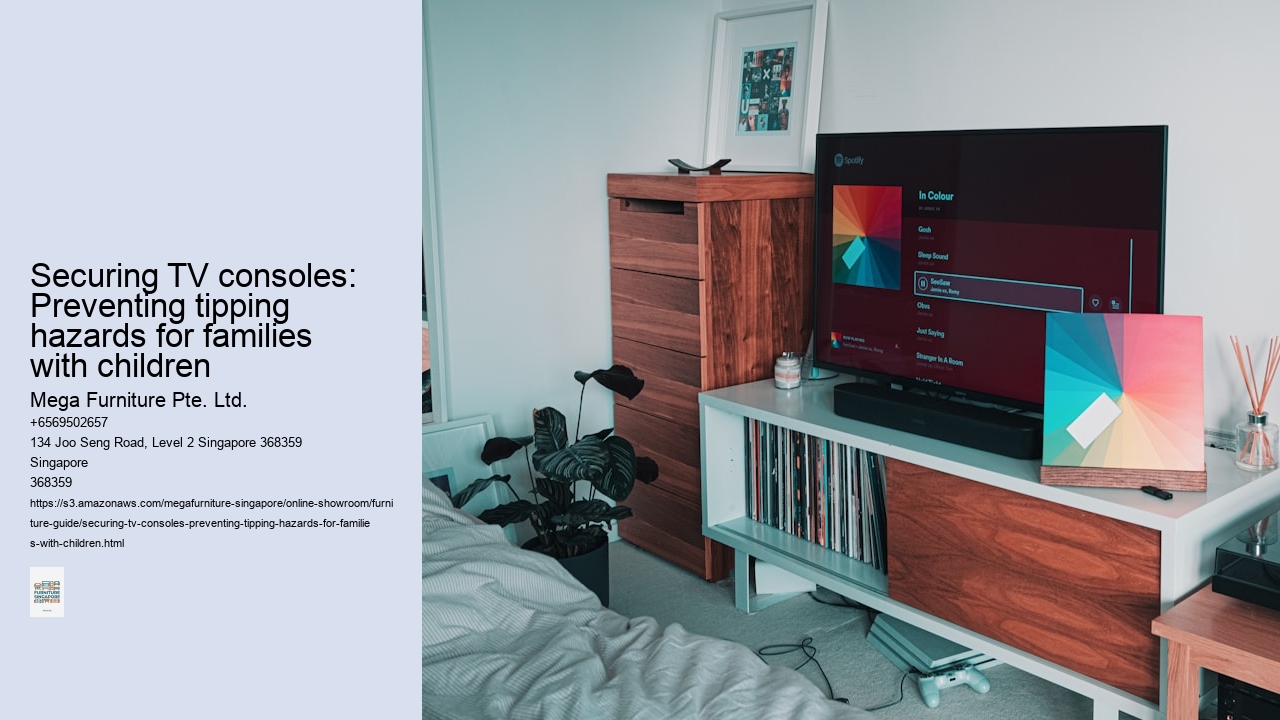
The most critical specification for families, however, is often invisible. Any floor-standing console over about 60cm tall, particularly a long 240cm model built for a 75-inch TV, becomes a top-heavy tipping hazard the moment a child uses an open drawer as a step. Anti-tip anchors, those metal brackets that secure the unit’s back rail directly to the wall stud, are non-negotiable. It’s a five-minute installation that most buyers overlook, but it’s the difference between a stable fixture and a preventable accident. Some retailers, like Megafurniture, include these kits with their taller units — it’s a small detail that shifts a piece from being just furniture to being a properly installed fixture.
Consider the floor plan, not just the console. In a narrow 4-room BTO layout where the living area flows directly into the dining space, a floor-standing unit with a low, clean profile keeps the sightlines open and reduces visual clutter. For homes with both high humidity and high activity, the material matrix narrows: you’ll want that engineered wood body, a tough laminate finish on all horizontal surfaces, and integrated cable management to keep cords from becoming a tugging temptation. It’s about matching the cabinet’s construction to the reality of your household’s rhythm, where the furniture has to endure more than just being looked at.
In a showroom, the silent slide of a drawer reveals more than a smooth action—it hints at long-term reliability. Test each drawer fully; quality glides, often metal with a dampened close, won't sag or wobble even when loaded with game controllers and remotes. Cheap plastic runners feel gritty, and they’re the first to fail under Singapore’s humidity, leaving you with a jammed storage compartment. Listen for silence and watch for alignment; a good console makes this hardware feel effortless, almost forgettable, which is precisely the point.
Forget the gentle push—you need to slam it. A proper soft-close hinge on a cabinet door should arrest a deliberately forceful swing without a sound, a critical feature for households with kids rushing for the PlayStation. Inspect the hinge’s build; it should be solid metal, not thin plated steel that will corrode in our climate. This isn't just about quiet luxury; it's about preventing door damage and frustrated repairs years down the line in your BTO flat.
Turn the unit around. That flimsy cardboard-like backing, often just 3mm thick, is a tell-tale sign of cost-cutting and offers zero structural rigidity. You want a proper 6mm or thicker fibreboard panel, securely screwed in, not just stapled. A robust back panel prevents racking, keeping the entire console square and stable against your media wall—especially important for longer, 240cm models that must stay perfectly straight.
Run your fingers along every exposed particleboard edge. Full PVC wrapping, not just a thin veneer on the front face, is non-negotiable here; it seals the core from moisture that leads to swelling and warping. Check the seams at corners and underneath shelves—any peeling or gaps mean the adhesive will likely fail. In a humid Tampines flat, that sealed edge is what stops a console from becoming a bloated, unsightly mess within a couple of seasons.
Ask to place weight on the open shelves. A quality console’s shelf, particularly the centre span of a wide model, should confidently hold a heavy soundbar like a Sonos Arc plus a series of game consoles without any discernible bowing. Press down firmly; if you see flex or hear creaking, the internal supports or material thickness are insufficient. That shelf isn't just for decor—in many homes, it's mission-critical infrastructure for your entire entertainment setup.
The floating console is the default feature wall choice for a reason — it’s clean, modern, and feels spacious. But that sleek silhouette often crashes into the reality of a concrete HDB wall. Drilling into structural concrete isn’t a simple matter of a plug and screw; it requires a proper hammer drill and concrete anchors rated for the load, a step many DIY buyers underestimate until they’re staring at a crumbled hole and a console still in its box.
Material choice is another aesthetic trap. That high-gloss, marble-look laminate might look stunning in a showroom lit by soft downlights. In a typical HDB living room with a west-facing balcony, however, it becomes a relentless glare panel every afternoon, washing out the TV screen and creating a visual nuisance. Matte or textured finishes, or even sintered stone with a softer sheen, tend to work harder in our sun-drenched flats.
Then there’s the storage miscalculation. Buyers focus on the console’s length to fit a 65-inch TV, but forget about its depth and internal organisation. Where does the Singtel TV box go, or the Wi-Fi router that can’t be buried behind solid wood? What about the board games, charging cables, or PlayStation controllers? An open shelf for decor is fine, but a console without dedicated, ventilated compartments for electronics and deep drawers for clutter simply shifts the mess elsewhere.
It’s a classic Singaporean trade-off: the desire for a minimalist statement piece versus the practical needs of a lived-in family space. The console that looks perfect in a Tampines showroom might not account for the glare in a Bedok flat or the storage demands in a 4-room BTO. Prioritising the wrong details leads to a beautiful piece that’s frustrating to live with — which, for a central living room fixture, defeats the purpose entirely.
The average 4-room BTO living room wall is a specific shade of off-white, somewhere between Dulux’s ‘Crisp Linen’ and ‘Misty Dawn’. It’s a backdrop that can make a standalone console look either lost or garish. Megafurniture’s Joo Seng and Tampines showrooms address this directly, displaying their units in full room-set contexts against these exact, typical wall colours. You’re not just seeing a piece of furniture; you’re seeing how its proportions and finish hold up under the specific ambient light of a Singaporean flat. This localised thinking extends to the materials. Their collections frequently feature humidity-resistant laminates and treated wood veneers—a non-negotiable for anyone who’s watched a cheaper MDF board swell at the edges after one too many monsoon seasons. For families in newer BTOs, where open-plan layouts mean the living room absorbs kitchen moisture, that engineered resistance is critical. It’s a practical consideration that often gets overlooked for a trending silhouette. Cable management is another quiet necessity. Many of their consoles come with built-in grommets and dedicated channels at the back, designed to swallow the inevitable tangle of a PlayStation 5, soundbar, router, and set-top box. In a typical HDB layout where the TV point is fixed, this keeps wires from snaking across the floor and becoming a tripping hazard. It’s a small detail that prevents a major headache. Modularity is the final piece. With TV sizes now routinely hitting 75 inches, a fixed 180cm console might not cut it. Their modular options let you configure the length to your specific screen, ensuring a balanced, anchored look. You can centre a massive panel without it appearing to float precariously above a cabinet that’s too short. For design-focused shoppers, this flexibility means the console can act as a genuine feature piece, scaled correctly for your wall and your
entertainment setup.
The delivery crew will arrive, and that’s when the real questions start. In a landed home or a walk-up apartment, you must verify lift access and stairwell dimensions yourself before ordering; a 240cm console in a box won’t fit a 90cm-wide staircase turn in a Joo Seng shophouse, and hoisting it through a window is a costly, unplanned spectacle. It’s a logistical detail many buyers forget until the truck is idling outside.
Self-assembly is common for flat-pack options, saving around $80 to $150, but it’s a two-person job for anything over 180cm — and you’ll need your own hex keys and a level. Paid contractor service ensures it’s done in an hour, anchored properly to your condo’s feature wall. Crucially, check if an anti-tip kit is included; some retailers bundle it, while others treat it as an optional accessory, a baffling oversight for a piece meant to hold a 75-inch screen.
Warranties here typically run one year for structural integrity. You’ll need to scrutinise the terms for finish defects, though. Singapore’s humidity can cause veneers to peel or laminates to bubble at the edges, and many warranties classify this as ‘environmental wear’ rather than a manufacturing fault. A claim might hinge on whether you kept the unit 50cm from an air-con vent or used a chemical cleaner.
That fine print matters because a cloudy white spot on a matte black sintered stone top, or warping in a rubberwood frame, becomes a permanent feature in your living room. It’s worth asking the retailer for a clarity in writing — a one-year promise means little if it only covers the screws snapping.
The most common questions about TV consoles aren't about style—they’re about the hard logistics of fitting a 2-metre unit into a 3.6-metre deep living room with a sofa already in it. Can a console fit behind my existing sofa? That depends entirely on your walkway. A standard three-seater sofa is around 90cm deep; a typical console adds another 40–50cm. In a 3.6m room, you’ll have about 2.3m left for circulation, which is tight but workable if you’re willing to sidle past. The real issue is the power point—if it’s on the wall behind the sofa, you’ll be crawling to plug things in. What’s the difference between wall-mounted and floating for a false wall? A wall-mounted unit is fixed directly to the studs or brick of your main wall, which is impossible with a false wall cavity behind it. A floating console, however, is designed with a sturdy back panel that anchors securely to the false wall’s framework; it’s the only safe option here, and it keeps that clean, suspended look buyers want. Best colour for a North-South facing HDB living room? North-facing rooms get cool, indirect light all day, so warm oak or walnut finishes can add needed warmth. South-facing spaces are bathed in strong, warm light that can wash out light colours and intensify dark ones—a mid-tone grey laminate or a white-washed oak often works as a neutraliser. How to secure a console to parquet flooring? You don’t drill into the parquet itself. Use the console’s anti-tip kit, which typically includes a metal bracket; screw one side into the solid timber rail at the console’s back, and the other side directly into your skirting board or, if you must, the concrete floor beneath the floating parquet. It’s a ten-minute job that stops a top-heavy unit from becoming a hazard. For families, it’s non-negotiable—check if the bracket is included when you
browse TV console options.
The most common regret with a new TV console isn't about colour or wood grain—it’s realising, after delivery, that the unit sits 15cm over your floor socket, or that your soundbar blocks the drawer meant for the PlayStation. That final checklist isn’t just bureaucratic; it’s what separates a seamless install from a weekend of frustration.
Confirm every dimension with a steel tape measure, not a visual estimate. Your 240cm media wall might actually be 238cm once you account for skirting boards, and that sleek 235cm console won’t forgive the difference. Bring your own AV equipment to the showroom if possible; a spec sheet saying a drawer fits a Skyworth soundbar is meaningless if you need to wrangle cables for a Sonos Arc and an Xbox Series X. Test the operation yourself—open every door, slide every drawer while your gear is inside, because that smooth glide under a demo remote can become a stubborn scrape under the weight of your own AV receiver.
Plan the cable route from the back of the console to the nearest power point before the unit is positioned. In many BTO living rooms, the only socket is near the floor, which means you’ll need to decide whether to drill a pass-through hole in the cabinet back, use a cable management raceway up the wall, or accept a visible cord snaking across the skirting. This decision dictates whether you’ll need a floating console or a floor-standing one with a raised back panel.
Finally, decide on placement relative to your room’s existing axis. Centring the console on the main wall creates a formal, intentional media focal point, which works in open-plan condos. Aligning it with an existing furniture run—say, extending the line of your three-seater sofa or a built-in display shelf—often feels more organically integrated in a furnished HDB living room. That choice affects everything from how you run lighting to where you’ll later place a floor lamp.
The blank wall in a standard 4-room BTO flat is almost always 4 metres - a length that looks generous until you account for the switch box, aircon trunking, and a window mullion. That's why a 180cm console feels like the natural fit; it leaves room for a side table or a plant pot, and it neatly centres beneath a 55-inch screen. In a condo with a longer media wall, you can stretch to 210cm or even 240cm, which accommodates a 75-inch television and creates that coveted, uninterrupted horizontal line. Landed property spans, of course, allow for the full 240cm units - the kind that become the room's architectural anchor.
Measuring your actual wall is the non-negotiable first step. You'll need to mark the exact positions of electrical outlets, data points, and any protruding trunking; a console that's designed to sit flush against the wall can't ignore these obstructions. Many buyers forget to factor in the depth of their TV's stand or wall-mount bracket, which can push the screen forward and create an awkward gap. A TV console anchors the wall opposite the sofa in the same way a tall bookshelf anchors a corner — long horizontal piece, mix of open and closed storage, defines the visual weight of one whole side of the room. Megafurniture's TV Console range covers floating wall-mounted designs, low-profile freestanding consoles, and modular feature-wall configurations. Most pieces sit at 40-50cm height, sized for screens up to 75 inches.. The goal is a seamless base that appears to support the television visually, even if it's mounted separately.
Proportion matters more than absolute size. A 120cm console beneath a 65-inch TV in a narrow HDB living room looks unbalanced - the screen dominates, and the cabinet seems like an afterthought. Conversely, a 240cm console in a compact space overwhelms the room and leaves no space for other furniture. The rule of thumb is simple: the console should be at least as long as the TV's width, and ideally a bit longer, to provide a stable, grounded appearance. That visual weight is what prevents the setup from looking precarious.
Material choices follow from the room's function. In a family living room with young children, a sintered stone top or a laminated finish withstands spills and scratches better than untreated wood. Open shelving is useful for display, but enclosed cabinets with soft-close doors are safer for storing remotes and game consoles away from curious hands. The console's internal layout should organise cables and devices, not just hide them; a dedicated compartment for the router, with ventilation, is a small detail that pays off daily.
For those working with a standard 4m BTO wall, the selection often narrows to units around 180cm - a size that balances storage capacity with spatial harmony. You can browse a range of these proportionally considered options, from floating designs to solid floor-standing cabinets, at Megafurniture's collection. The key is to treat the console as a measured response to your room's fixed dimensions, not as a standalone piece you hope will somehow fit.
The blank wall in a standard 4-room BTO flat is almost always 4 metres — a length that looks generous until you account for the switch box, aircon trunking, and a window mullion. That’s why a 180cm console feels like the natural fit; it leaves room for a side table or a plant pot, and it neatly centres beneath a 55-inch screen. In a condo with a longer media wall, you can stretch to 210cm or even 240cm, which accommodates a 75-inch television and creates that coveted, uninterrupted horizontal line. Landed property spans, of course, allow for the full 240cm units — the kind that become the room’s architectural anchor.
Measuring your actual wall is the non-negotiable first step. You’ll need to mark the exact positions of electrical outlets, data points, and any protruding trunking; a console that’s designed to sit flush against the wall can’t ignore these obstructions. Many buyers forget to factor in the depth of their TV’s stand or wall-mount bracket, which can push the screen forward and create an awkward gap. The goal is a seamless base that appears to support the television visually, even if it’s mounted separately.
Proportion matters more than absolute size. A 120cm console beneath a 65-inch TV in a narrow HDB living room looks unbalanced — the screen dominates, and the cabinet seems like an afterthought. Conversely, a 240cm console in a compact space overwhelms the room and leaves no space for other furniture. The rule of thumb is simple: the console should be at least as long as the TV’s width, and ideally a bit longer, to provide a stable, grounded appearance. That visual weight is what prevents the setup from looking precarious.
Material choices follow from the room’s function. In a family living room with young children, a sintered stone top or a laminated finish withstands spills and scratches better than untreated wood. Open shelving is useful for display, but enclosed cabinets with soft-close doors are safer for storing remotes and game consoles away from curious hands. The console’s internal layout should organise cables and devices, not just hide them; a dedicated compartment for the router, with ventilation, is a small detail that pays off daily.
For those working with a standard 4m BTO wall, the selection often narrows to units around 180cm — a size that balances storage capacity with spatial harmony. You can browse a range of these proportionally considered options, from floating designs to solid floor-standing cabinets, at Megafurniture’s collection. The key is to treat the console as a measured response to your room’s fixed dimensions, not as a standalone piece you hope will somehow fit.