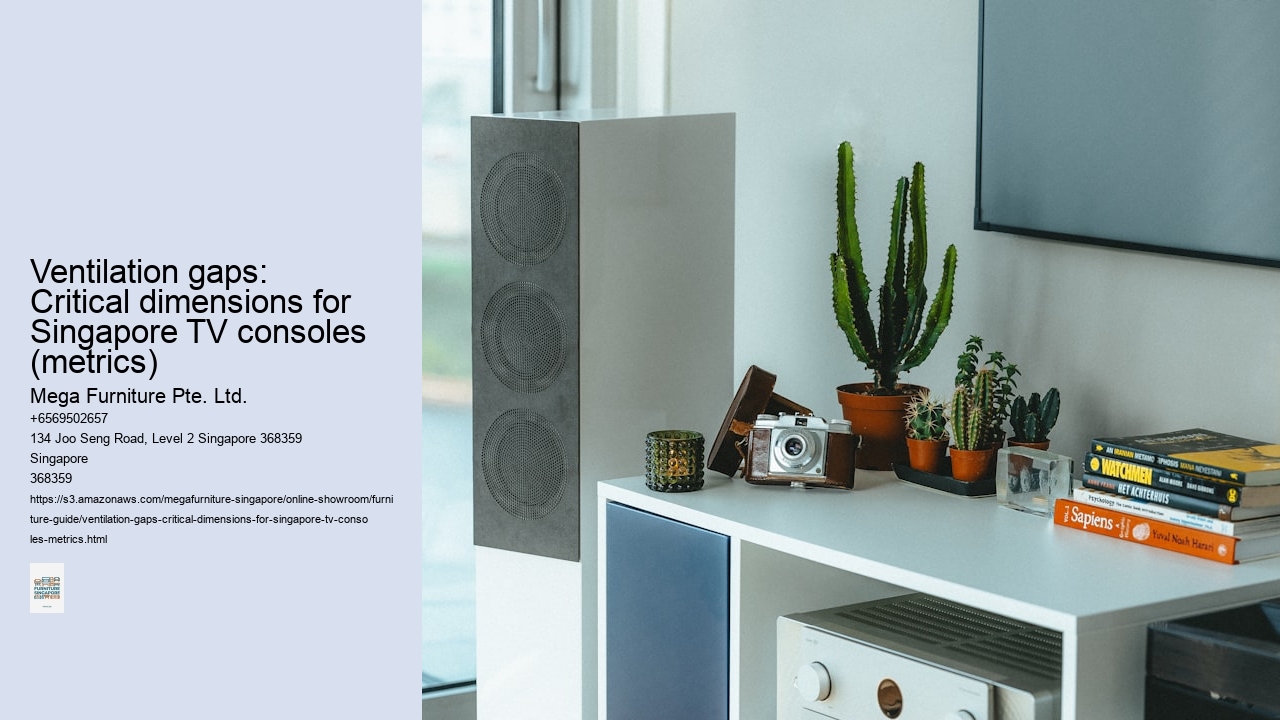
That 65-inch TV looks like it’s about to tip forward off its stand — a common sight in a new BTO living room, where the console is too short for the screen. It’s a top-heavy visual that throws the whole wall off balance, and it’s easily avoided with a simple rule of proportion.
For a 65-inch panel, which measures roughly 145cm wide, your console length should exceed that screen width. Aim for a unit between 180cm and 200cm. The extra 35cm or more on either side isn’t just aesthetic; it creates practical ledges for bookshelf speakers, a small sculpture, or a trailing pothos plant. More critically, that extended length usually correlates with better depth — consoles in this size range often have a 45cm to as much as xxxcm front-to-back measurement, which is essential for managing the heat output of modern AV equipment.
Singapore’s living rooms, particularly in 4-room BTOs, often have a wall just over 3 metres wide. A 200cm console leaves a comfortable 50cm buffer on each side for floor lamps or planters, preventing the media wall from feeling crammed. It’s a deliberate choice that organises the room around a single, grounded focal point, rather than a floating black rectangle.
Beyond looks, that extra real estate underneath is where ventilation becomes non-negotiable. A longer console typically provides more interior cabinet volume and, if designed well, more strategic gaps at the back or along the sides. You’ll need that space for the PlayStation, the AV receiver, and the set-top box — none of which should be stacked or shoved into a cramped, sealed cavity. The goal is a clean, proportional line that also lets your electronics breathe.
Pushing a console tight against the wall for that seamless, built-in look is a common impulse in Singapore's compact living rooms. It's a mistake that immediately compromises the rear ventilation gaps specified by manufacturers for devices like AV receivers and PlayStation 5s. That hot, stagnant air has nowhere to go but back into the components, silently degrading their performance and lifespan. In a humid climate, this trapped heat accelerates internal corrosion far faster than in drier environments. You'll often see the tell-tale signs first in random system shutdowns during a movie's climax or a gaming marathon.
Cable management is a virtue until it becomes a vice, and stuffing every power brick and HDMI lead directly behind the unit is a classic error. Those tangled nests physically obstruct the intake and exhaust vents on your equipment, which are often located on the rear panel. It's like trying to breathe through a thick blanket; the fans spin harder, generating more noise and drawing in dust from the room. This specific act of blocking vents is frequently cited in warranty voidance clauses, leaving you with a costly repair for a $1,200 AVR. A simple cable channel or sleeve routed to the side can make all the difference.
Many condo owners select a wall-mounted, floating TV console believing it solves the clearance issue entirely. The visual gap beneath the unit creates a false sense of airflow, but the critical rear gap remains unchanged. High-performance consoles and amplifiers exhaust heat backwards, not downwards, so that sleek silhouette offers no real thermal benefit. In fact, mounting it incorrectly on drywall without proper studs introduces a whole separate risk of collapse. The design addresses dusting and floor space, not the operational needs of the electronics it's meant to house.
Overheating doesn't just fry a circuit board; it burns through your consumer protections. Manufacturers' warranty stickers are often placed over internal screws or near thermal sensors designed to log operating temperatures. Persistent over-temperature events leave a digital fingerprint that service centres can easily retrieve, proving improper installation. That legitimate claim for a faulty HDMI port on your new Xbox Series X gets denied outright, with a technician's report citing "environmental damage." It's a frustrating, entirely avoidable outcome that turns a free repair into a $500 replacement.
The problem compounds in a closed media wall setup, where a flush console sits within an alcove or between built-in shelves. Heat from multiple devices—a router, a soundbar, a gaming console—builds into a collective thermal mass that no single component's fan can dissipate. You get a localised microclimate in your Tampines living room that consistently runs 10 to 15 degrees Celsius above ambient temperature. This sustained stress makes capacitors brittle and can lead to total failure during Singapore's hottest months, when general room temperature is already elevated. The solution isn't more air-conditioning, but intentional space planning behind the cabinet.
The laminate on a TV console’s top panel isn’t just about colour or finish—it’s the first defence against the relentless humidity in a Bedok flat. Moisture-resistant certification, often a small stamp or code on the spec sheet, is what separates a surface that warps after one rainy season from one that stays flat for years. You’ll want that assurance, especially for a console holding expensive electronics; condensation from a chilled room meeting warm, moist air is a constant, silent threat.
Examine the drawer construction, too. Dovetail joints, where interlocking “tails” and “pins” fit together like puzzle pieces, are a clear signal of longevity. They’re mechanically stronger than stapled or glued butt joints, resisting the racking force of a drawer packed with game controllers and remote controls. In many local homes, that drawer gets opened dozens of times a week—cheap joinery simply won’t hold up.
Weight is the final, often overlooked, quality check. A surprisingly heavy unit for its size typically indicates solid core panels or thicker material, not hollow construction. This is critical for wall-mounted or floating consoles, which must bear the load of a 65-inch TV and all its peripherals without sagging. A hollow panel might save on shipping costs, but it’ll flex and creak under that weight, feeling insubstantial the moment you try to lift it.
For a long, low console spanning 180cm or more, that structural integrity is non-negotiable. It’s the difference between a piece that feels like a foundational part of your media wall and one that feels like a temporary prop. You can assess it in a showroom with a simple test: apply firm pressure to the centre of a shelf or the top surface—significant flex suggests corners were cut.
Given these parameters, a shopper’s best move is to physically inspect the options, looking for these tangible signs. It turns a confusing array of similar-looking consoles into a clearer decision based on substance, not just style.
A spec sheet’s 15cm rear clearance can shrink to 10cm once you account for a chunky plug head and a wall that isn’t perfectly straight—that’s the kind of reality you measure for in a showroom. At Megafurniture’s Joo Seng or Tampines locations, you can push a console flush against a mock wall and slide a hand behind it; if you can’t comfortably fit a fist sideways for cable routing, you’ll be wrestling with connections every time you need to switch out a gaming console. Bring a tape measure, but also bring the approximate dimensions of your own media stack—a typical AV receiver is deeper than a PlayStation 5, and that’s what dictates the true functional gap. Test the drawers with actual weight. A showroom unit might glide empty, but load it with a hard drive, a stack of Blu-rays, and a soundbar’s remote, and you’ll hear the tell-tale scrape of a thin side-rail under strain. The best test is to open a fully-loaded drawer with one hand while applying slight downward pressure; if it still moves smoothly, it’ll likely hold up in a family living room. You’re looking for full-extension glides with a solid stop, not the partial rollout that leaves items at the back perpetually out of reach. Showroom lighting is notoriously flattering, so make a point of wheeling a unit near a window or into a corner shadow. That warm oak laminate you loved under spotlights can turn stark and orange against the muted, green-tinged beige of a BTO feature wall, while a grey-washed finish might look dingy next to Resale Silver’s cooler tones. It’s worth taking a photo with your phone’s flash off to see how the finish reads in a more neutral light—the difference between a cohesive centrepiece and a piece that constantly fights its surroundings. Finally, assess the overall fit for your space. A 240cm console looks majestic in a warehouse showroom, but in a 4-room BTO living room with a 65-inch TV centred on it, the proportions can overwhelm. You want enough surface to anchor the TV without the unit appearing to float on a narrow wall. For most local setups, a 180cm to 210cm length hits the sweet spot, offering ample storage without dominating the room. You can browse the full range of sizes and configurations at Megafurniture’s
TV console collectionto compare in person. The real test is visualising your own clutter inside it. If you can’t picture where the router, the spare cables, and the board game boxes will go, that sleek showroom piece might just become a very expensive dust collector.
A console longer than 200cm might not fit into your HDB’s lift. It’s a common oversight, particularly in older blocks around Toa Payoh or Bedok where lift cabins can be narrower than those in newer BTOs; you’ll need to confirm the diagonal clearance, not just the width, before committing to a purchase. Many buyers discover, too late, that their 240cm solid wood unit requires a staircase carry from the void deck — a costly, sweaty affair that delivery crews typically charge extra for. Measure your lift’s interior, then add 15cm to the console’s longest dimension to be safe.
Professional assembly isn’t just about screwing legs on. BTO floors, especially in estates like Punggol or Sengkang, are notorious for having subtle slopes and uneven patches that can throw a long console out of level. A seasoned installer will use shims and a laser level to stabilise the unit, ensuring drawers slide smoothly and doors don’t sag — a DIY attempt here often results in a persistent wobble that rattles your soundbar.
The standard three-year warranty should cover more than just a peeling laminate edge. Scrutinise the terms to confirm it includes structural integrity: the joinery of the cabinet’s frame, the stability of floating wall mounts, and the mechanisms of soft-close hinges. A warranty that only addresses surface defects is of little use when the real test is years of humidity and the weight of a 75-inch TV.
For peace of mind, look for a guarantee that explicitly mentions load-bearing components and offers in-home service calls. That’s far more valuable than a simple promise to replace a scratched panel.
The most common living room mistakes in Singapore aren't about style—they're about heat and humidity. A router tucked neatly behind a console door might look tidy, but it’s a sure way to throttle your internet speed; that heat needs to escape, or you’ll face constant signal drops during your evening stream. Similarly, a solid wood console in an unrenovated, high-humidity resale flat can warp within a single monsoon season, leaving drawers that won’t close and a surface that’s no longer level.
Can my TV console be shorter than my TV? Only if you’re using a wall-mounted bracket that lets the TV overhang the cabinet cleanly—otherwise, the proportions look unbalanced, and you risk the set appearing precariously perched. For a 65-inch TV on a stand, you’ll want a console at least 180cm long to create a stable visual base and accommodate your soundbar or media players.
What’s the best material if I have pets? Laminates are your friend. They resist scratches from claws far better than wood veneers or lacquered finishes, and a quick wipe cleans up most spills or paw prints. Performance laminates with textured woodgrains can even mimic the look of real oak or walnut without the vulnerability, a practical choice for a household with active cats or a young dog.
The goal is to organise the chaos of cables and devices without cooking your electronics. That means prioritising models with open backs, built-in cable management ports, and, for enclosed sections, ventilation grilles or gaps at the rear. For a curated selection that considers these practical needs, you can browse Megafurniture’s collection of TV consoles, which includes wall-mounted and floating options suited to our climate. It’s about finding that centrepiece that works as hard as it looks.
The console fits perfectly against the wall, but the wall socket behind it becomes unreachable — a common oversight in 4-room BTO layouts where power points are often placed low and central. Buyer wants storage, not a tangle of extension cords snaking out from the sides. So, measure your wall space with a tape, marking the exact length you can commit while excluding any existing sockets or switches; that clean, uninterrupted span is what you're shopping for.
Rear clearance often gets overlooked until the unit arrives. AV receivers and game consoles vent heat backwards, and in Singapore's humid climate, that trapped warmth can shorten component life. You'll need at least 5cm of gap between the console's back panel and the wall, more if you're packing an older, bulkier amplifier. A floating console design can help here, but even floor-standing models should be pulled forward slightly — it's a compromise between aesthetics and function.
Inside, shelf height is critical. The tallest component you'll own is typically an AV receiver, around 17cm high, but some gaming PCs or centre-channel speakers push 20cm. Check the interior specifications of any console you're considering; many designs prioritise shallow drawers over deep shelves, which forces you to leave that receiver sitting openly on top, cluttering the clean line you wanted. It's a trade-off between concealed storage and practical accommodation.
Before you confirm any order, mentally walk the delivery route from the lorry bay to your lift lobby. That 240cm console might fit in your living room, but can it navigate the tight turn into your Eunos HDB block's lift? Contractors will often charge extra for complex manoeuvres or staircase carries. A final, practical measurement isn't on the tape — it's the path from the truck to your front door.
That new solid-core door in your BTO flat swelled shut after a single monsoon season - that's particle board for you. It's the same material used in the back panels and internal shelves of countless TV consoles, and in Singapore's climate, it behaves like a sponge. At 80% humidity, engineered wood absorbs moisture from the air, expanding, warping, and creating a perfect, dark environment for mould behind your expensive electronics.
The problem compounds with heat. A media console packed with an AV receiver, game console, and set-top box traps exhaust heat; in a confined 4-room BTO living room, that heat soaks back into the cabinet and the wall. Without a significant rear clearance - a deliberate air gap between the console back and your wall - you're essentially slow-cooking the particle board while it's damp. The result is predictable: a warped back panel that pushes the whole unit forward, or worse, a musty smell that signals mould creeping into your living room.
This is why that 5–10cm rear clearance isn't just a designer's suggestion - it's a material necessity. A TV console anchors the wall opposite the sofa in the same way a tall bookshelf anchors a corner — long horizontal piece, mix of open and closed storage, defines the visual weight of one whole side of the room. Megafurniture's TV Console range covers floating wall-mounted designs, low-profile freestanding consoles, and modular feature-wall configurations. Most pieces sit at 40-50cm height, sized for screens up to 75 inches.. It allows ambient air to circulate, carrying away both the moisture that the board absorbs and the heat that your gear generates. For a 180cm console under a 65-inch TV, that gap is your primary defence. It protects the cabinet's structure and, more critically, prevents your electronics from overheating in their own confined space, which can shorten lifespans significantly.
When you're browsing options, you'll notice many modern, wall-mounted or floating designs inherently provide this gap. Study Table . For floor-standing units, you'll need to commit to pulling it away from the wall, which changes the room's sight lines. It's a worthwhile trade. A console shoved flush against the wall in a humid neighbourhood like Bedok or Pasir Ris is a gamble on how quickly the materials will fail.
Choosing a console made with more stable materials, like rubberwood or with a full plywood carcass, mitigates the core issue. Even then, that ventilation gap remains non-negotiable for heat dissipation. It's the single easiest way to future-proof your setup against Singapore's two relentless forces: moisture and heat.
That new solid-core door in your BTO flat swelled shut after a single monsoon season — that’s particle board for you. It’s the same material used in the back panels and internal shelves of countless TV consoles, and in Singapore’s climate, it behaves like a sponge. At 80% humidity, engineered wood absorbs moisture from the air, expanding, warping, and creating a perfect, dark environment for mould behind your expensive electronics.
The problem compounds with heat. A media console packed with an AV receiver, game console, and set-top box traps exhaust heat; in a confined 4-room BTO living room, that heat soaks back into the cabinet and the wall. Without a significant rear clearance — a deliberate air gap between the console back and your wall — you’re essentially slow-cooking the particle board while it’s damp. The result is predictable: a warped back panel that pushes the whole unit forward, or worse, a musty smell that signals mould creeping into your living room.
This is why that 5–10cm rear clearance isn’t just a designer’s suggestion — it’s a material necessity. It allows ambient air to circulate, carrying away both the moisture that the board absorbs and the heat that your gear generates. For a 180cm console under a 65-inch TV, that gap is your primary defence. It protects the cabinet’s structure and, more critically, prevents your electronics from overheating in their own confined space, which can shorten lifespans significantly.
When you’re browsing options, you’ll notice many modern, wall-mounted or floating designs inherently provide this gap. For floor-standing units, you’ll need to commit to pulling it away from the wall, which changes the room’s sight lines. It’s a worthwhile trade. A console shoved flush against the wall in a humid neighbourhood like Bedok or Pasir Ris is a gamble on how quickly the materials will fail.
Choosing a console made with more stable materials, like rubberwood or with a full plywood carcass, mitigates the core issue. Even then, that ventilation gap remains non-negotiable for heat dissipation. It’s the single easiest way to future-proof your setup against Singapore’s two relentless forces: moisture and heat.