 |
You.i Engine
|


|
|
You.i Engine
|
|
The asset system consists of a flexible set of classes that provide functionality for assets to be loaded and managed by applications.
Asset objects represent different types of data that can used in an application. Some asset types have hardware counterparts and may have particular hardware requirements that must be satisfied before they can be used, while others can be manipulated by the application directly after they have been created. There are other types that represent particular assets used by You.i Engine and cannot be loaded or unloaded.
There are several CYIAsset types available for applications to use:
| Asset | Description | Supported Extensions | Hardware Dependent |
|---|---|---|---|
| CYIAssetBif | Decoded BIF archive which is used to encapsulate a set of still images, or thumbs, that can be used by video playback components or for supporting trick play modes in conjunction with fast-forward or rewind operations. | .bif | No |
| CYIAssetBufferObjectData | Buffered object content that wraps shared index or vertex buffer object data. | N/A | No |
| CYIAssetFramebuffer | Frame-buffer asset used in off-screen rendering. | N/A | Yes |
| CYIAssetJSON | An asset which contains a JSON document.
| N/A | Yes |
| CYIAssetShaderObject | Shader data for vertex or fragment shaders. | .vert .frag | No |
| CYIAssetShaderProgram | A series of CYIAssetShaderObjects that constitute a shader program. | N/A | Yes |
| CYIAssetSound | Contains raw PCM sound data used to play CYISoundInstance in the CYIAudioEngine. | .wav .wave | No |
| CYIAssetTexture | An asset with internal CYIBitmap and IYIGPUObject objects representing image content. | .png .jpg .jpeg .9.png .webp .gif .tga | Yes |
| CYIAssetTextureRaw | An asset that contains only raw pixel data instead of relying on CYIBitmap, and IYIGPUObject objects representing image content on the GPU. | N/A | Yes |
| CYIAssetTextureFramebuffer | An asset containing a frame-buffer, rendered as a texture, used in off-screen rendering. | N/A | Yes |
| CYIAssetTimelineSource | An asset with a CYITimelineBackingStore object which is used for rendering After Effects based animations or other timeline based operations. | .timeline | No |
| CYIAssetTranslation | Contains a CYITranslator object for processing language translations. | .po | No |
| CYIAssetViewTemplate | Contains a CYIViewTemplate object for rendering After Effects based scenes. | .layout | No |
Textures are one of the most common asset types in a project and are an integral part to any You.i Engine application. Essentially, there are two parts to every texture asset: CYIBitmap and IYIGPUObject. A bitmap contains the raw data for an image and can be modified directly by an application developer. An IYIGPUObject is an interface representing content that can be consumed by 3D rendering hardware.
In many applications, once the bitmap has been loaded and the texture has been made available to the graphics processing unit (GPU), the bitmap can be deleted. This can be done easily by unloading it (see the CYIAsset and CYIAssetTexture classes for more information about loading and unloading). Once unloaded, the memory used by the bitmap will have been reclaimed by the system but the texture will still be available. In some rarer cases, the texture may need to be unloaded instead of the bitmap. For example, in situations where load times are critical but it becomes too expensive to keep both the bitmap and the texture in memory at the same time, the hardware version can be unloaded while retaining the bitmap (see the CYIAssetHardware class for more information about requesting deletion of the GPU asset).
Before any asset can be loaded it must be located via the CYIAssetLocator. The locator's job is to find the appropriate asset to load based on the locator's configuration. The asset locator uses configuration objects to filter out content based on screen dimensions, locale, or other custom attributes.
After configuring the locator, the asset can be loaded using the CYIAssetLoader and can be loaded synchronously or asynchronously. Loading assets usually involves decoding the file format and can be a significant performance consideration. To alleviate this problem, asychronous loading can be used to offload the decoding onto another thread.
The following is an example of how to load an asset synchronously with the CYIAssetLoader:
Using asynchronous asset loading is a bit more work since it requires the CYIAssetLoader::DecodeListener interface to be implemented:
Asset objects are typically created by the CYIAssetLoader, which are then used to render a scene, and are subsequently discarded when screens are unloaded (see Screen Management for more details around screen lifecycle behavior).
It's easy for application developers to manage the resources their assets consume. All assets within You.i Engine are reference counted if they are wrapped using a smart pointer, such as std::shared_ptr. They are wrapped automatically if the asset was loaded via the CYIAssetLoader or through the one of the asset factory classes like CYITextureFactory. Reference counting is a means to determine when an object is no longer being used or referenced elsewhere in the application. If the reference count for an asset falls to zero, the resources associated with the asset would be automatically reclaimed since the CYIAsset instance would be deleted.
Assets exist in memory and consume resources for as long as their associated asset object exists. In some cases, the lifetime of those asset objects are tied to other data structures, such as a scene tree. In other scenarios, it may be desirable to employ specialized caching techniques so that they can be retrieved more quickly thus improving the runtime performance of your application in key areas.
Allowing You.i Engine to delete the objects automatically may not be the best solution for every scenario when developing an application, there are other things to consider, such as performance and network bandwidth consumption. As always, those requirements must be balanced against available memory and storage for each platform.
The CYIAssetManager can be used to share assets more easily between components in a decoupled way. It is a weak cache that does not contribute to the reference count of the assets.
When an asset is loaded, the content of the file is usually passed through a CYIAssetDecoder. The role of a decoder is to process the content of a file and produce an asset object. If an application requires support for a file format not supported by You.i Engine, custom decoders can be written.
For example, to add support for a new image format, sub-class the CYIAssetDecoderImage type and implement a new CYIImageDecoder:
In this example the asset type is supported (CYIAssetTexture) but the BMP file format is not. Sometimes it is necessary to support a completely custom asset, this is covered in the following section.
If an application requires an asset type not supported by You.i Engine, a custom asset type can be created. The following steps show how to do this.
Create a CYIAsset subclass
This class must contain any data required to represent the custom asset, in whatever format makes the most sense. An RTTI definitions is required as the following steps will rely on it.
Create a decoder
The decoder must parse the asset file and optionally decode the asset from a data stream. The decoder is also responsible for populating an instance of the CYIAsset subclass created in step 1.
Register the decoder with the CYIAssetLoader
The CYIAssetLoader will automatically determine the correct CYIAssetDecoder to use when loading an asset.
Associate the custom CYIAsset with an asset type directory
The CYIAssetLocator will be able to automatically construct a path after the custom asset is associated with a directory.
Assets can be remotely hosted on servers to be later downloaded and used by applications at runtime. A manifest is generated, which contains a representation of the folder/file structure for the remote assets. The generated manifest and remote assets folder are both uploaded to the server, which can be downloaded and used by the application.
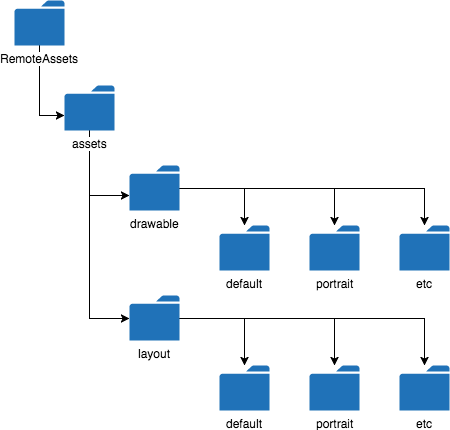
Manifests can be generated by making use of the generate_manifest.rb ruby script located under tools/workflow in the You.i Engine SDK package. It will take a relative path to a specified folder as an argument and generate a manifest in that folder, which will contain information about the folder structure and the assets of that folder. This manifest and the specified folder should be uploaded together and placed in the same directory on the server.
For example - using the folder structure above - the specified folder is RemoteAssets. A manifest will be generated inside of the RemoteAssets. The assets folder and manifest should be uploaded to the server together to the same location, or RemoteAssets should be uploaded.
The manifest can be downloaded and used in an application as follows:
The assets and the manifest can also be downloaded separately as follows:
Classes | |
| class | CYIAbstractAssetConfiguration |
| Represents a set of qualifiers and rules for resolving paths to assets, used in conjunction with CYIAssetLocator. More... | |
| class | CYIAsset |
| Base class for any asset. An asset provides functions for dynamically loading and unloading itself and is used by other classes to help manage device resource consumption. A loaded asset can be created by loading an asset file or by programmtically constructing one at run time. Once loaded, an asset occupies memory and should be unloaded whenever possible based on the resource strategy used by your application. Unloading an asset frees the memory associated with the underlying object, such as a CYIBitmap which is associated with an CYIAssetTexture, but does not remove the asset from the CYIAssetManager if it is being managed. More... | |
| class | CYIAssetBif |
| Asset representing BIF files. More... | |
| class | CYIAssetBufferObjectData |
| As asset container which wraps shared index or vertex buffer object data. More... | |
| class | CYIAssetCacheStrategy |
| Base class for an asset caching strategy. Specializations of this class could apply one of more algorithms based on the information provided through the CYIAsset interface. For example, an algorithm could be created so that the combined resource consumption for managed assets do not exceed a maximum value. More... | |
| class | CYIAssetConfigurationDataSource |
| Represents a data source for asset configuration. More... | |
| class | CYIAssetDecoder |
| Base class for all specialized decoders. More... | |
| class | CYIAssetDecoderBif |
| Asset decoder for view templates from After Effects; these typically have a ".layout" file extension. More... | |
| class | CYIAssetDecoderGIF |
| Asset decoder for GIF image files. More... | |
| class | CYIAssetDecoderImage |
| Base class for all specialized raster image decoders. More... | |
| class | CYIAssetDecoderJPG |
| Asset decoder for JPEG image files. More... | |
| class | CYIAssetDecoderJSON |
| Parses/decodes JSON data. More... | |
| class | CYIAssetDecoderPNG |
| Asset decoder for PNG image files. More... | |
| class | CYIAssetDecoderScript |
| Decodes a script source file. More... | |
| class | CYIAssetDecoderShaderObject |
| Asset decoder for shader objects; these do not have a file format at present, so this class is purely a container. More... | |
| class | CYIAssetDecoderSTU |
| Asset decoder for STU files. More... | |
| class | CYIAssetDecoderTemplate |
| Asset decoder for view templates from After Effects; these typically have a ".layout" file extension. More... | |
| class | CYIAssetDecoderTGA |
| Asset decoder for TGA image files. More... | |
| class | CYIAssetDecoderTimelineSource |
| Asset decoder for timeline sources from After Effects; these typically have a ".timeline" file extension. More... | |
| class | CYIAssetDecoderTranslation |
| Decodes an ".mo" binary translation file. More... | |
| class | CYIAssetDecoderVideo |
| Asset decoder for video files. More... | |
| class | CYIAssetDecoderWAV |
| Asset decoder for WAVE sound files; these typically have a ".wav" file extension. More... | |
| class | CYIAssetDecoderWEBP |
| Asset decoder for WEBP image files. More... | |
| class | CYIAssetFramebuffer |
| Wraps CYIAssetBuffers and their hardware counterparts, and an internally managed FBO. More... | |
| class | CYIAssetHardware |
| Hardware-mirrored asset. These assets contain IYIGPUObject counterparts. More... | |
| class | CYIAssetJSON |
| Represents the contents of a JSON file or string. More... | |
| class | CYIAssetLoader |
| The asset loader provides an interface for loading asset objects, which in turn wrap resource objects like bitmaps, shaders, etc. More... | |
| class | CYIAssetLoadParams |
| Base class for decoders which can accept specialized parameter objects. More... | |
| class | CYIAssetLocator |
| Using a base file path, determines the path to an asset given a file name and an asset type. More... | |
| class | CYIAssetManager |
| This class provides a cache that users can use to store various types of assets. More... | |
| class | CYIAssetManifest |
| Stores information for the asset manifest. More... | |
| class | CYIAssetScript |
| Represents the contents of a script source file. More... | |
| class | CYIAssetShaderObject |
| Shader object asset. Can either be loaded from a precompiled binary, or loaded as source and compiled at run-time. More... | |
| class | CYIAssetShaderProgram |
| Shader program asset. Contains a vector of CYIAssetShaderObject types. More... | |
| class | CYIAssetSound |
| Asset representing sound PCM data. More... | |
| class | CYIAssetTexture |
| A texture asset representing an image which will be loaded into the GPU. More... | |
| class | CYIAssetTextureBase |
| This asset represents the base class for POT (Power Of Two) and NPOT (Non-Power Of Two) textures. More... | |
| class | CYIAssetTextureFramebuffer |
| A texture frame buffer representing an image in the GPU that can be drawn to. More... | |
| class | CYIAssetTextureRaw |
| A texture asset representing an image which will be loaded into the GPU. More... | |
| class | CYIAssetTimelineSource |
| TimelineSource asset. Wrapper around a CYITimelineBackingStore. More... | |
| class | CYIAssetTranslation |
| An asset container which holds a shared translator that refers to a specific localisation resource. More... | |
| class | CYIAssetVideo |
| Asset representing a video. More... | |
| class | CYIAssetViewTemplate |
| ViewTemplate asset. Wrapper around a CYIViewTemplate. More... | |
| class | CYIBif |
| Encapulates and provides services for getting the data in BIF (Base Index Frames) file archives. More... | |
| class | CYIImageAssetLoadParams |
| Asset loading parameters which are specific to image asset decoding. More... | |
| struct | _YI_DECODER_BITMAP_PARAMS |
| General container for passing parameters to an image decoder. More... | |
| class | CYIImageDecoder |
| Raster image decoder base class; all raster image decoders should sub-type this class. More... | |
| class | CYIImageDecoderGIF |
| Image decoder for the GIF file format. Animated images are not supported at this time. More... | |
| class | CYIImageDecoderJPG |
| Image decoder for the JPEG file format. More... | |
| class | CYIImageDecoderPNG |
| Image decoder for the PNG file format. More... | |
| class | CYIImageDecoderSTU |
| Image decoder for the STU file format. More... | |
| class | CYIImageDecoderTGA |
| Image decoder for the TGA file format. More... | |
| class | CYIImageDecoderWEBP |
| class | CYIRemoteAssetCatalog |
| An asset representing remote asset catalogs. More... | |
| class | CYIShaderObjectAssetLoadParams |
| Asset loading parameters which are specific to shader object asset decoding. More... | |
Typedefs | |
| typedef struct _YI_DECODER_BITMAP_PARAMS | YI_DECODER_BITMAP_PARAMS |
| General container for passing parameters to an image decoder. More... | |
| typedef struct _YI_DECODER_BITMAP_PARAMS YI_DECODER_BITMAP_PARAMS |
General container for passing parameters to an image decoder.
 1.8.11