


Page 223 - TransportationPlanUsetsGuide
P. 223
Transportation Project Development
            Capital Project Priorities
            The goals, objectives and strategies of the TSP establish funding priorities. These priorities reflect a balance of impor-
            tant criteria to be considered when selecting projects for funding. Each funding program has different rules, criteria,
            and/or criteria weighting, which may change over time. Changes to the funding program rules and criteria are gener-
            ally established through an independent process and are not directly linked to the County’s TSP. Prioritizing proposed
            projects to meet the different goals of the TSP must be based on the specific situations being addressed. Therefore, the
            TSP must be flexible enough to respond to the rules and criteria established by the various funding programs. Identify-
            ing how a particular project may score against the established rules and criteria of each funding program is critical in
            determining which funding sources would be most appropriate for individual projects and in applying for funds from
            different programs. In many cases, it is important to demonstrate within the funding application how a particular project
            is consistent with the goals of the TSP, while meeting the specific requirements of the funding source.

            The TSP identifies the need, mode, function, and general location of transportation system improvements, but does not
            establish specific project priorities. The Oregon Transportation Planning Rule (TPR) requires that transportation plan-
            ning be divided into two phases: Transportation System Planning and Transportation Project Development. Transporta-
            tion System Planning is a land use action and establishes a network of facilities and services to meet overall trans-
            portation needs including their function, mode, and general location. Transportation Project Development implements
            the TSP by determining the precise location, alignment, and design of the improvements included in the TSP. Projects
            authorized in an acknowledged transportation system plan are not subject to further justification with regard to their
            need, function, or general location.

            Project Development Process
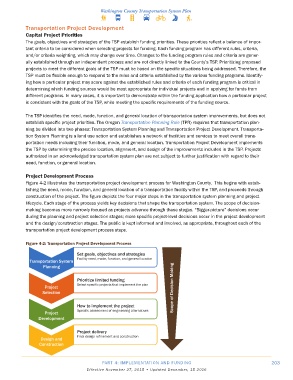
            Figure 4-2 illustrates the transportation project development process for Washington County.  This begins with estab-
            lishing the need, mode, function, and general location of a transportation facility within the TSP, and proceeds through
            construction of the project. The figure depicts the four major steps in the transportation system planning and project
            lifecycle. Each stage of the process yields key decisions that shape the transportation system. The scope of decision-
            making becomes more narrowly focused as projects advance through these stages. “Bigger-picture” decisions occur
            during the planning and project selection stages; more specific project-level decisions occur in the project development
            and the design/construction stages. The public is kept informed and involved, as appropriate, throughout each of the
            transportation project development process steps.


            Figure 4-2: Transportation Project Development Process


                                            PART 4: IMPLEMENTATION AND FUNDING                                    203
                                     Effective November 27, 2015 • Updated December, 15 2016

