


Page 220 - TransportationPlanUsetsGuide
P. 220
North Bethany Transportation Funding
            The North Bethany subarea has two additional funding programs: the North Bethany Transportation System Develop-
            ment Charge and the North Bethany County Service District for Roads. These charges provide additional revenue to
            fund specific capital improvements needed to serve the planned development. Together, these charges are intended
            to raise more than  $35 million to be used towards 14 specific transportation projects. The timeline for the complete
            development of North Bethany is unknown. The funding strategy was designed to implement transportation improve-
            ments as development occurs and funding becomes available. These two funding programs will sunset once the area
            has developed and the specified improvements have been implemented and paid for.


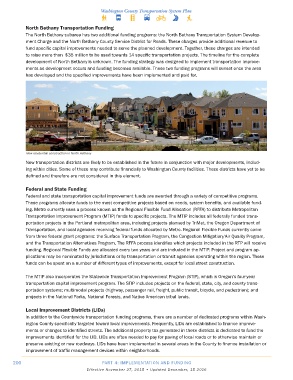
            New residential construction in North Bethany

            New transportation districts are likely to be established in the future in conjunction with major developments, includ-
            ing within cities. Some of these may contribute financially to Washington County facilities. These districts have yet to be
            defined and therefore are not considered in this element.

            Federal and State Funding
            Federal and state transportation capital improvement funds are awarded through a variety of competitive programs.
            These programs allocate funds to the most competitive projects based on needs, system benefits, and available fund-
            ing. Metro currently uses a process known as the Regional Flexible Fund Allocation (RFFA) to distribute Metropolitan
            Transportation Improvement Program (MTIP) funds to specific projects. The MTIP includes all federally funded trans-
            portation projects in the Portland metropolitan area, including projects planned by TriMet, the Oregon Department of
            Transportation, and local agencies receiving federal funds allocated by Metro. Regional Flexible Funds currently come
            from three federal grant programs: the Surface Transportation Program, the Congestion Mitigation/Air Quality Program,
            and the Transportation Alternatives Program. The RFFA process identifies which projects included in the RTP will receive
            funding. Regional Flexible Funds are allocated every two years and are included in the MTIP. Project and program ap-
            plications may be nominated by jurisdictions or by transportation or transit agencies operating within the region. These
            funds can be spent on a number of different types of improvements, except for local street construction.

            The MTIP also incorporates the Statewide Transportation Improvement Program (STIP), which is Oregon’s four-year
            transportation capital improvement program. The STIP includes projects on the federal, state, city, and county trans-
            portation systems; multimodal projects (highway, passenger rail, freight, public transit, bicycle, and pedestrian); and
            projects in the National Parks, National Forests, and Native American tribal lands.


            Local Improvement Districts (LIDs)
            In addition to the Countywide transportation funding programs, there are a number of dedicated programs within Wash-
            ington County specifically targeted toward local improvements. Frequently, LIDs are established to finance improve-
            ments or changes to identified streets. The additional property tax generated in these districts is dedicated to fund the
            improvements identified for the LID. LIDs are often needed to pay for paving of local roads or to otherwise maintain or
            preserve existing or new roadways. LIDs have been implemented in several areas in the County to finance installation or
            improvement of traffic management devices within neighborhoods.


      200                                   PART 4: IMPLEMENTATION AND FUNDING
                                     Effective November 27, 2015 • Updated December, 15 2016

