


Page 225 - TransportationPlanUsetsGuide
P. 225
MAINTENANCE
            Preserving Washington County’s investment in its transportation infrastructure is the principle purpose of mainte-
            nance. Adequate system maintenance is critical since it is much less expensive in the long run to maintain assets in
            a deliberate manner rather than allow them to deteriorate to the point where major improvements or reconstruction
            are needed. Competing interests and limited funds present a challenging task for those charged with maintaining a
            complex transportation network. Civic leaders must make difficult choices that are sometimes unpopular. Washing-
            ton County’s situation of an aging infrastructure coupled with a reduced revenue stream is not unique. In fact, the
            maintenance difficulties facing Washington County are similar to other transportation agencies throughout the region
            and across the country.

            The Operations & Maintenance Division (OPS) of LUT strives to apply the appropriate level of resources at the right time
            to ensure the most cost-effective use of available funds to maintain the best overall condition of the County’s trans-
            portation system assets. There are nearly 1,300 centerline miles of paved and gravel roads, almost 200 bridges, more
            than  3,000 culverts, close to 900 miles of drainage ditches, and numerous miles of roadside vegetation to maintain in
            Washington County. Achieving the best overall condition of the transportation system requires cooperation, creativity,
            and collaboration. To help achieve the needed balance for roadway maintenance investments, OPS utilizes a variety of
            tools including County policies, empirical analysis, professional judgment, and citizen input to decide where to spend
            road maintenance funds.


            The maintenance goal of the County’s Department of Land Use & Transportation (LUT) is to protect public safety and
            personal property, make effective use of available funds and preserve the public and private investments in the trans-
            portation system. In addition, LUT also strives to preserve and protect the natural environment.

            Maintenance Priorities
            The four different types of priorities associated with
            maintenance are listed below:

              •  Emergencies/Hazards Work related to abating
                 or managing an immediate threat to public safe-
                 ty, private property, or environmental resources.
                 These occurrences may cause a road to become
                 impassable, or an operator of a vehicle to lose
                 control. These occurrences may require prompt
                 action in order to protect human life or welfare
                 and/or access.
              •  Mandated Work related to regulatory or legisla-
                 tive requirements that require the agency to per-
                 form certain activities. The specific authorization
                 may vary by the type of activity.
              •  Essential Work that maximizes the efficiency of
                 the transportation system but is not required, by
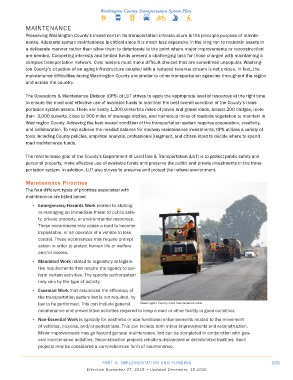
                 law to be performed. This can include general   Washington County road maintenance crew
                 maintenance and preventative activities required to keep a road or other facility in good condition.
              •  Non-Essential Work is typically for aesthetic or non-functional enhancements related to the movement
                 of vehicles, bicycles, and/or pedestrians. This can include both minor improvements and reconstruction.
                 Minor improvements may go beyond general maintenance, but can be completed in conjunction with gen-
                 eral maintenance activities. Reconstruction projects rebuild substandard or deteriorated facilities. Such
                 projects may be considered a comprehensive form of maintenance.


                                            PART 4: IMPLEMENTATION AND FUNDING                                    205
                                     Effective November 27, 2015 • Updated December, 15 2016

