


Page 226 - TransportationPlanUsetsGuide
P. 226
A long-standing tool used for selecting road maintenance activities has been the Road Maintenance Priority Matrix
            shown in Table 4.2. This guideline has been in place since adoption of the 1988 Transportation Plan and focuses on the
            functional classification of the roadway for the selection process.


            Table 4.2: Road Maintenance Priority Matrix*
                                                           Rural Resource       Neighborhood
                    Activity        Arterial  Collector                                           Local Road
                                                              Route**               Route
             Emergencies / Hazards    1          1               1                    1               1
             Mandated                 1          1               1                    1               1
             General Maintenance      2          3               4                    5               8
             Minor Improvements       6          7               11                  13               14
             Reconstruction           9         10               12                  15               16
            *“1” is the highest priority; “16” is the lowest.
            **Resource Routes are an identified network of rural local roads important to the economy and connectivity in the county. Their designation may be
            adjusted periodically as needed as part of the Board-adopted annual maintenance program.

            Target Service Levels
            Each year LUT develops an Annual Road Maintenance Program. The Board of Commissioners evaluates the transporta-
            tion system based on available resources and risks and adopts the Road Maintenance Program. This program becomes
            the department’s plan for scheduled work during the fiscal year and focuses on preservation of existing transportation
            assets and safety. The target service levels provide a guideline for the department to use when establishing the annual
            road maintenance work program, responding to emergencies and service requests, selecting projects, and develop-
            ing budgets. The target service levels supplement the Maintenance Priority Matrix to improve the process for selecting
            maintenance activities. The major assets that represent the foundation of the transportation system generally fall into
            the following categories:
              •  Bridge: A structure that typically consists of vertical sup-
                 ports and horizontal members connecting at least two
                 segments that allows safe and efficient passage over an
                 obstacle such as a body of water, a road, or a railway. In
                 some instances, large culverts are considered bridges.
              •  Culvert: A structure underneath the roadway used to allow
                 storm water to pass through a roadway fill section.
              •  Pavement: The hard surface of a road or other facility.
                 The pavement can be made of bituminous material (as-
                 phalt or chip seal) or Portland cement concrete.
              •  Gravel Road: A facility that has crushed aggregate mate-
                 rial as the wearing surface.
              •  Ditch: An open channel adjacent to a roadway used for
                 the collection and conveyance of storm runoff.
              •  Landscaped Area: A region in the public right-of-way with
                 ornamental trees, shrubs, and/or ground cover intended
                 to provide erosion control, environmental mitigation, traf-
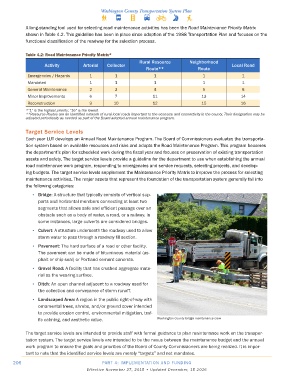
                 fic calming, and aesthetic value.                 Washington County bridge maintenance crew


            The target service levels are intended to provide staff with formal guidance to plan maintenance work on the transpor-
            tation system. The target service levels are intended to be the nexus between the maintenance budget and the annual
            work program to ensure the goals and priorities of the Board of County Commissioners are being realized. It is impor-
            tant to note that the identified service levels are merely “targets” and not mandates.

      206                                   PART 4: IMPLEMENTATION AND FUNDING
                                     Effective November 27, 2015 • Updated December, 15 2016

