


Page 218 - TransportationPlanUsetsGuide
P. 218
FUNDING
            The transportation funding element identifies transportation revenue sources and describes the County’s overall fund-
            ing strategy for needed transportation improvements. The information in this section reflects the funding conditions
            at the time the document was prepared. Projected revenues and estimated project costs are expected to change over
            time. Further, the list of candidate transportation improvements is anticipated to evolve as development occurs and
            new opportunities and challenges develop.

            Washington County’s transportation system funding currently is based on numerous revenue sources. The main prin-
            ciple in the use of these revenues has been the creation of a sustainable funding program to implement improvements
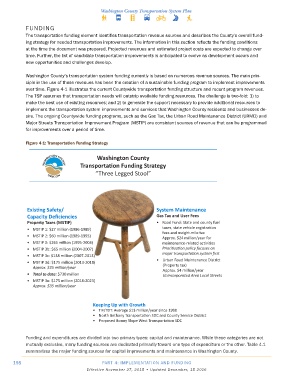
            over time. Figure 4-1 illustrates the current Countywide transportation funding structure and recent program revenues.
            The TSP assumes that transportation needs will outstrip available funding resources. The challenge is two-fold: 1) to
            make the best use of existing resources; and 2) to generate the support necessary to provide additional resources to
            implement the transportation system improvements and services that Washington County residents and businesses de-
            sire. The ongoing Countywide funding programs, such as the Gas Tax, the Urban Road Maintenance District (URMD) and
            Major Streets Transportation Improvement Program (MSTIP) are consistent sources of revenue that can be programmed
            for improvements over a period of time.


            Figure 4-1: Transportation Funding Strategy

                                          Washington County
                                   Transportation Funding Strategy
                                         “Three Legged Stool”


            Existing Safety/                                      System Maintenance
            Capacity Deficiencies                                 Gas Tax and User Fees
            Property Taxes (MSTIP)                                •  Road Fund: State and county fuel
            •  MSTIP 1: $27 million (1986-1989)                      taxes, state vehicle registration
                                                                     fees and weight-mile tax
            •  MSTIP 2: $60 million (1989-1995)
                                                                     Approx. $24 million/year for
            •  MSTIP 3: $265 million (1995-2004)                     maintenance-related activities
            •  MSTIP 3b: $65 million (2004-2007)                     Prioritization policy focuses on
            •  MSTIP 3c: $138 million (2007-2013)                    major transportation system first
            •  MSTIP 3d: $175 million (2013-2018)                 •  Urban Road Maintenance District
               Approx. $35 million/year                              (Property tax)
                                                                     Approx. $4 million/year
            •  Total to date: $730 million                           Unincorporated Area Local Streets
            •  MSTIP 3e: $175 million (2018-2023)
               Approx. $35 million/year


                                        Keeping Up with Growth
                                        •  TIF/TDT: Average $13 million/year since 1990
                                        •  North Bethany Transportation SDC and County Service District
                                        •  Proposed Bonny Slope West Transportation SDC


            Funding and expenditures are divided into two primary types: capital and maintenance. While these categories are not
            mutually exclusive, many funding sources are dedicated primarily toward one type of expenditure or the other. Table 4.1
            summarizes the major funding sources for capital improvements and maintenance in Washington County.

      198                                   PART 4: IMPLEMENTATION AND FUNDING
                                     Effective November 27, 2015 • Updated December, 15 2016

