


Page 213 - TransportationPlanUsetsGuide
P. 213
is allowed through a Type II process may be allowed through a Type III process subject to the criteria in the
                CDC. Modifications that do not meet the Type III criteria shall be subject to a quasi-judicial or legislative
                plan amendment process.

                Director’s Determination                                                                      ADOPTED TEXT
                The Director of the Department of Land Use & Transportation shall determine if a proposed road alignment
                modification is legislative, quasi-judicial or a minor adjustment.


            COORDINATION
            Coordination is essential in the implementation of the County’s TSP. Input from community residents and businesses, a
            broad range of public agencies, elected officials, non-profit organizations, and special interest groups is needed in order
            to develop a transportation plan that meets the transportation needs and aspirations of the County in an efficient and
            equitable manner.

            Public Involvement
            Engaging the general public and interested
            stakeholders is imperative to ensure that
            the transportation system effectively meets
            the needs of all County residents and busi-
            nesses, and to ensure that recommended
            transportation system improvements are
            implemented in a fair and equitable man-
            ner. Public involvement is critical during
            plan development to ensure that transporta-
            tion needs are appropriately defined and
            that solutions are identified that will meet
            the community’s aspirations. Washington
            County uses an active citizen involvement
            program during all stages of transportation
            planning and project development. Methods
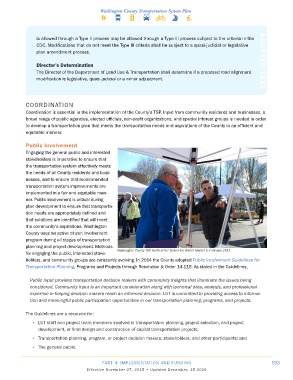
                                                  Washington County TSP booth at the Beaverton Winter Market in February 2014.
            for engaging the public, interested stake-
            holders, and community groups are constantly evolving. In 2014 the County adopted Public Involvement Guidelines for
            Transportation Planning, Programs and Projects through Resolution & Order 14-115. As stated in the Guidelines,

              Public input provides transportation decision makers with community insights that illuminate the issues being
              considered. Community input is an important consideration along with technical data, analysis, and professional
              expertise in helping decision makers reach an informed decision. LUT is committed to providing access to informa-
              tion and meaningful public participation opportunities in our transportation planning, programs, and projects.


            The Guidelines are a resource for:
              •  LUT staff and project team members involved in transportation planning, project selection, and project
                 development, or final design and construction of capital transportation projects;
              •  Transportation planning, program, or project decision makers, stakeholders, and other participants; and

              •  The general public.


                                            PART 4: IMPLEMENTATION AND FUNDING                                    193
                                     Effective November 27, 2015 • Updated December, 15 2016

