


Page 170 - TransportationPlanUsetsGuide
P. 170
Types of System Users
            An important consideration in preparing a bicycle plan is to recognize the primary types of cyclists and their differing
            needs. Generally, bicyclists fall into three categories:
              •  Strong and Fearless or Type A (Advanced) – This group includes bicyclists who are comfortable riding on
                 busy roads with a low level of separation from traffic and navigating in traffic when necessary to reach
                 destinations. This group makes up a small percentage of cyclists and the population.
              •  Enthused and Confident or Type B (Basic) – This group includes utilitarian and recreational riders who will
                 ride on busy streets if bike lanes or other facilities are provided, but may deviate from the most direct route
                 to ride on low-traffic streets or shared-use paths.
              •  Interested, but Concerned or Type C (Concerned) – This group includes a wide range of people of all ages
                 who enjoy bicycling occasionally, but may only ride on shared use paths, protected on-street facilities, or
                 low-traffic local streets. The majority of the population falls into this category.

            Achieving regional active transportation performance targets will require attracting a wider range of users. A variety of
            factors limit bicycling by Type B and C cyclists, including adjacent vehicle speeds (>35 mph), adjacent vehicle volumes
            (>3,000 ADT), and freight conflicts. Some jurisdictions are responding to these issues by increasing the separation be-
            tween vehicle and bicycle travel through enhanced bicycle facility design. The Washington County Bicycle Facility Design
            Toolkit provides detailed design considerations intended to provide safe and convenient bikeways that will be especially
            beneficial to Type B and C bicyclists.

            Bikeway Facilities
            The following section describes the
            spectrum of existing and potential
            separated on-street bikeway facilities.

              •  Shoulder Bikeways: On rural
                 roads or interim urban roads with
                 a large shoulder, shoulder bike-
                 ways can accommodate bicycle
                 travel. Shoulder bikeways are
                 generally used by commuter and
                 long-distance recreational riders,
                 rather than families with children
                 or more inexperienced riders.
              •  Bike Lanes: Designated exclu-
                 sively for bicycle travel, bike
                 lanes are separated from vehicle
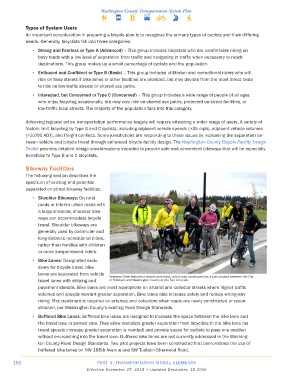
                                               Veterans Drive features a raised cycle track, which was constructed as a joint project between the City
                 travel lanes with striping and   of Hillsboro and Washington County at the Fair Grounds.
                 pavement stencils. Bike lanes are most appropriate on arterial and collector streets where higher traffic
                 volumes and speeds warrant greater separation. Bike lanes also increase safety and reduce wrong-way
                 riding. This treatment is required on arterials and collectors when roads are newly constructed or recon-
                 structed, per Washington County’s existing Road Design Standards.

              •  Buffered Bike Lanes: Buffered bike lanes are designed to increase the space between the bike lane and
                 the travel lane or parked cars. They allow motorists greater separation from bicyclists in the bike lane (as
                 travel speeds increase greater separation is needed) and provide space for cyclists to pass one another
                 without encroaching into the travel lane. Buffered bike lanes are not currently addressed in the Washing-
                 ton County Road Design Standards. Two pilot projects have been constructed that demonstrate the use of
                 buffered bike lanes on NW 185th Avenue and SW Tualatin-Sherwood Road.


      150                                 PART 3: TRANSPORTATION MODAL ELEMENTS
                                     Effective November 27, 2015 • Updated December, 15 2016

