


Page 169 - TransportationPlanUsetsGuide
P. 169
BICYCLE ELEMENT
            Bicycle planning in Washington County began in earnest following the passage of the Oregon Bicycle Law in 1971.
            The Washington County Bicycle Pedestrian Pathway Master Plan soon followed and was adopted in 1974. The master
            plan proposed an extensive network of on-street and off-street bicycle routes and a point system to prioritize routes
            for construction. By 1983 approximately seven miles of pathways had been completed. In 1986, the County adopted
            bikeway standards as part of the Uniform Road Improvement Design Standards calling for “a six-foot-wide bicycle lane
            constructed adjacent to the curb within the pavement area.” The 1988 Washington County Transportation Plan notes
            that 15 miles of bike lanes built to design standards and 14 miles of substandard bicycle paths existed on, or adjacent
            to, County roads. By 2002 that number had grown to more than 64 miles of existing on-street bikeway facilities, as a
            result of adding more than 2.5 miles of bikeways to the system annually between 1988 and 2002 in conjunction with
            the Major Streets Transportation Improvement Program. Today, the County’s major street network (Arterials and Collec-
            tors) has more than 91 miles of on-street urban bikeway (6’ bicycle lanes and minimum 4’ width paved shoulders) and
            36 miles of rural on-street bikeways (minimum 4’ width paved shoulders).

            Bicycle Trip Characteristics
            Bicycling is an important mode of transportation, whether used separately or with other travel modes such as transit.
            Bicycling is the most efficient form of transportation and is considered particularly well suited for shorter trips, typically
            less than three miles. A recent study that tracked cyclists’ activity in the Portland metropolitan region, including Wash-
            ington County, found the median length of bicycle trips of study participants was 2.8 miles. However, it was found that
            participants were willing to travel further from home to work; the median single trip distance was 3.8 miles with an aver-
            age trip length of 5.2 miles. Acceptable trip length can vary greatly depending on the skill and fitness level of the cyclist.


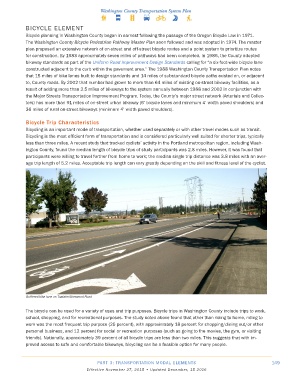
            Buffered bike lane on Tualatin-Sherwood Road

            The bicycle can be used for a variety of uses and trip purposes. Bicycle trips in Washington County include trips to work,
            school, shopping, and for recreational purposes. The study noted above found that other than riding to home, riding to
            work was the most frequent trip purpose (25 percent), with approximately 18 percent for shopping/dining out/or other
            personal business, and 12 percent for social or recreation purposes (such as going to the movies, the gym, or visiting
            friends). Nationally, approximately 39 percent of all bicycle trips are less than two miles. This suggests that with im-
            proved access to safe and comfortable bikeways, bicycling can be a feasible option for many people.


                                          PART 3: TRANSPORTATION MODAL ELEMENTS                                   149
                                     Effective November 27, 2015 • Updated December, 15 2016

