



 52-53 / 112

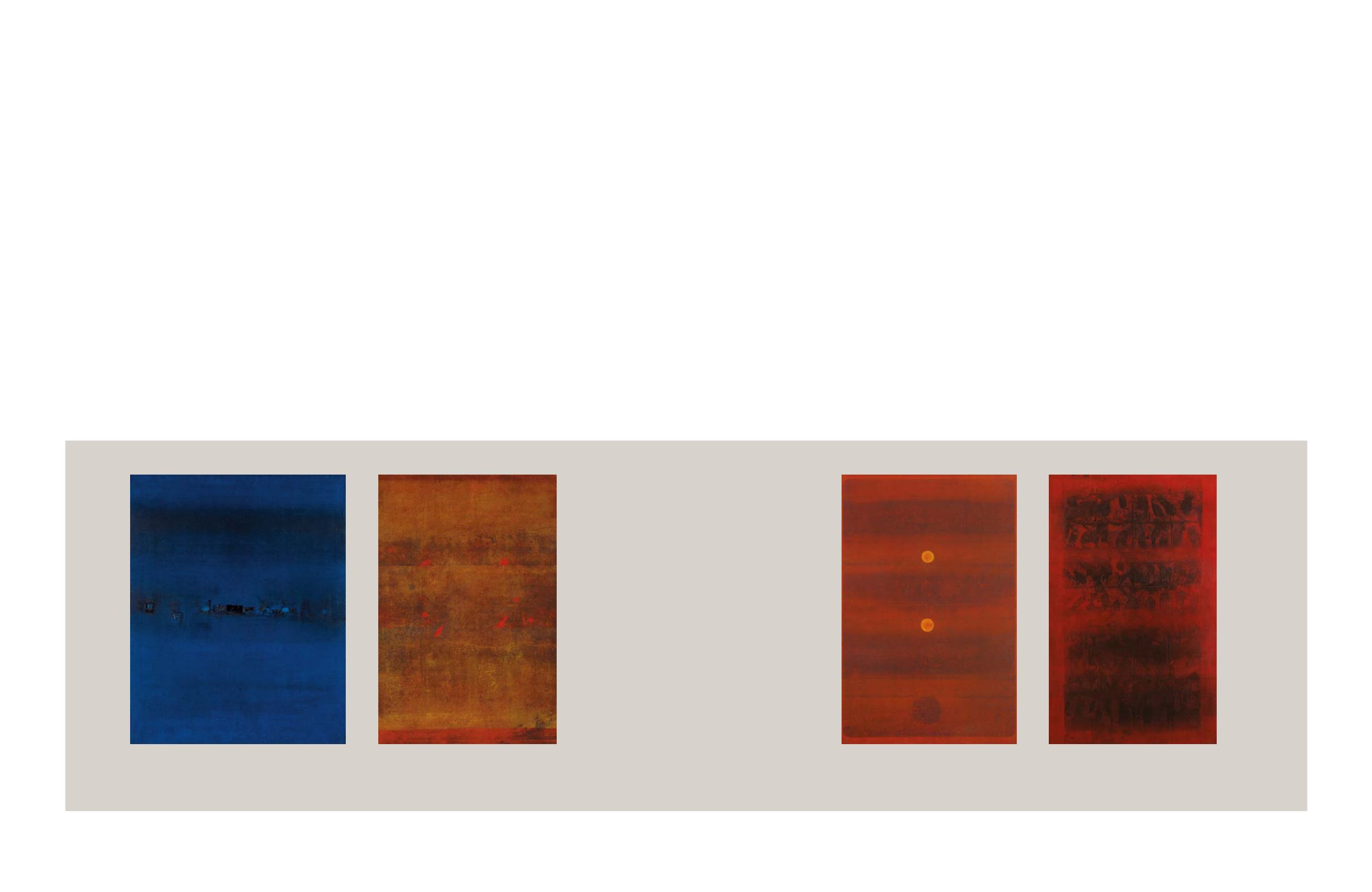
Untitled
, 1971
Saffronart, 24 February 2016, lot 39
Sold for Rs 7.77 crores ($1.1 million)
Untitled
, 1973
Saffronart, Mumbai, 26 March 2019, lot 37
Sold for Rs 25.2 crores ($3.7 million)
Untitled
, 1975
Saffronart, New Delhi, 20 September 2018, lot 13
Sold for Rs 15.4 crores ($2.16 million)
In 1971 – one year before the present lot was painted – V S Gaitonde received the prestigious Padma Shri award
from the Government of India in recognition of his status as one of the country’s foremost modern painters. A
private person known for his contemplative creative process, Gaitonde was never complacent; his constant aim was
to perfect his art.
In the late 1960s and early 1970s, he made a number of stylistic choices, such as working exclusively in a vertical format,
which he would continue to do for the rest of his career. He also began to experiment with a “lift‒off” process involving
torn magazine and newspaper cut‒outs, from which he would transfer painted shapes onto his canvas with the help
of rollers. The artist used palette knives to erase, and masking tape to mark the borders of his painting. “The ensuing
abstract forms hover across the surface, creating silhouetted shapes and geometries. In a work from 1973, he folded
the newspapers into thin slivers in order to stencil horizontal, diagonal and vertical bands toward an overall symphonic
field of quiet, abstracted geometry. These paintings have a gravity‒defying weightlessness and yet there is a real sense
of physicality and presence to them.” (Sandhini Poddar,
V S Gaitonde: Painting as Process, Painting as Life
, New York: The
Solomon R Guggenheim Museum, 2014, p. 30)
Rather than the floating or calligraphic forms often seen in his works of this period, the present lot depicts
geometric, grid‒like lines and planes in pastel shades of blue‒green. The colours blend into each other, creating
a sense of serenity and harmony. As Sharon Lowen – a renowned American dancer, and Gaitonde’s close friend
– once said, “Gai’s art is, without any question, abstraction that is organic. There is nothing cold about it in its
abstraction. You are not looking at lines, there are no lines, it is only transition… (sic) everything is micro changing
into what it is supposed to be and where it is coming from. Everything is causing the next thing, but there is no
point where it permanently is.” (Meera Menezes,
Vasudeo Santu Gaitonde: Sonata of Solitude
, Mumbai: Bodhana
Arts and Research Foundation, 2016, p. 166)
It was in 1972 that Gaitonde permanently moved to Delhi, and the colours in this painting recall the sea which Gaitonde
missed, which also manifested in similarly hued canvases he created in this period. That this nostalgia found its way into
Gaitonde’s art is an observation made by many fellow artists, friends and critics. Ram Kumar said, “When he came from
Bombay to Delhi he was always missing the sea, the Bombay way of life.” (Quoted in Menezes, p. 165). According to
Richard Bartholomew, "In Gaitonde's work... the theme of the sea, the surf, the play of light, and the sea's mystique itself
are orchestrated as music within the mind and expressed as a score or an organic fabric, a fine lace‒work of melodic
motifs." (Quoted in Poddar, p. 31)
However, Gaitonde's work was never that literal. What he painted was a deeply personal vision of the physical world
filtered through deep interests in the teachings of Maharshi Ramana, the work of Paul Klee and Abstract Expressionism,
and most significantly, Zen philosophy – which had a profound impact on his life and art from the late 1950s onwards.
Gaitonde once said that his paintings, which were informed by his study of Zen Buddhism, were “nothing else but a
reflection of nature.” (Artist quoted in Poddar, p. 28) His engagement with Zen especially allowed him to go beyond the
ideas and concepts of other artists and movements. As he once explained, “I suddenly saw no reason to paint from any
kind of concept at all. There came an amazing sense of liberation, and that is where my painting began to flow from.”
(Artist quoted in Menezes, p. 104)
Untitled
, 1963
Saffronart, New Delhi, 21 September 2017, lot 13
Sold for Rs 19.99 crores ($3.17 million)
52
53