



 42-43 / 112

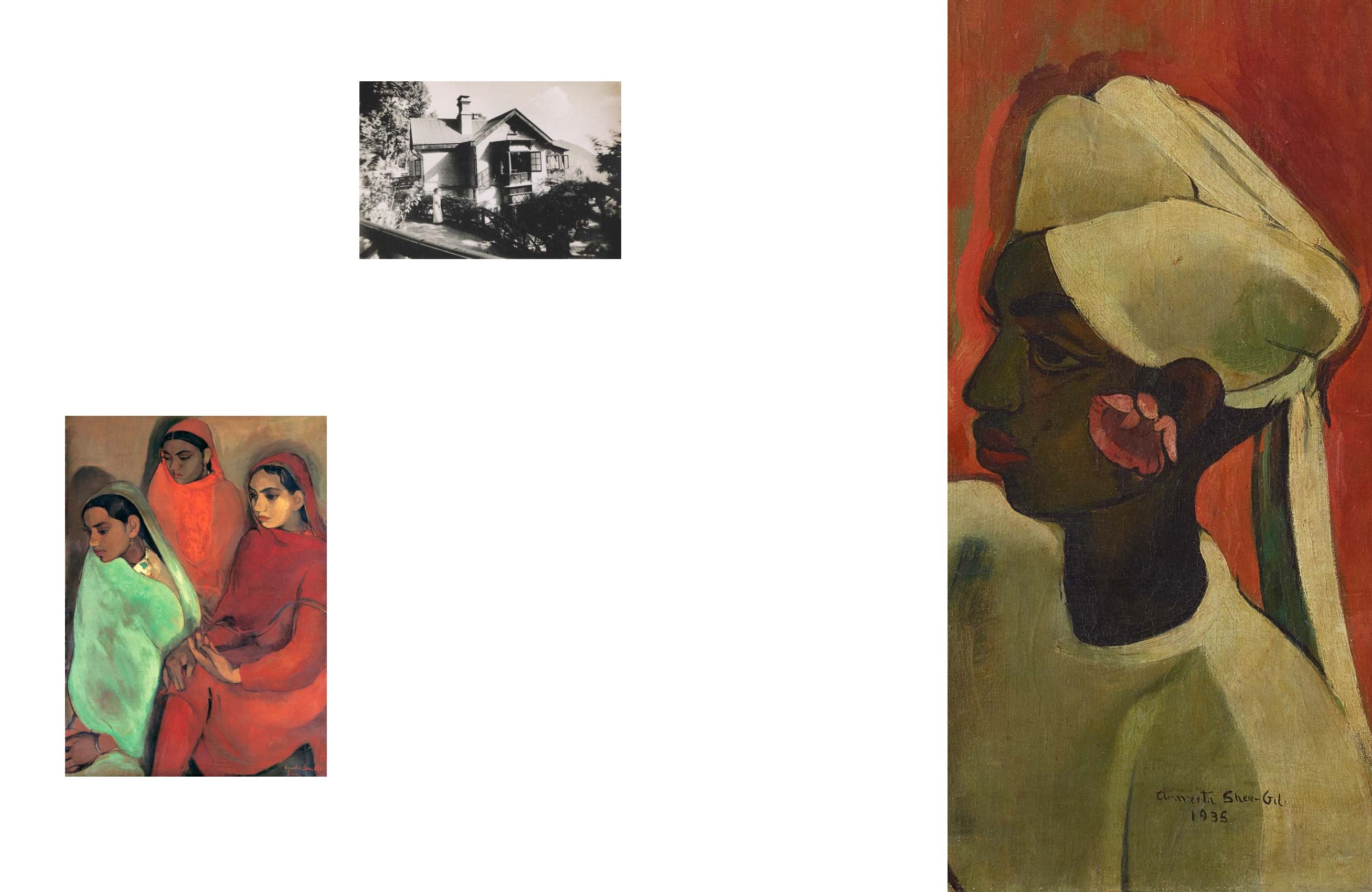
Marie Antoinette at The Holme, Simla, mid‒1930s. Photo by Umrao Singh
Amrita Sher‒Gil,
Group of Three Girls
, 1935
Collection: NGMA, New Delhi
Wikimedia Commons
Despite her rising success, Sher‒Gil felt that Europe
was not conducive to the growth of her art. She had
realised that the study of European art had led her to
appreciate Indian painting and sculpture – a realisation,
paradoxically, she would not have arrived to if she had
not come to Europe. “I began to be haunted by an
intense longing to return to India, feeling in some strange
inexplicable way that there lay my destiny as a painter.”
(Artist quoted in N Iqbal,
criticalcollective.in, online)
Returning to India in 1934, Sher‒Gil first stayed at her
father’s ancestral home in Amritsar, Punjab, where she
painted
Group of Three Girls
, which won the Gold Medal
at the 46
th
Bombay Art Society Annual Exhibition in 1937.
This painting reflects the change in her colour palette,
departing from the blues and greens of her Paris years
towards the earthy reds and browns of her surroundings.
“The lines and forms were a continuation of her years
abroad, as the figures stood together in a studio pose,
but their grave expressions, the sense of being at once
together and isolated, would become the key motif of
all her paintings in India.” (Dalmia, p. 60) The sombre
atmosphere that Dalmia refers to is vividly evident in the
present lot.
Boys with Lemons
, perhaps painted in the summer
of 1935 when Sher‒Gil was back in her family home
at Simla, is an important work in Sher‒Gil’s oeuvre.
The depiction of the two boys selling lemons, their
expressions resigned and forlorn, was deliberate. “While
the colours and sounds of India exhilarated Amrita, the
poverty aroused a deep compassion in her. She wanted,
she said, “to interpret the life of Indians, particularly the
poor Indians pictorially; to paint those images of infinite
submission and patience; to depict their angular brown
bodies, strangely beautiful in their ugliness, to reduce the
impression their sad eyes created in me.”… her success
lay in achieving something that was neither sentimental
nor pictorial but went beyond mere aestheticization of
poverty to a reappraisal of deprivation and the attitude
of the privileged.” (Dalmia, p. 74)
With works like the present lot, Sher‒Gil was attempting
to carve her own identity “in consonance with the reality
of India… She could look back on this period in her life as
a fecund, fertile one which resulted in fresh discoveries.”
(Dalmia, p. 75) In the next few years, Sher‒Gil travelled
across India, which led to fascinating encounters with
painters, royalty, art historians like Karl Khandalavala
and Charles Fabri, and even political
stalwarts like Jawaharlal Nehru. In
1938, while in Hungary, she married
her cousin Victor Egan, and the
couple would eventually settle at
her father’s family estate in Saraya,
Gorakhpur. Her experiences in these
new places informed her art, and she
would create a revolutionary body
of work that was at once modern
and Indian, but uniquely her own.
As expressive as she was with her
art, Sher‒Gil was also vocal with
her thoughts, often contributing
several essays on her thoughts
about modern Indian art and the
form it must acquire. In many ways,
she was one of the earliest critics of
20
th
century Indian art and a seminal
influence for future generations of
Indian artists.
Sher‒Gil passed away suddenly
on 5 January 1941 in Lahore after
a brief illness. She was only 28. In
her short lifetime, Sher‒Gil made
a very limited number of works, of
which 172 have been documented,
95 are in the permanent collection
of the National Gallery of Modern
Art, New Delhi, and two more
are in institutional collections in
Chandigarh and Lahore. In 1972,
Sher‒Gil was declared one of India's
nine 'National Art Treasure' artists
by the Archaeological Survey of
India, and her works are not allowed
to leave the country. The present
lot offers a rare, once‒in‒a‒lifetime
opportunity for collectors of
modern Indian art to acquire a work
by one of the most important artists
and pioneers of Indian modernism.
42