



 40-41 / 112

language the two girls spoke when they were children
was Hungarian, and Amrita was to maintain this marker
of her Hungarian identity and family bonds till the
end of her life, even after she returned to India.” (Vivan
Sundaram ed.,
Amrita Sher‒Gil: A Self‒Portrait in Letters
& Writings, Volume 1
, Tulika Books, New Delhi, 2010, p.
xxxiii)
Sher‒Gil showed a proclivity to art at a very young age.
By the time she was five, she was sketching illustrations
of Hungarian folk stories and fairy tales, and even writing
her own poems and stories. When the Sher‒Gil family
returned to India in 1921 and settled in Simla, her
prodigious talent and obsessive painting had come to
Marie Antoinette’s attention, who recognised that her
daughter’s talent was far advanced for her age. Wanting
to expand her horizons and expose her to “the highest
levels of artistic achievements,” she took her to Florence
in 1924. However, school in Italy proved too dull and
regimented for Amrita, and she returned to Simla in less
than six months.
Back in Simla, Sher‒Gil started art lessons with British
artistsMajorWhitmarsh andHal Bevan Petman, although
their conventional style may not have yielded much. In
the summer of 1926, Marie Antoinette’s brother, Ervin
Baktay, came to India and stayed with the Sher‒Gils.
“The painter in Ervin was quick to recognize Amrita’s
artistic talent, and he guided her to move away from her
highly emotional early paintings and to draw from reality,
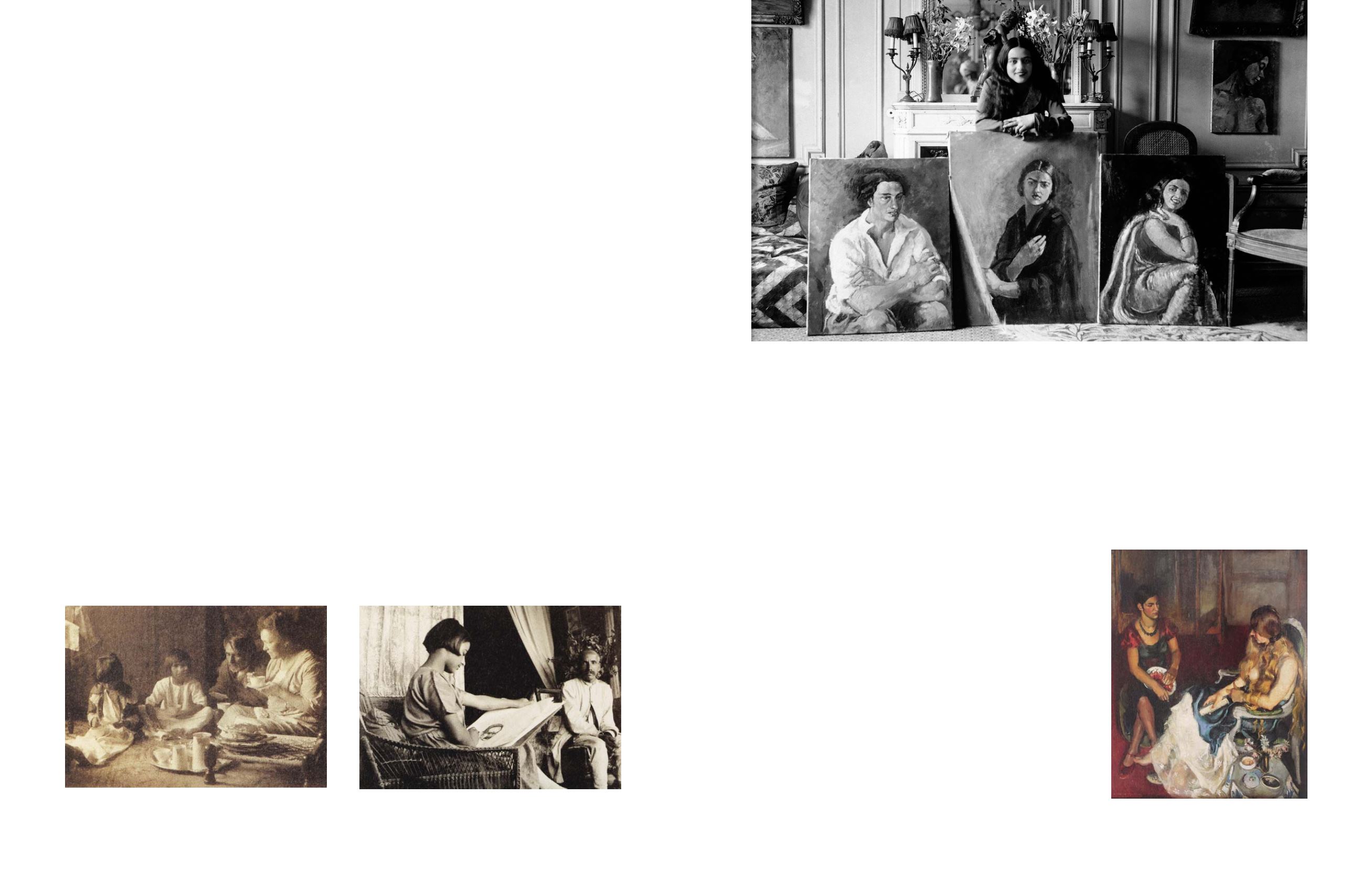
Amrita with her paintings in the family flat at Rue de Bassano, Paris, 1930.
Photo by Umrao Singh
Amrita Sher‒Gil,
Young Girls
, 1932
Amrita Sher‒Gil – often deemed as the “Frida Kahlo”
of Indian art – was not only one of the first women to
emerge into the Indian art space, but was also an artist
par excellence, considered one of India's most important
artists of the 20
th
century. In her brief career spanning just
about a decade, she was able to evolve a new language
for modern Indian art, changing its course forever.
“She went on to spearhead the path of modernity in
Indian art by imbuing her work with aspects of both
Western and Eastern traditions. When she made the
famous statement ‘Europe belongs to Picasso, Matisse
and many others, India belongs only to me’ she did not
realize that she had in fact entered the terrain where she
would bridge the gap between widely divergent and yet
interdependent systems and that in carving this path
she would be showing the way for generations of artists.”
(Yashodhara Dalmia,
Amrita Sher‒Gil: A Life
, New Delhi:
Penguin, 2006, p. xiii)
Sher‒Gil’s unique parentage and childhood experiences
privileged her with a cosmopolitan and individualistic
character that was unusual and rare for Indian women at
that time, and enabled her to fearlessly tread uncharted
waters. “Dalma‒Amrita,” as she was christened, was
born on 30 January 1913 in in Budapest in 1913 to
Marie Antoinette Gottesmann, a Hungarian‒Jewish
opera singer, and Umrao Singh Sher‒Gil Majithia, a Sikh
aristocrat and a scholar of Persian and Sanskrit. A year
later, her sister Indira was born, and the family continued
to reside in Hungary for the next eight years. “The main
emphasizing structure rather than naturalism. Under her uncle’s
direction, her lines started to become strong and angular…”
(Sundaram, p. xl)
Upon Baktay’s suggestion that Sher‒Gil be sent to Europe to
study art, the family moved to Paris in 1929, where she joined
La Grande Chaumière and began to train under Pierre Vaillant.
Later that year, she competed for and won admission to the
studio of artist Lucien Simon at the École Nationale des Beaux‒
Arts, where she studied till 1933. During her three years there,
Sher‒Gil won prizes for her work at each of the school's annual
competitions, and in 1932, exhibited at the Grand Salon in Paris.
A year later, she was appointed the youngest Associate of the
Grand Salon, when her painting
Young Girls
was judged best in
show. Only 18 at that time, Sher‒Gil was the first Indian, perhaps
even the first Asian, to achieve this distinction. “The years in
Paris proved both purposeful and rewarding. There she learnt,
for the first time, the mystery of the anatomy of the human
form. She discovered the significance of line, form and colour.
She fell under the spell of Gauguin and Cezanne… Amrita was
full of admiration for Modigliani… and her one great love was
Vincent van Gogh… Though full of admiration for all these
artists, Amrita was never either derivative or initiative…” (N
Iqbal, “Amrita Sher‒Gil,”
Roopa Lekha, Vol 53
, 1982, pp. 47‒59,
accessed through
criticalcollective.in, online)
Umrao Singh Sher‒Gil,
Sher‒Gil family eating
, Dunaharaszti, circa 1919
Images reproduced with kind permission of Vivan Sundaram
Umrao Singh Sher‒Gil,
Amrita sketching
, Simla, 1927
40
41