



 30-31 / 112

His “tragic” heroines usually stemmed from mythology and the lived experience of Indian womanhood at the time.
Chawla categorises portraits similar to the present lot as a depiction of
vasikasajjika nayika
, “the bejewelled and glittering
woman happily awaiting her lover’s arrival… The happy expectation of a much loved woman is also manifested through
singing or the playing of a musical instrument.” (Chawla, p. 211)
Although the realism favoured by the Varma brothers would not last for more than three decades after their death,
Ravi Varma’s images and iconography, made popular through his lithographic press, would resonate for generations.
Bollywood was heavily influenced by his portrayal of women; according to artist Sharmistha Ray, “You can really draw a
straight line from Varma to popular stereotypes today of women in cinema.” (Quoted in Benita Fernando, “Women Gaze
Back at Raja Ravi Varma,”
mid
‒day.com ,2016, online) In the same interview, author and art critic Rosalyn D’Mello explains
that “The women in Varma’s paintings had their own feminine wiles, albeit capable of both seduction and arousing our
sympathies… overall, the artistic strategies for depiction of either gender are quite canonised in Varma’s works. These
stereotypes were enforced by the social milieu and vice‒versa, given Varma’s popularity at the time.”
The timeless faces of Ravi Varma’s women draw the viewer into their interior worlds, while their attire and adornments
provide clues to their place in society. A seemingly straightforward portrait thus opens up many narratives. “The magic
and allure of Ravi Varma’s women is one of the reasons that his paintings are perceived as unforgettable and seductive.
Collectively speaking, his women radiate a soft beauty combined with inner strength and intelligence that go beyond
beauty of the exterior. This is the type of face that he associated with women known for their courage and tenacity, the
uttama nayika
or the high‒minded woman of many virtues and qualities.” (Chawla, p. 199)
Raja Ravi Varma is widely regarded as one of the early pioneers of modern Indian art. Known for his depictions of royalty,
mythological and religious scenes and figures, and realistic portraits, he – alongside his brother Raja Raja Varma – was
well aware of and strongly inspired by Indian classical art, dance and music, which they were exposed to from a young
age. Ravi Varma’s portraits were usually based on photographs and European ‘model’ books, and occasionally on real
models; but he also borrowed from literary references and the moods and postures of Kathakali. Musical instruments
frequently featured as supporting props, as seen in the present lot.
Author and art conservator Rupika Chawla writes that “Realism was a very important component of the genre of
paintings that Ravi Varma excelled in. From the richness of brocade and satin to the glow of Basra pearls, the glint of
gold and metal and the lavishness of detail, Ravi Varma and Raja Varma utilized every conceivable device to make their
paintings as visually appealing and as real as they could make them.” (Rupika Chawla,
Raja Ravi Varma: Painter of Colonial
India
, Ahmedabad: Mapin Publishing, 2017, p. 243) The present lot is rich in such features, depicting a woman gazing into
the distance. The diaphanous cloth covering her, and the intricacy of the ornaments adorning her ears, neck and hands
are almost palpable in their detail.
According to Chawla, Ravi Varma’s women were painted with “passion and understanding,” and when he did base them
on real people, he favoured his models to have certain types of facial features – “pronounced eyebrows, large, innocent
eyes and wide cheekbones… together with an expression that was both sensitive and intelligent. Yet their faces were
deconstructed and assimilated into the stylisation of his preference... The faces that he eventually painted are not specific
to any particular model.” (Chawla, p. 200)
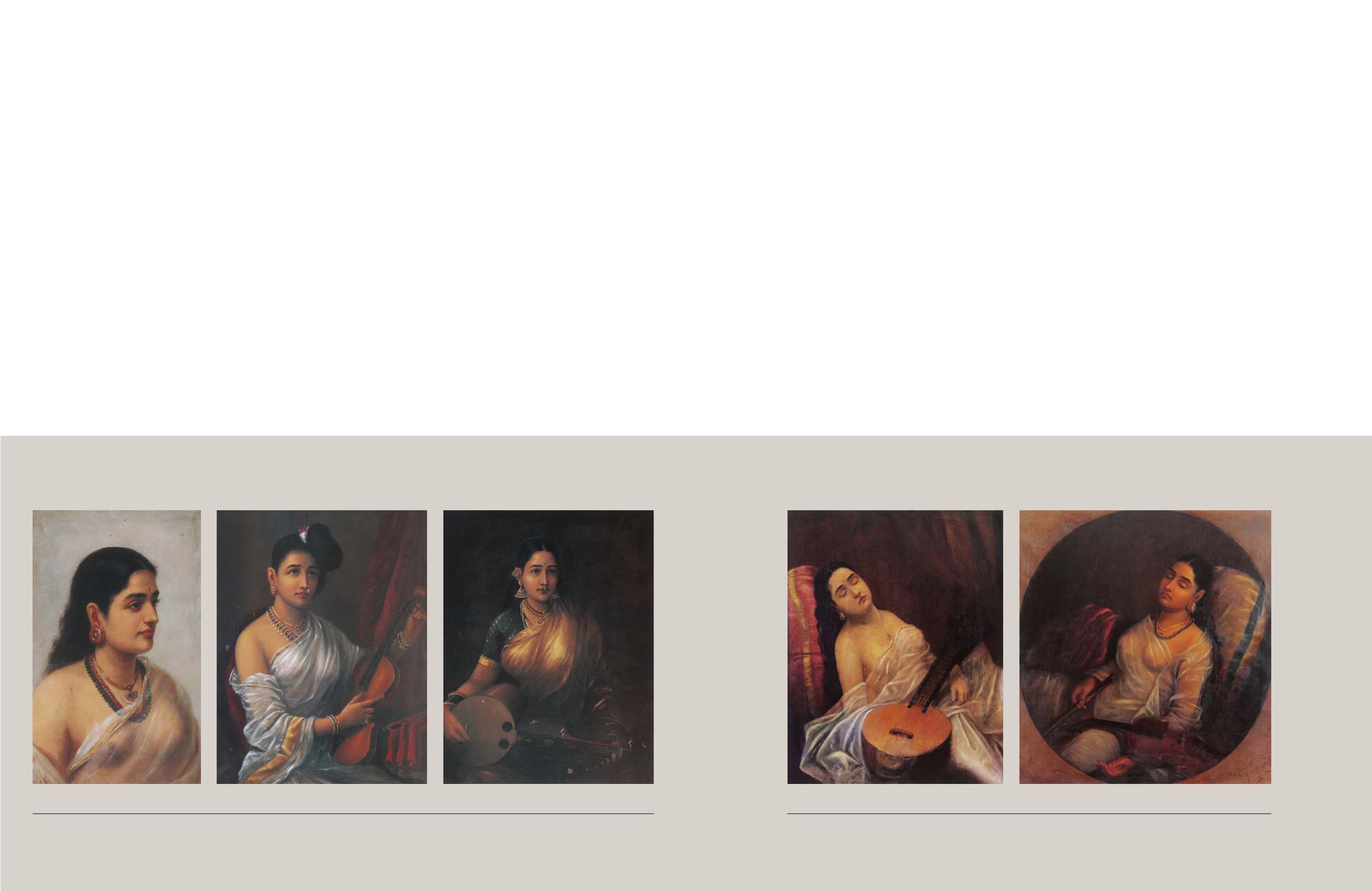
Raja Ravi Varma often painted similar portraits of bejewelled women gazing into the distance in anticipation, playing a musical
instrument to pass the time.
Sleeping Beauty of Urvashi
Collection: Maharaja Fatesingh Museum and Laxmi Vilas Palace, Baroda
A Lady Resting on the Pillow
Collection: Dr. M A Chidambaram, Chennai
Images reproduced from Parsram Mangharam,
Raja Ravi Varma: The Painter Prince 1848 ‒ 1906
, Bangalore: Parsram Mangharam, 2003, p. 126 and 176
Woman with the Violin
Private Collection
Mahashweta
Private Collection
Images reproduced from Rupika Chawla,
Raja Ravi Varma: Painter of Colonial India
, Ahmedabad: Mapin Publishing, 2017, pp. 210, 211 and 271
Lady Playing the Swarbat
Collection: Travancore Royal Family, Kaudiar Palace, Thiruvananthapuram
30
31