



 26-27 / 112

6
K K HEBBAR
(1911 ‒ 1996)
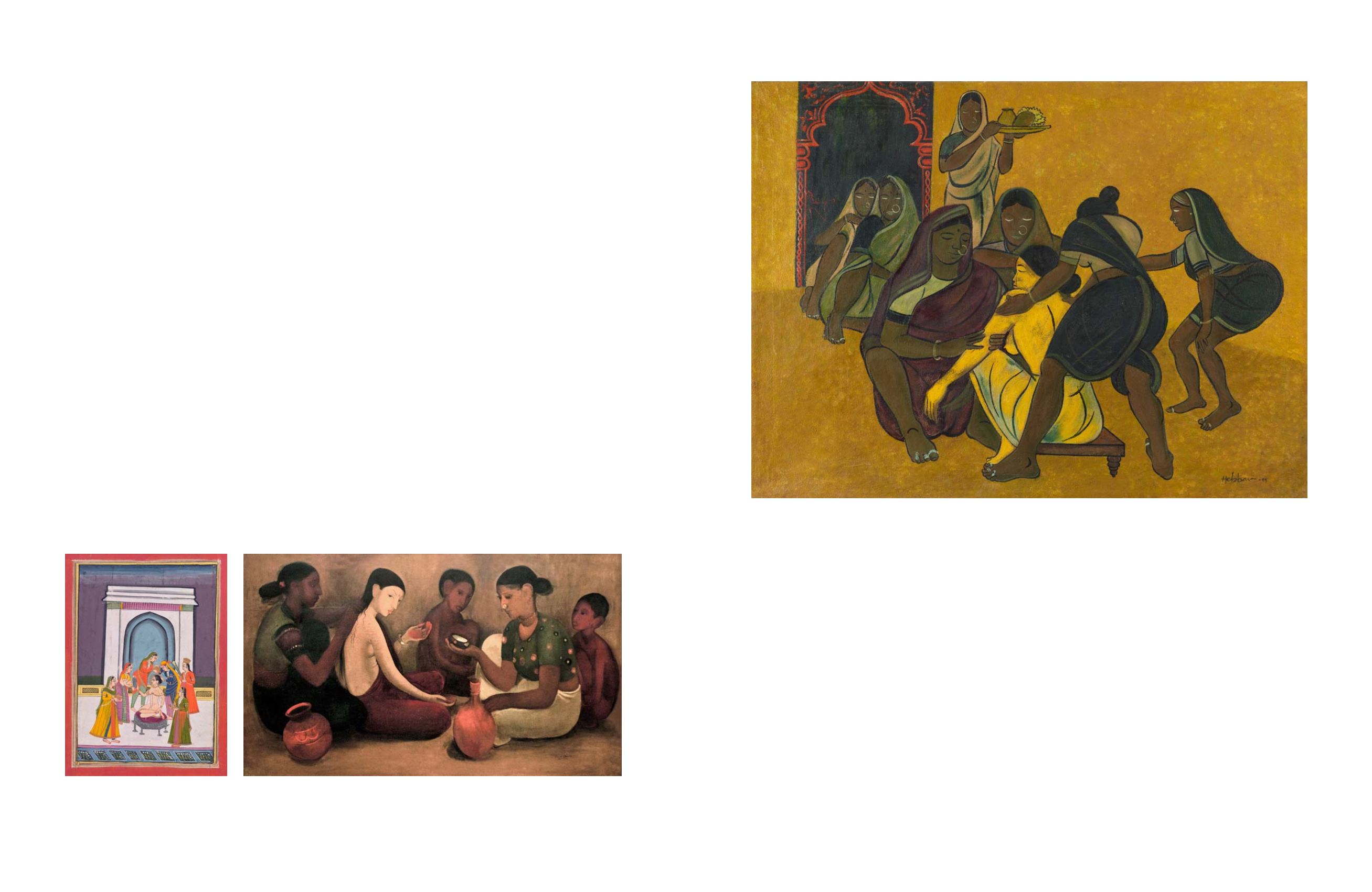
Untitled (Bride’s Toilette)
Signed and dated ‘Hebbar ‒ 44’ (lower right)
1944
Oil on canvas
29.25 x 39.5 in (74 x 100.3 cm)
Rs 35,00,000 ‒ 55,00,000
$ 50,000 ‒ 78,575
Amrita Sher‒Gil,
Bride’s Toilet
, 1937
Collection: NGMA, New Delhi
Wikimedia Commons
A Lady in Toilette
Jodhpur, Circa 1830
K K Hebbar's practice was deeply rooted in the folk art traditions of dance, drama and music that he encountered
growing up in the picturesque village of Kattingeri in Karnataka. “Even as a child… Hebbar was captivated by the songs
and dances and dazzlingly colourful costumes of Yakshagana, the folk play of coastal Karnataka... Song and dance and
colour have remained interwoven in his mind ever since.” (H Y Sharada Prasad,
The Book I Won't be Writing and Other
Essays
, New Delhi: D C Publishers, 2003, p. 215) These early impressionable years left an impact on his artistic style, which
has been deemed as a “happy combination of rustic imagination and urban sophisticate plastically expressed.” (V R
Amberkar,
Hebbar: Lalit Kala Series
, New Delhi: Lalit Kala Akademi, p. ii)
A student of the J J School of Art, Hebbar – like his contemporaries – struggled to throw off the yoke of the school’s rigid
academic style of painting. He explored and studied illustrations from Jain manuscripts, Rajput and Mughal miniatures
and Ajanta murals. “I discovered that in these works the themes chosen were mostly religious or the life of the elite;
whereas I preferred to depict rural life using the traditional techniques that I was familiar with.” (K K Hebbar,
Voyage in
Images
, Mumbai: Jehangir Art Gallery, 1990)
People, especially the working classes, were central to Hebbar's practice, and appear either as the protagonists of the
works or populating the larger landscape, engaged with their daily labour or gracefully engrossed in lighter revelries, as
seen in the present lot. The subject of this painting – the bride’s toilette – is a recurring theme in Indian art traditions,
from Rajput miniature paintings to Amrita Sher‒Gil’s famous painting
Bride’s Toilet
. A cultural tradition that continues
even today, the scene focuses on the bride surrounded by female companions, sometimes attendants, who prepare and
beautify her before her wedding day.
Sher‒Gil’s influence on this early work of Hebbar’s is implicit in the subject matter, as well as the style. He had first
encountered her work at the annual Bombay Art Society show in 1937. When he made this painting in 1944, “the
dazzling metamorphosis of Indian and the post‒Impressionistic style by Sher‒Gil was in vogue. And no wonder, Hebbar
had a short interlude with this post‒Impressionism… The work of that period reveals strangely contradictory results like
the emotionalised line of Ajanta and Bagh and the impasto‒moulding of masses in oils. His sensitivity of line struggled
against the mobile plasticity of the mass. Ultimately the line triumphed and this child of the village with peripatetic
experimentation came back to the village.” (Amberkar, p. ii)
26
27