



 18-19 / 112

Herwitz writes: “Husain views such inner and outer struggle as a condition we are fated to live through. The sense of
characters being impelled into entanglement pervades his works… The two warring families of the
Mahabharata
spring
from the same lineage, just as the two rivers Gunga (Ganges) and Jumna share a common source in the Himalayas.
Husain portrays these two rivers – these two families – in the act of division. His representation is one of chaotic and
violent separation.” (Herwitz, p. 25)
Husain further extends this metaphor of the inner battle, the destruction and rebuilding of the individual, to art itself.
According to him, “In painting there is not so much explanation as mere reflection. As soon as you paint a line the
canvas is divided. Whether you put a tree or whatever is immaterial; the line itself has defined something. This is the
disintegration of the surface, the piercing of it into so many fragments… You have created two opposite planes, then
thought out how to unite them. This working is a constant process of disintegrating and uniting. You destroy and then
you try to make it coherent. That is life.” (Artist quoted in Herwitz, p. 27)
The present lot contains recurring motifs fromHusain’s oeuvre, including the
mudra
and the
tribhanga
pose, both inspired
by his early years studying ancient Indian sculptures. Even his former practice of painting film posters and billboards can
be seen in the scale of the work. “Husain projects the epic’s monumentality and pageantry in almost cinematic terms. His
canvases are huge, densely packed and animated. Some seem to layer filmic images telescopically. Together the canvases
can be read as if the precis of a film. As a young man Husain made his living painting the huge film posters one can see
splashed across the walls of Indian cities. He grasped a continuity between these and the more ancient Indian sense of
monumentality, but also the general idea the cinemascope is our century’s way of presenting the larger‒than‒life with
immediacy. What better way to modernize the epical than to present it as cinematic.” (Herwitz, pp. 24‒25)
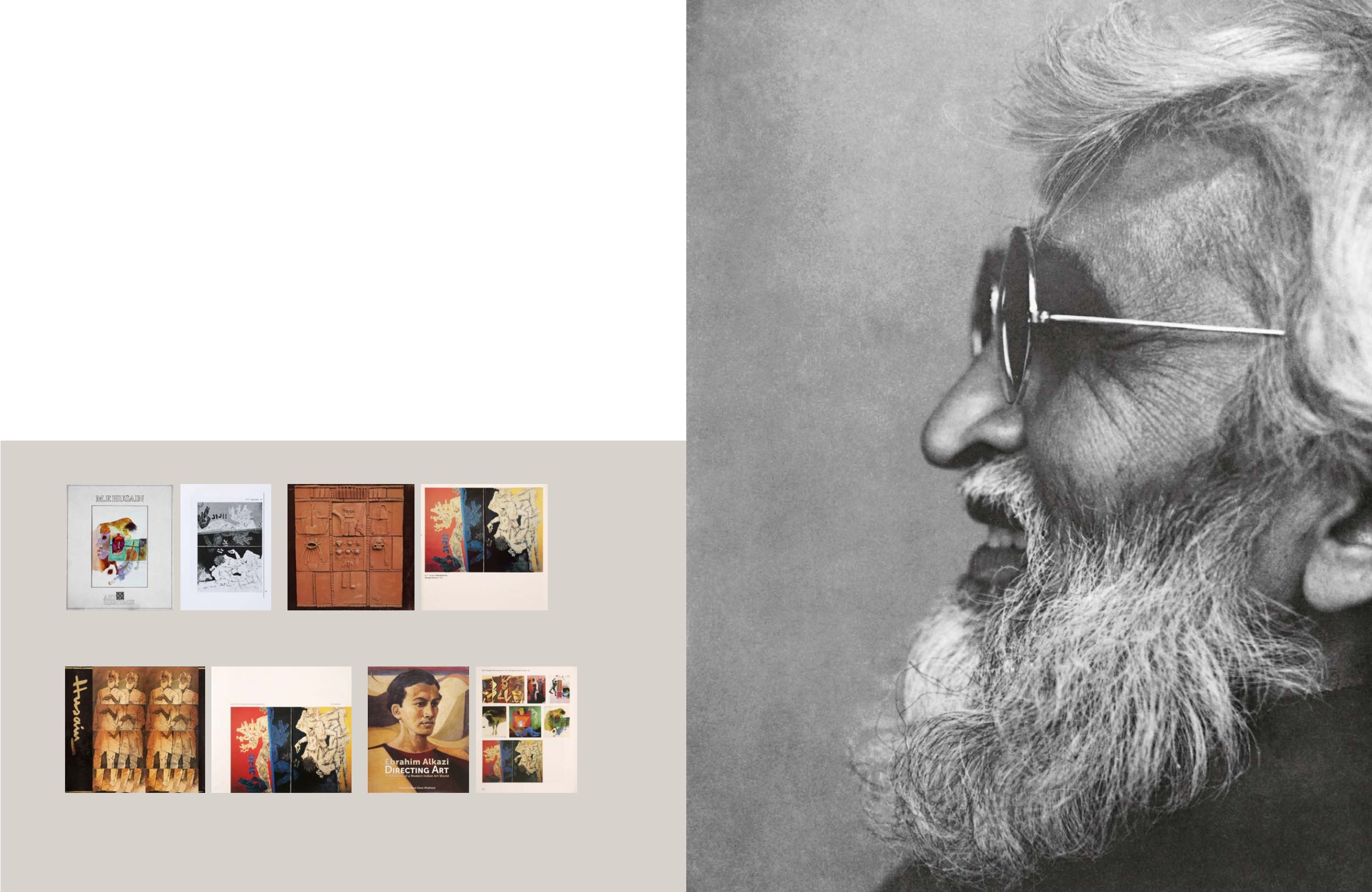
The present lot published in:
David Elliott and Ebrahim Alkazi eds.,
India: Myth & Reality, Aspects of
Modern Indian Art
, Oxford: Museum of Modern Art, 1982, p. 6
Image courtesy of M F Husain Foundation
Parul Dave‒Mukherji ed.,
Ebrahim Alkazi: Directing Art ‒ The
Making of a Modern Indian Art World
, Ahmedabad: Mapin
Publishing and New Delhi: Art Heritage Gallery, 2016, p. 66
Dr Daniel Herwitz,
Husain
, Bombay: Tata Steel Publications, 1998, p. 103
Ebrahim Alkazi,
M F Husain: The Modern Artist and Tradition
,
New Delhi: Art Heritage, 1978, pl. 33
18