



 14-15 / 112

4
MANJIT BAWA
(1941 ‒ 2008)
Untitled
Signed and dated ‘Manjit Bawa, 1992’ (on the reverse)
1992
Oil on canvas
57.75 x 64.5 in (147 x 164 cm)
Rs 3,00,00,000 ‒ 5,00,00,000
$ 428,575 ‒ 714,290
PROVENANCE
Christie’s, New York, 16 September 2008, lot 152
Saffronart, 9‒10 September 2009, lot 19
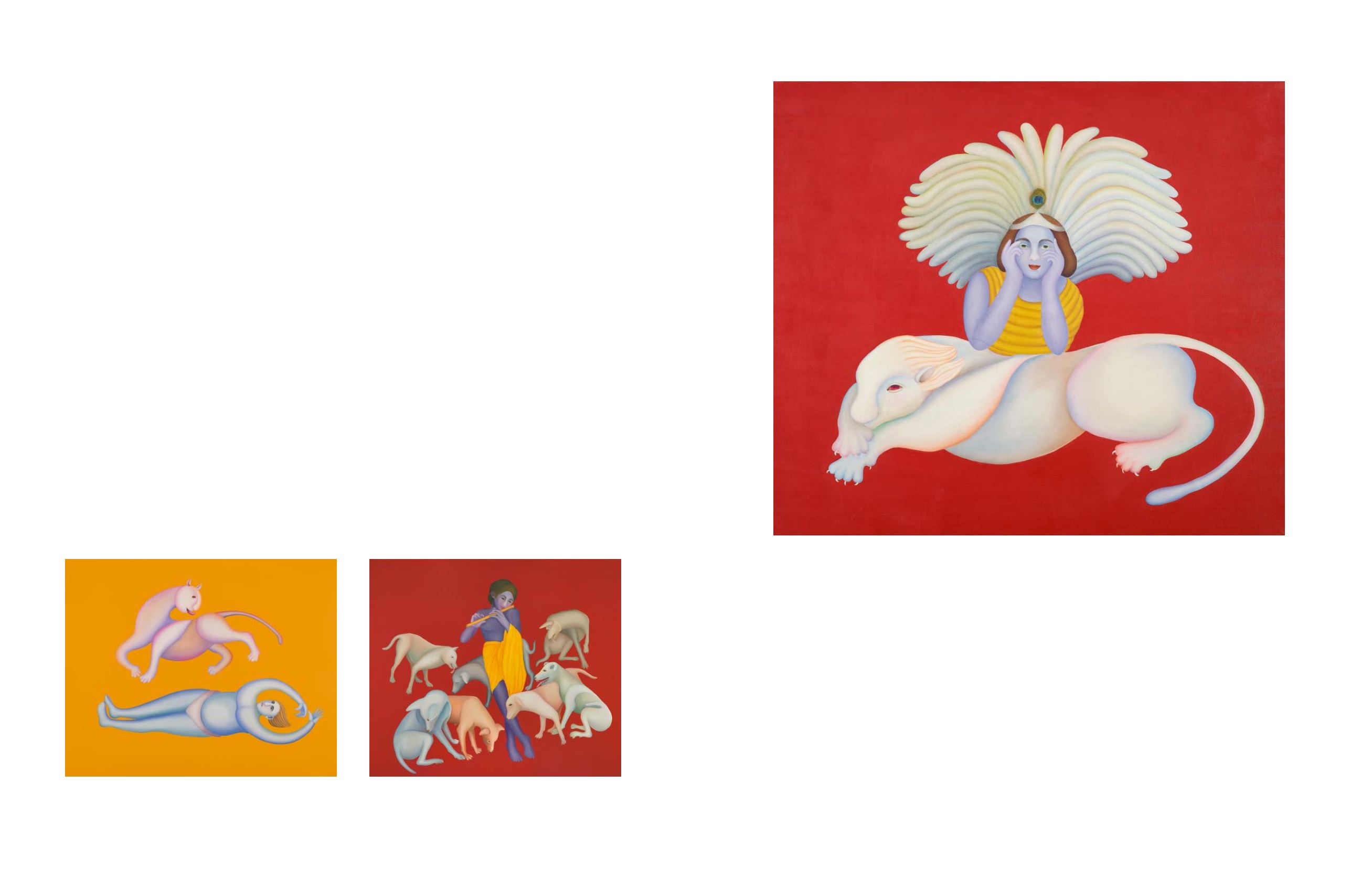
The central figure in this large, classic Bawa painting, set against a flat, vivid red background bears a strong resemblance to
Krishna, identified by the peacock feather that adorns his hair. Bawa was deeply influenced by Indian mythology, Pahari
miniature paintings and Sufism. In the present lot, the artist depicts his protagonist leaning over, almost fused with, a
supine lion – perhaps alluding to passages from the
Bhagavad Gita
where Krishna introduces himself as ‘Hari’ or lion,
or to Krishna’s transformation into the ‘Nrsimhadeva’ avatar where he transforms into a form that is half man, half lion.
Such intimate pairings of humans and animals in Bawa’s work, whether inspired by myth or everyday life in rural India,
highlight the artist’s lifelong interest in asymmetrical relationships and non‒verbal communication. Interacting with his
autistic son, Bawa often contemplated the ideal of a shared universal language through which all sentient beings could
express and share their experiences of the world with each other. "...in Bawa's paintings, humans and animals engage in a
wordless dialogue that throws its participants back onto an older, nearly forgotten language of instinct and intuition…
How, he appears to ask, do humans and animals account for one another's presence, share their responses? Bawa's
question unveils a deeper disquietude: how can two beings, who share the same physical environment but occupy
separate mental universes, compare their respective experiences of the world?" (Ranjit Hoskote,
Manjit Bawa: Modern
Miniatures, Recent Paintings
, New York: Bose Pacia, 2000)
Bawa deliberately stayed away from artistic movements prevalent at the time, choosing instead to develop a style
distinctly his own. He associated colour with Indianness, employing a rich palette to counter the sombre tones of British
art. The artist also worked as a silk‒screen printer in Britain in the 1960s, and this influence can be clearly discerned in the
uniform tones of his paintings. In his deceptively simple works, both human figures and animals are rendered with equal
care and delineation, and they seem to exist in an undisturbed world of understanding and communion. Art historian
Geeti Sen reinforces this notion, stating that, "This interaction between man and beast forms a vital undercurrent in all
Bawa's paintings. It is significant that the meditational form in his canvas could be an animal, as much as it could be a
human form or a demigod or a deity." (S Kalidas, Bhavna Bawa et al,
Manjit Bawa: Let's Paint the Sky Red
, New Delhi:
Vadehra Art Gallery, 2011, p. 77)
Untitled
, 2005
Saffronart, 13‒14 June 2018, lot 84
Sold for Rs 3.36 crores ($510,000)
Untitled
, 1992
Saffronart, 24 February 2016, lot 11
Sold for Rs 3.24 crores ($476,471)
14
15