



 16-17 / 112

M F Husain is perhaps among India’s most prolific modern artists whose unique visual idiom left an indelible mark on
the history of Indian art. A largely self‒taught artist, he began his career painting cinema billboards and then making toys,
before joining the Progressive Artists’ Group in 1947. During this formative period, right after Independence, Husain travelled
extensively, assimilating the techniques, colours and styles of Jain and Basohli painting, the sensuous forms of Mathura
sculpture, and the energy and fluid lines of Chinese calligraphy. His encounter with the works of European modern masters
including Klee, Picasso, Matisse and Modigliani helped him hone his own intuitions and perceptions regarding colour, form,
line and symbolism. These various stylistic influences, combined with his own rootedness in India, led him to invent a new
aesthetic vocabulary of modernity. “And in doing so, he was to become a legend in his lifetime, a man who delivers the
common man from the ordinariness of his existence to the international arena.” (Yashodhara Dalmia, “A Metaphor for
Modernity,”
The Making of Modern Indian Art: The Progressives
, Oxford University Press, New Delhi, 2001, p. 101)
Motivated by a desire to rediscover his Indian roots, Husain began painting works based on the
Ramayana
in the late 1960s.
This was followed by the
Mahabharata
series, including works such as the present lot. The first of these he painted as a
series of 27 works when he was invited to participate in the São Paulo Biennial in 1971. The present lot, painted in 1972, is
an important work in this series and was once part of the famous Chester and Davida Herwitz collection. In 1982, it was
exhibited at the seminal show
India: Myth & Reality, Aspects of Modern Indian Art
at the Museum of Modern Art in Oxford,
UK, curated by Ebrahim Alkazi, Victor Musgrave and David Elliot. In 2008, it sold in auction at $1.6 million, a world record
price for the artist at the time.
The epic of the
Mahabharata
, a founding text in Hindu mythology, details the many years of conflict between two warring
clans: the Pandavas (the heroes) and the Kauravas (the villains). Its ultimate thematic sentiment of right versus wrong –
influenced by the many complexities of morality, duty, power and fate – is one that has impacted the Hindu Indian psyche
on a social and anthropological level. “Husain’s concept is intensely poetic: with a stroke of genius, the entire mythic world
which has enriched the minds of the common people is brought vividly alive. Past and present, myth and reality are shown
to exist simultaneously in the Indian imagination.” (E Alkazi,
M F Husain: The Modern Artist & Tradition
, New Delhi: Art
Heritage, 1978, p. 17)
The struggle for territorial possession of Madhyadesa (North India) between the Pandavas and Kauravas forms the crux
of the
Mahabharata
, ultimately resulting in the epic battle of Kurukshetra, where Arjuna and his brothers defeat the evil
Kauravas. Throughout his career, Husain was preoccupied with pictorially engaging ancient Indian epics and to make them
“speak again in the light of recent Indian history and contemporary Indian geo‒political life. Specifically, he is convinced that
themes of fate and of power one finds in the
Mahabharata
and
Ramayana
are universally true of the modern world and can
be re‒enacted on the modern Indian canvas.” (Dr Daniel Herwitz,
Husain
, Bombay: Tata Steel, 1988, p. 22)
In contemporarising this myth, Husain focuses on the psychological component of the
Mahabharata
, and the metaphor it
represents about the internal moral struggles within an individual self. He explores this concept by quoting Gandhi: “I regard
Duryodhana and his party as the baser impulses in man, and Arjuna and his party as the higher impulses. The field of battle
is our own body. An eternal battle is going on between two camps and the poet seer has vividly described it.” (Quoted in
Herwitz, p. 25)
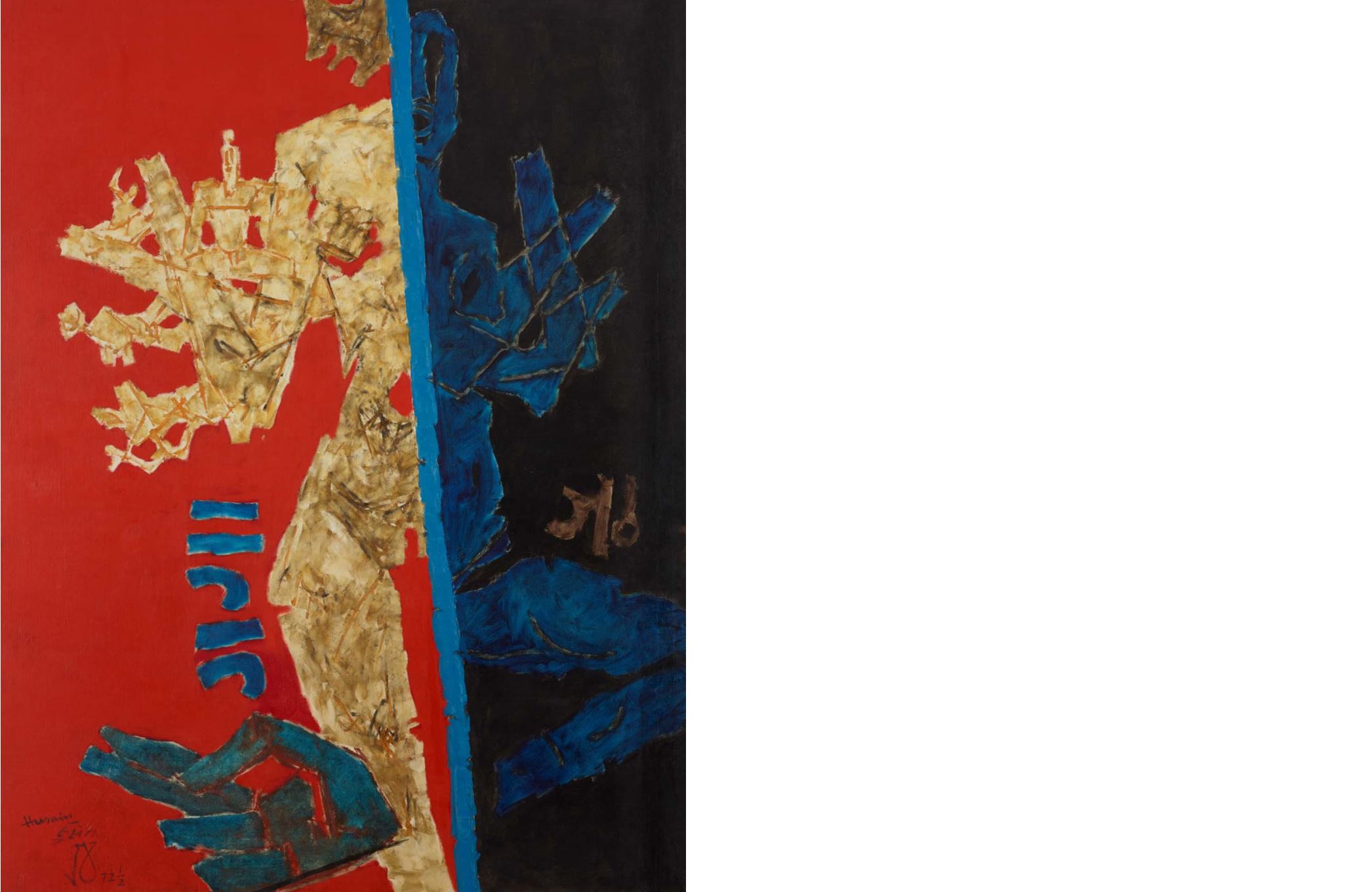
This metaphor can be similarly interpreted in the present lot. Here, two parts of a diptych have been joined together to form
one whole composition, depicting the battle between the rivers Ganga and Jamuna. Husain sections off the painting in three
distinct colour planes, while the urgent movement between the figures takes place in the foreground. The figure on the left,
cut across the centre, is a dual anthropomorphic representation of the eponymous rivers, who, in reality, are part of the same
source. They are two halves, in essence, representing the dichotomy of the human condition. Of a painting titled similarly,
17