



 36-37 / 112

8
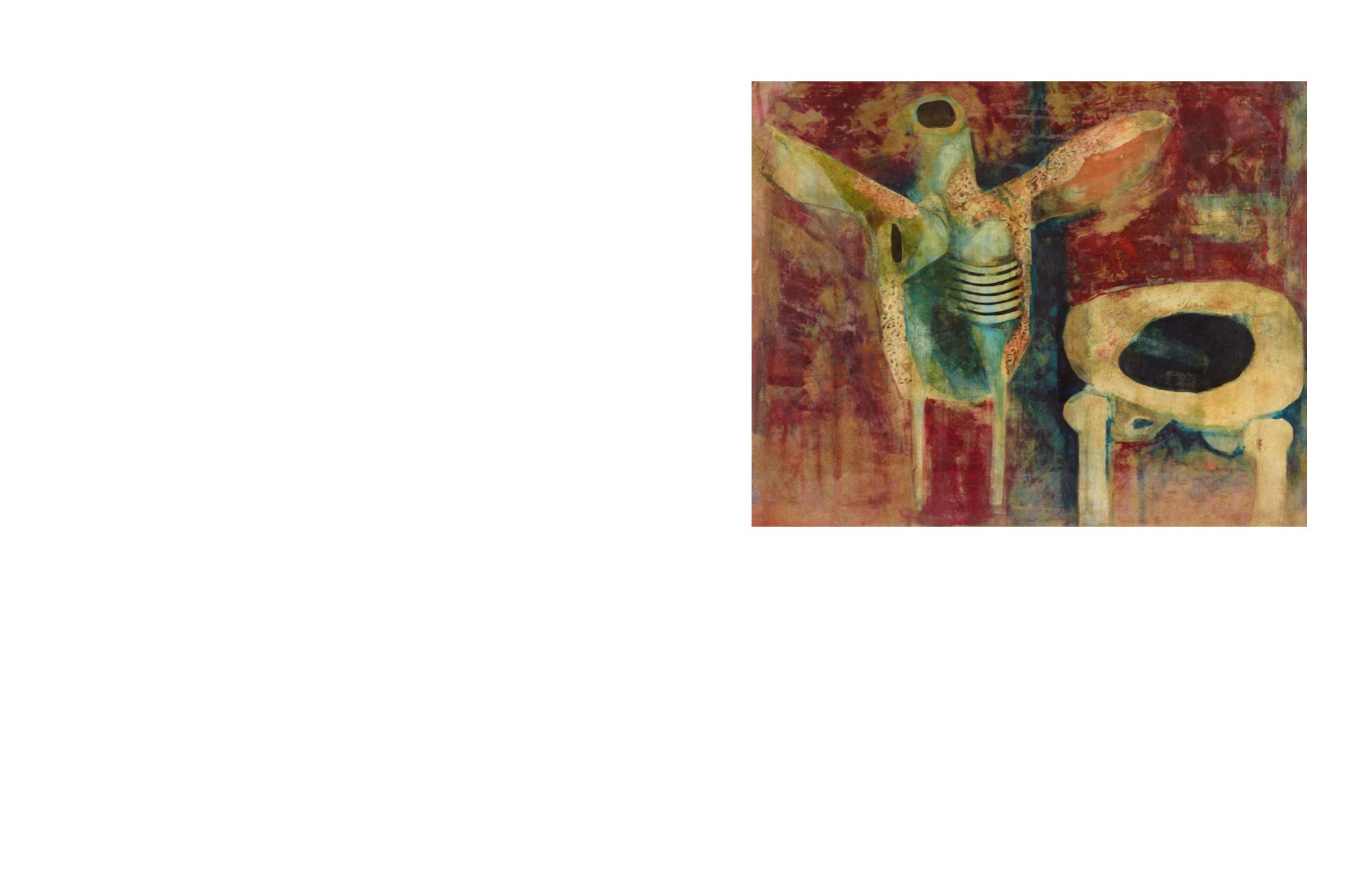
GANESH PYNE
(1937 ‒ 2013)
Untitled
Signed and dated in Bengali (lower left)
1966
Tempera on paper pasted on board
21.25 x 26.5 in (54 x 67 cm)
Rs 40,00,000 ‒ 60,00,000
$ 57,145 ‒ 85,715
PROVENANCE
Sotheby’s, New York, 16 September 2010, lot 53
Ganesh Pyne’s work is deeply personal and emotive, stemming from his experiences and familial legacy. Memories of the
fairy tales and epics narrated by his grandmother, and his childhood home and surroundings manifest in his paintings in
unconventional ways. “The architectural arabesque that was the family home, the strange‒looking shadows cast by the
listeners on the surrounding walls, the narrow lane… created the ambience of his grandmother’s tales.” (Sovon Som,
An
Enchanted Space: The Private World of Ganesh Pyne,
Kolkata: Centre of International Modern Art, 2005, p. 13) The dark,
gaping faces in the present lot can also be traced to “The family deity, Narayana, [who] had a strange appearance. His
iconic visage was a black, solid, rounded stone resting on a wooden torso… On festive occasions the icons were ritually
invoked with sandalwood‒paste marks indicating their features. The recurrent face of darkness, the black mask and the
hidden identity in Pyne’s paintings owe their origin to these iconic symbols.” (Som, p. 13)
In the 1960s, Pyne’s work underwent a period of experimentation and transition. The artist, who used to work primarily
with watercolours, began to grow dissatisfied with the medium. Till 1965, he worked mostly with ink and washes, though
he also explored mediums like gouache. He then moved to tempera to create opaque, monochromatic tones, as seen
in the present lot. This medium “helped him to refine his style to achieve a subtler articulation of emotions without
sacrificing the intensity of his feelings.” (Ella Datta,
Ganesh Pyne: His Life and Times,
Calcutta: Centre of International
Modern Art, 1998, p. 45) He learned the technique by reading extensively about other artists’ use of the medium, as well
as his own methods of trial and error.
Distancing himself from the European use of the medium, the artist said that “he was most indebted to the process
followed by the traditional Indian miniaturists,” and rather than an egg‒bound tempera, he would “prepare his own
powder pigments by reading the treatise
Shilpacharcha
by Nandlal Bose,” and also fashioned special, versatile brushes
for the purpose. (Datta, p. 46) The medium brought about a maturity and identity to Pyne’s work, which became more
angular, enigmatic and textured. The artist said that “the medium demanded” the change in his style henceforth. Being a
flat medium, working with tempera needed the painstaking application of “short, hatching strokes” to give it depth and
variation. (Datta, p. 46)
“The visual experience of my art is an extension of the colours and
forms absorbed in childhood.”
GANESH PYNE
36
37