



 46-47 / 112

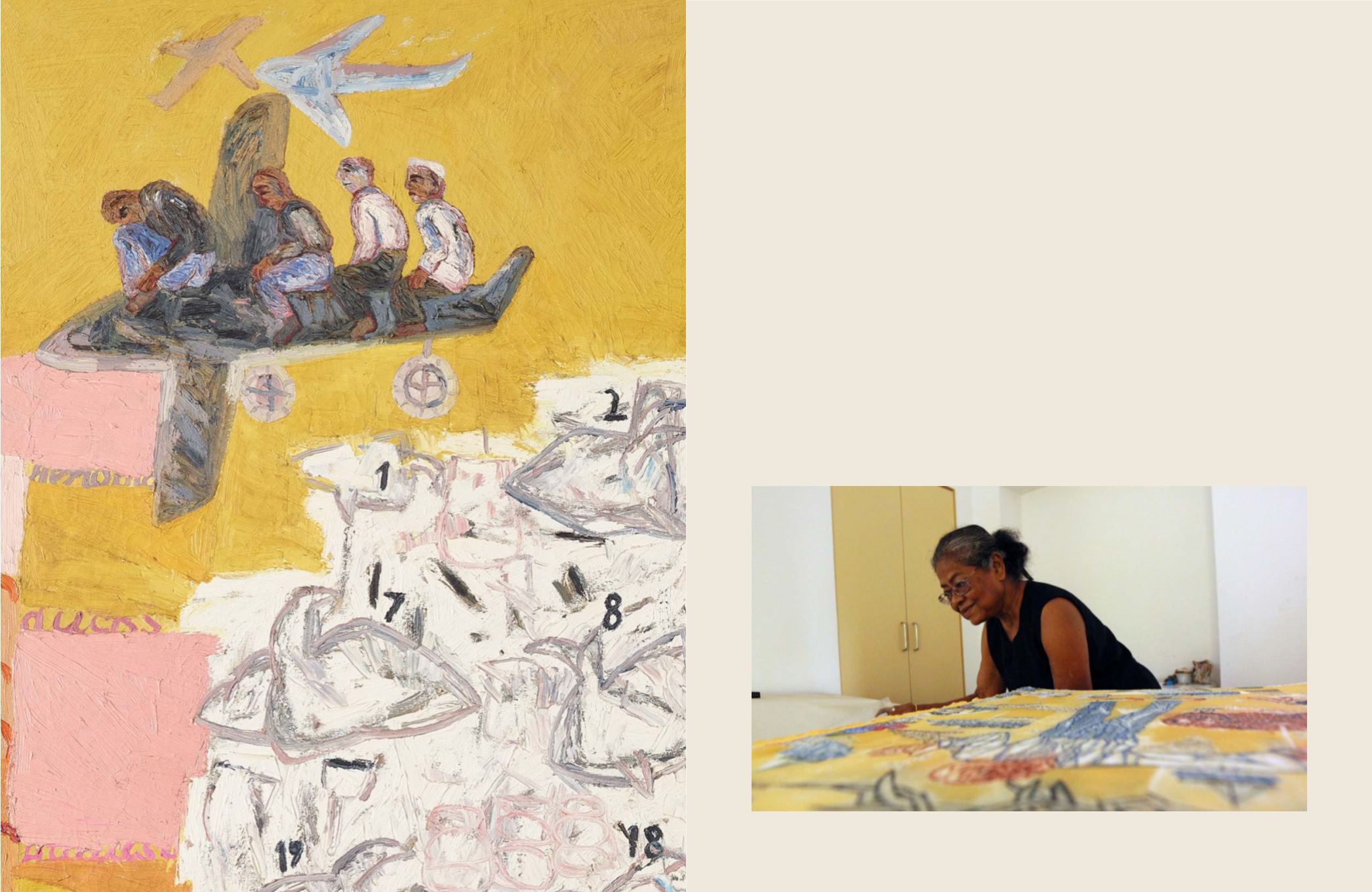
Arpita Singh’s paintings are known for their vibrant depiction of people, and everyday objects frequently present as
floating, recurring motifs. After graduating from the Delhi College of Art, she worked as a consulting designer with the
Weavers’ Service Centre, and her paintings often reflect the textures and ornamentation of textiles. “The relationship
of Arpita Singh’s paintings to textiles, imitating with paint the textile crafts – weaving, stitchery, embroidery, tapestry
– fosters a deceptive sense of comfort… the rhythm of the repeated elements in Singh’s paintings… while adding the
lyricism of modern poetry or music, might also function as a sort of visible mantra, a means of transporting the artist
– and perhaps the viewer – to another level of consciousness.” (Betty Seid ed.,
New Narratives: Contemporary Art from
India
, Ahmedabad: Mapin Publishing Pvt. Ltd., 2007, p. 42) The motifs that Singh uses add both personal and political
layers to the narratives she portrays.
People appear in the top corners of the present lot – on the left, a group of men ride an aeroplane, while on the right is a
supine, nude figure which the artist employs in her later paintings as "icon, as protagonist, sometimes naked – baring the
postmenopausal sexuality of her body, as cavernous as it is vulnerable." (Nilima Sheikh, "Of target‒flowers, spinal cords,
and (un)veilings,"
Arpita Singh: Memory Jars
, New York: Bose Pacia Modern, 2003) Both images, indicating departures
and ageing, underscore the significance of memories as an antidote to the passage of time. A vast portion of the canvas
is dominated by cloudy, dreamlike strokes – perhaps representing this nostalgia – embellished with motifs of ducks and
numbers from 1 to 27. These, in addition to a clock, indicate the “ceaseless march of calendar dates... Humans may struggle
to control time, tracking it incessantly with numbers, but it pushes ahead ceaselessly as the natural world progresses
irrespective of the human... The images on the edges of Singh's pictures may function as footnotes or addendums to the
main image, in these margins a fleeting thought or a whispered secret can be easily accommodated.” (Peter Nagy, “The
Simplest of Means of Arpita Singh,”
Arpita Singh: Memory Jars
, New York: Bose Pacia Modern, 2003)
© Manisha Gera Baswani
47