



 58-59 / 112

14
DESMOND LAZARO
(b. 1968)
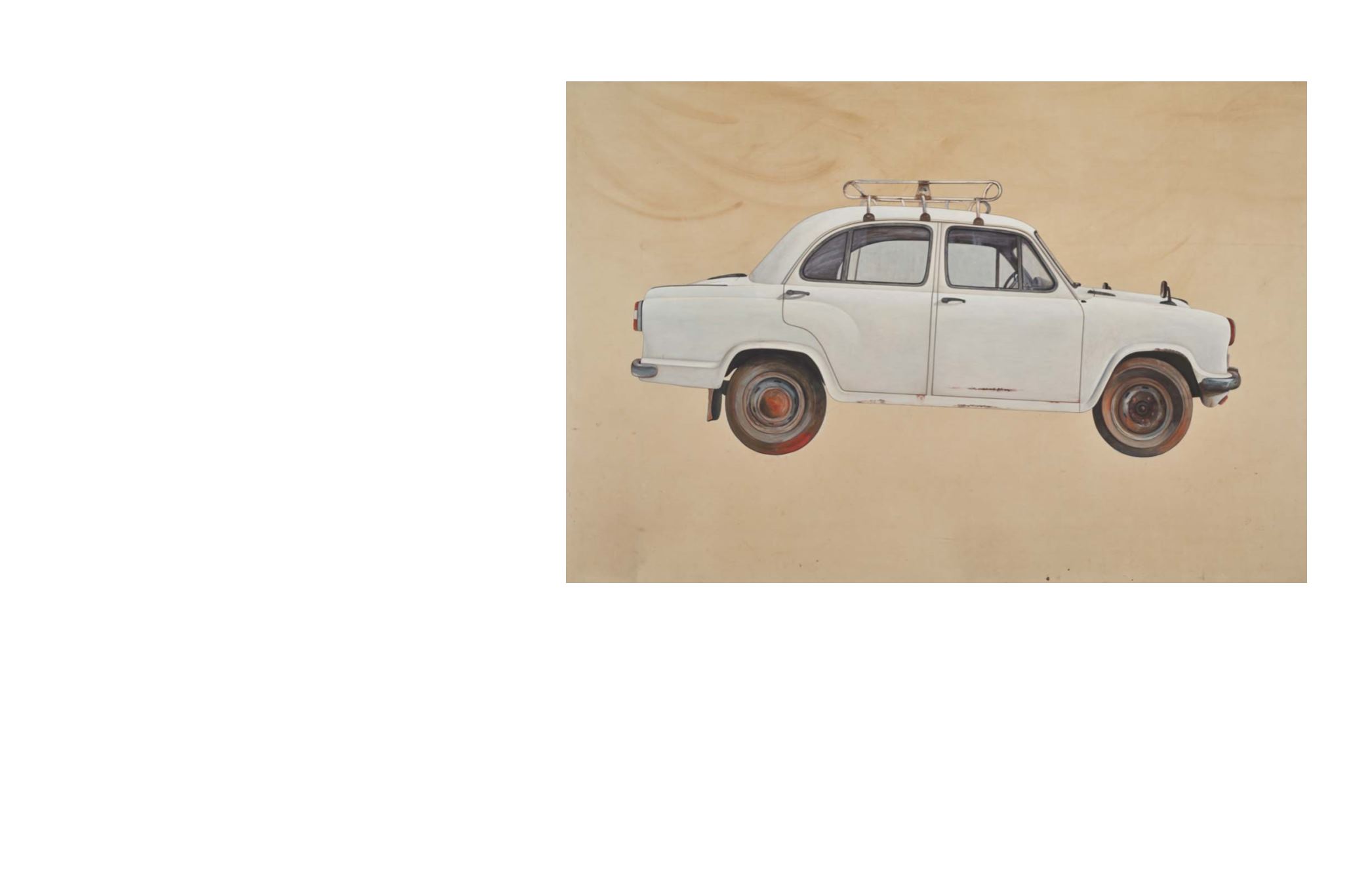
Untitled (Ambassador)
Natural pigments on linen
71.75 x 106.5 in (182.5 x 270.5 cm)
Rs 6,00,000 ‒ 8,00,000
$ 8,575 ‒ 11,430
PROVENANCE
Acquired from Chemould Prescott Road, Mumbai
British‒born artist Desmond Lazaro straddles the fine edge between
contemporary image‒making and traditional Indian aesthetics in his art.
In the present lot, he depicts a rundown‒looking Ambassador car, an
automobile associated strongly with Indian culture and once a symbol of
status and affluence. “Lazaro's larger skill lies in how he picks up elements
often throwbacks to the '70s and yet manages to retain a stark, contemporary
edge. For instance, an Ambassador is as retro as it gets. A rusted Ambassador
however is contemporary, for it has to be that old to be so jaded.” (Vishwas
Kulkarni, “Hands‒on and honed,”
Mumbai Mirror
, 17 September 2008, online)
By giving central focus to this quotidian object, Lazaro apotheosises the car
and gives the colonial relic a dignified status in the eyes of the viewer. “Lazaro’s
work… makes mundane objects into precious artefacts, their preciousness
enhanced by his use of pure jewel colours… The earlier works are more the
things he loves about India: objects that are for you as the viewer, and for him
as a painter, precious spaces to see.” (Naman Ahuja, “The hand that leads the
eye leads the hand,”
Desmond Lazaro: Paintings
, Mumbai: Chemould Prescott
Road, 2008, online) The emphasis on the enshrining of the everyday object
is reiterated by his use of special pigments derived organically and prepared
painstakingly in his studio.
While completing a Master’s in painting from the M S University of Baroda
in the early 1990s, Lazaro came across the master miniaturist Bannu Ved Pal
Sharma of Jaipur – recommended to him by Nilima and Gulammohammed
Sheikh. Lazaro served as his apprentice on and off for ten years, learning
traditional Indian art forms, which came to define his artistic practice. An
influential form in his work is that of the traditional
pichwai
, a 400‒year‒old
Rajasthani practice which depicts detailed narratives based on the Hindu
deity Krishna through intricate visuals on cloth. The study of
pichwais
formed
the basis of Lazaro’s PhD thesis, with a special focus on the cotton‒painted
pichwais
of the Pushtimarga sect at Nathdwara.
In works like the present lot, Lazaro combines the traditional methods of
miniature and
pichwai
painting with the modernist ideal of the singular,
mundane image, creating a successful marriage of the two. “In these…works
I continue to employ traditional techniques in a craftsman like manner
through the stringent preparation of all my materials: cloth, paper, brushes
and pigment colours. These materials are an integral part of the process of
painting. However, by changing the imagery, ‘context and meaning’ inevitably
shift. The
pichhvai
scale continues although the iconography moves from the
sacred to the secular; rusting cars, shards of modern life, modernity itself is
animated… the often‒discarded moments, people and places, ordinary and
everyday things, become elevated and transmuted.” (Artist quoted in Ahuja,
online)
58
59