


Page 49 - TransportationPlanUsetsGuide
P. 49
Roadway Safety
            Transportation safety is a complex subject due to the variety of factors that interact with each other during the course
            of a person’s use of the right-of-way. Road conditions, weather, driver attention, and user type (vehicle, pedestrian, etc.)
            are just some of the factors that come into play when considering the safety of a particular location. Predictive models
            are available, along with an¬ecdotal knowledge and experience with similar conditions. Traffic volumes, crash data, and
            on-site observations provide information to analyze locations and travel corridors and determine the types of improve-
            ments that would improve safety. Each situation and location is unique and requires engineering analysis and profes-
            sional judgment in determin¬ing appropriate safety improvements.

            Washington County transportation policies and actions are aimed at improving the overall safety of the County’s transpor-
            tation system. Modern techniques, industry standards, and best management practices are used for new construction and
            on-going maintenance of the transportation system in Washington County in order to create a safe and reliable network of
            roads and bridges. Washington County’s roads, bridges, and traffic safety appurtenances are engineered, constructed, and
            maintained to minimize fatalities and personal injuries, and reduce property damage. In addition, active presence by law
            enforcement personnel reinforces the rules of the road, contributing to a safer environment for all travelers. Tens of thou-
            sands of vehicles traverse Washington County roads on a daily basis and the vast majority of those trips are completed
            without incident. However, some locations may have a higher-than-average rate of accidents or crashes.


            Motor Vehicle Collision Data
            Traffic safety monitoring is based on historical crash data. Primary information comes from local police agency reports
            that are submitted to ODOT for processing and evaluation statewide. The ODOT Crash Analysis and Reporting Unit
            compiles data for reported motor vehicle traffic crashes occurring on city streets, county roads, and state highways. This
            data only reflects reported collisions involving motor vehicles; the number of actual collisions that occur is not known.
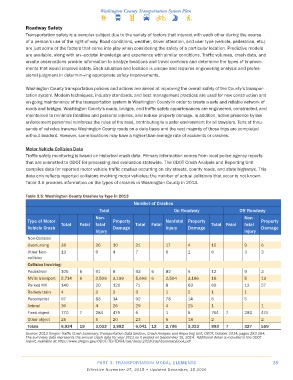
            Table 3.5 provides information on the types of crashes in Washington County in 2013.

            Table 3�5: Washington County Crashes by Type in 2013
                                                         Number of Crashes
                                           Total                          On Roadway                 Off Roadway
                                         Non-                                                          Non-
             Type of Motor   Total  Fatal  fatal   Property   Total  Fatal  Nonfatal  Property   Total Fatal  fatal   Property
             Vehicle Crash                      Damage                Injury    Damage                        Damage
                                         Injury                                                        Injury
             Non-Collision
             Overturning   36            26     10        21          17        4        15            9      6
             Other Non-    13            9      4         7           6         1        6             3      3
             collision
             Collision Involving:
             Pedestrian    105    6      91     8         93    6     82        5        12            9      3
             MV in transport  5,714  6   2,509  3,199     5,696  6    2,504     3,186    18            5      13
             Parked MV     140           20     120       71          8         63       69            12     57
             Railway train  4            2      2         3           1         2        1             1
             Pedalcyclist  97            83     14        92          78        14       5             5
             Animal        30            4      26        29          4         25       1                    1
             Fixed object  770    7      284    479       6           1         5        764   7       283    474
             Other object  25            5      20        23          5         18       2                    2
             Totals        6,934  19     3,033  3,882     6,041  12   2,706     3,323    893   7       327    559
            Source: 2013 Oregon Traffic Crash Summary, Transportation Data Section, Crash Analysis and Reporting Unit, ODOT, October 2014, pages 283-284.
            The summary data represents the annual crash data for year 2013 as it existed on September 15, 2014.  Additional detail is included in the ODOT
            report, available at: http://www.oregon.gov/ODOT/TD/TDATA/car/docs/2013CrashSummaryBook.pdf


                                          PART 3: TRANSPORTATION MODAL ELEMENTS                                    39
                                     Effective November 27, 2015 • Updated December, 15 2016

