


Page 111 - Rural Tourism Report Washington County
P. 111
CHAPTER 5: ASSESSMENT OF IMPACTS


                                                                The case study research also identified a number
                                                                of strategies useful in eliminating or mitigating
                                                                potential impacts.


                                                                These strategies include:
                                                                    • Traffic Control: Many of the participants
                                                                    cited the need to optimize traffic control
                                                                    procedures, tailored for their site, and to
                                                                    follow them consistently. This is critical for

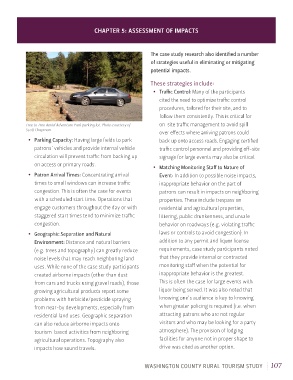
            Tree to Tree Aerial Adventure Park parking lot. Photo courtesy of    on-site traffic management to avoid spill-
            Scott Chapman
                                                                    over effects where arriving patrons could
                • Parking Capacity: Having large fields to park     back up onto access roads. Engaging certified
               patrons' vehicles and provide internal vehicle       traffic control personnel and providing off-site
               circulation will prevent traffic from backing up     signage for large events may also be critical.
               on access or primary roads.
                                                                    • Matching Monitoring Staff to Nature of
                • Patron Arrival Times: Concentrating arrival       Event: In addition to possible noise impacts,
               times to small windows can increase traffic          inappropriate behavior on the part of
               congestion. This is often the case for events        patrons can result in impacts on neighboring
               with a scheduled start time. Operations that         properties. These include trespass on
               engage customers throughout the day or with          residential and agricultural properties,
               staggered start times tend to minimize traffic       littering, public drunkenness, and unsafe
               congestion.                                          behavior on roadways (e.g. violating traffic

                • Geographic Separation and Natural                 laws or controls to avoid congestion). In
               Environment: Distance and natural barriers           addition to any permit and liquor license
               (e.g. trees and topography) can greatly reduce       requirements, case study participants noted
               noise levels that may reach neighboring land         that they provide internal or contracted
               uses. While none of the case study participants      monitoring staff when the potential for

               created airborne impacts (other than dust            inappropriate behavior is the greatest.
               from cars and trucks using gravel roads), those      This is often the case for large events with
               growing agricultural products report some            liquor being served. It was also noted that
               problems with herbicide/pesticide spraying           knowing one’s audience is key to knowing
               from near-by developments, especially from           when greater policing is required (i.e. when
               residential land uses. Geographic separation         attracting patrons who are not regular
               can also reduce airborne impacts onto                visitors and who may be looking for a party

               tourism-based activities from neighboring            atmosphere). The provision of lodging
               agricultural operations. Topography also             facilities for anyone not in proper shape to
               impacts how sound travels.                           drive was cited as another option.


                                                             WASHINGTON COUNTY RURAL TOURISM STUDY                107

