


Page 106 - Rural Tourism Report Washington County
P. 106
CHAPTER 5: ASSESSMENT OF IMPACTS


            This study considers tourism activities in the
            County’s rural areas -- existing, developing, and
            desired. One of the County’s goals was to evaluate

            potential regulatory controls on tourism activities.
            Understanding the nature of these activities and
            the types of impacts they may generate is central
            to regulating or guiding rural tourism in the
            County. This Chapter, "Assessment of Impacts,"
            will help inform decisions regarding appropriate
            levels of rural tourism activity to allow.


            The consulting team identified a range of activities
            leading to potential impacts, developed a
            framework for characterizing the related impacts,
            and established a set of strategies to mitigate

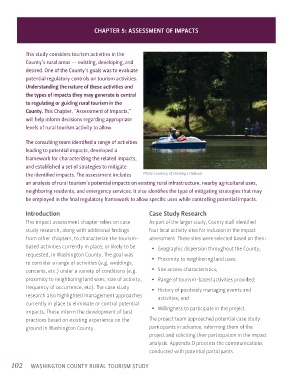
            the identified impacts. The assessment includes   Photo courtesy of Horning's Hideout
            an analysis of rural tourism’s potential impacts on existing rural infrastructure, nearby agricultural uses,
            neighboring residents, and emergency services. It also identifies the type of mitigating strategies that may
            be employed in the final regulatory framework to allow specific uses while controlling potential impacts.

            Introduction                                       Case Study Research

            This impact assessment chapter relies on case      As part of the larger study, County staff identified
            study research, along with additional findings     four local activity sites for inclusion in the impact
            from other chapters, to characterize the tourism-  assessment. These sites were selected based on their:
            based activities currently in place, or likely to be     • Geographic dispersion throughout the County;
            requested, in Washington County. The goal was

            to consider a range of activities (e.g. weddings,       • Proximity to neighboring land uses;
            concerts, etc.) under a variety of conditions (e.g.     • Site access characteristics;
            proximity to neighboring land uses, size of activity,     • Range of tourism-based activities provided;
            frequency of occurrence, etc). The case study           • History of positively managing events and
            research also highlighted management approaches        activities; and
            currently in place to eliminate or control potential
            impacts. These inform the development of best           • Willingness to participate in the project.
            practices based on existing experience on the      The project team approached potential case study
            ground in Washington County.                       participants in advance, informing them of the
                                                               project and soliciting their participation in the impact
                                                               analysis. Appendix D presents the communications

                                                               conducted with potential participants.

      102     WASHINGTON COUNTY RURAL TOURISM STUDY

