 |
You.i Engine
|


|
|
You.i Engine
|
|
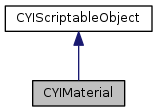
CYIMaterial is a place holder for all the drawing parameters required by the renderer to draw a mesh/shape.
The CYIMaterial is a component of the CYISceneNode, which describes what material to use to draw itself. This object is implicitly sharable.
#include <renderer/YiMaterial.h>
| CYIMaterial::CYIMaterial | ( | ) |
Constructor
| CYIMaterial::~CYIMaterial | ( | ) |
Destructor
| void CYIMaterial::ClearTextureSlot | ( | uint32_t | slot | ) |
Clear the data in the indicated texture slot, this data will no longer be sent to the renderer or accessible in any shader programs
| CYIRenderSystem::YI_BLEND_MODE CYIMaterial::GetBlendMode | ( | ) | const |
Returns the blending mode for this material
| const CYIColor& CYIMaterial::GetColor | ( | ) | const |
Get the color for this material
| CYIRenderSystem::YI_CULL_FACE CYIMaterial::GetCullFace | ( | ) | const |
Get the culling mode used for this material.
| const std::shared_ptr<CYIAssetShaderProgram>& CYIMaterial::GetShaderProgram | ( | ) | const |
Gets the shader program. If no shader program was set, it will return null. This function should typically be used only by the renderer.
| const std::shared_ptr<IYIUniformBufferObject>& CYIMaterial::GetShaderUniforms | ( | ) | const |
Gets the shader uniform buffer object. This construct is used to set shader uniform values that will be applied when this material is used in the renderer.
| std::shared_ptr<CYIAssetTextureBase> CYIMaterial::GetTexture | ( | uint32_t | slot | ) | const |
Gets the texture assigned to texture slot. If no texture were assigned to the given slot, it will return null. Slot should be between 0 and the maximum amount of texture units available on your target platform
| const std::map<uint32_t, std::shared_ptr<CYIAssetTextureBase> >& CYIMaterial::GetTextureBindings | ( | ) | const |
Returns the configured texture bindings for this material as an ordered map of the form (textureSlot, textureObject)
| const glm::mat3& CYIMaterial::GetTextureMatrix | ( | uint32_t | slot | ) | const |
Returns the texture matrix for the texture in slot slot.
| bool CYIMaterial::IsLoaded | ( | ) | const |
Returns true if all the available textures and shader programs are uploaded to the GPU, false otherwise.
| void CYIMaterial::SetBlendMode | ( | CYIRenderSystem::YI_BLEND_MODE | mode | ) |
Set the blending mode for this material
| void CYIMaterial::SetColor | ( | const CYIColor & | color | ) |
Set the color for this material
| void CYIMaterial::SetCullFace | ( | CYIRenderSystem::YI_CULL_FACE | eCullingMode | ) |
Set the cullingMode to be used for this material.
| void CYIMaterial::SetShaderProgram | ( | const std::shared_ptr< CYIAssetShaderProgram > & | pShaderProgram | ) |
Sets the shader program. Null shader program is allowed, but won't deallocate the previously set shader program.
| void CYIMaterial::SetTexture | ( | uint32_t | slot, |
| const std::shared_ptr< CYIAssetTextureBase > & | pTexture, | ||
| float * | pTextureMatrix = nullptr |
||
| ) |
Assigns a texture to a texture slot. Null textures are allowed, but won't deallocate the previously set texture. Slot should be between 0 and the maximum amount of texture units available on your target platform.
Each texture has an associated 3x3 pTextureMatrix, which can be used to re-map texture coordinates to a different space inside the texture, this is useful for things like animated textures or texture atlases. Passing nullptr for this matrix equates to using the identity matrix. For platforms that don't support non-power-of-two textures, the matrix will be scaled to re-map the coordinate space to the subregion of the power-of-two texture that contains the image.
The provided pTexture will be bound to the slot sampler location.
| void CYIMaterial::SetTexture | ( | uint32_t | slot, |
| const std::shared_ptr< CYIAssetTextureBase > & | pTexture, | ||
| const glm::mat3 | textureMatrix | ||
| ) |
 1.8.11
  Public Member Functions inherited from