


Page 75 - TransportationPlanUsetsGuide
P. 75
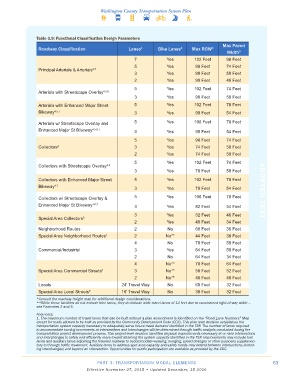
Table 3.9: Functional Classification Design Parameters
                                                                                              Max Paved
                 Roadway Classification                Lanes 1     Bike Lanes 2  Max ROW  3
                                                                                                Width 3
                                                         7             Yes        122 Feet      98 Feet
                                                         5             Yes         98 Feet      74 Feet
                 Principal Arterials & Arterials 4,5
                                                         3             Yes         90 Feet      50 Feet
                                                         2             Yes         90 Feet      48 Feet
                                                         5             Yes        102 Feet      74 Feet
                 Arterials with Streetscape Overlay 4,5,6
                                                         3             Yes         90 Feet      50 Feet

                 Arterials with Enhanced Major Street    5             Yes        102 Feet      78 Feet
                 Bikeway 4,5,7                           3             Yes         90 Feet      54 Feet

                 Arterials w/ Streetscape Overlay and    5             Yes        106 Feet      78 Feet
                 Enhanced Major St Bikeway 4,5,6,7       3             Yes         90 Feet      54 Feet

                                                         5             Yes         98 Feet      74 Feet
                 Collectors 4                            3             Yes         74 Feet      50 Feet
                                                         2             Yes         74 Feet      50 Feet

                                                         5             Yes        102 Feet      74 Feet
                 Collectors with Streetscape Overlay 4,6
                                                         3             Yes         78 Feet      50 Feet
                 Collectors with Enhanced Major Street   5             Yes        102 Feet      78 Feet
                 Bikeway 4,7                             3             Yes         78 Feet      54 Feet       ADOPTED TEXT

                 Collectors w/ Streetscape Overlay &     5             Yes        106 Feet      78 Feet
                 Enhanced Major St Bikeway 4,6,7         3             Yes         82 Feet      54 Feet
                                                         3             Yes         52 Feet      46 Feet
                 Special Area Collectors 5
                                                         2             Yes         40 Feet      34 Feet
                 Neighborhood Routes                     2             No          60 Feet      36 Feet
                 Special Area Neighborhood Routes 5      2            No**         44 Feet      38 Feet
                                                         4             No          70 Feet      50 Feet
                 Commercial/Industrial                   3             Yes         64 Feet      50 Feet
                                                         2             No          64 Feet      34 Feet
                                                         4            No**         70 Feet      64 Feet
                 Special Area Commercial Streets 5       3            No**         58 Feet      52 Feet
                                                         2            No**         46 Feet      40 Feet
                 Locals                             24’ Travel Way     No          60 Feet      32 Feet
                 Special Area Local Streets 5       16’ Travel Way     No          38 Feet      32 Feet
                *Consult the roadway freight map for additional design considerations.
                **While these facilities do not include bike lanes, they do include wide travel lanes of 14 feet due to constrained right-of-way width –
                see Footnotes 2 and 5.
                Footnotes:
                1. The maximum number of travel lanes that can be built without a plan amendment is identified on the “Road Lane Numbers” Map
                except for roads allowed to be built as provided by the Community Development Code (CDC). This plan-level decision establishes the
                transportation system capacity necessary to adequately serve future travel demand identified in the TSP. The number of lanes required
                to accommodate turning movements at intersections and interchanges will be determined through traffic analysis conducted during the
                transportation project development process. This project-level decision identifies physical improvements necessary at or near intersections
                and interchanges to safely and efficiently move toward attaining the system capacity identified in the TSP. Improvements may include turn
                lanes and auxiliary lanes adjoining the traveled roadway to accommodate weaving, merging, speed changes or other purposes supplemen-
                tary to through traffic movement. Auxiliary lanes to address spot area capacity and safety needs may extend between intersections (includ-
                ing interchanges) and beyond an intersection. Opportunities for public participation are available as provided by the CDC.


                                          PART 3: TRANSPORTATION MODAL ELEMENTS                                    63
                                     Effective November 27, 2015 • Updated December, 15 2016

