


Page 144 - TransportationPlanUsetsGuide
P. 144
PEDESTRIAN ELEMENT
            Walking, the most basic form of human travel,
            plays a fundamental role in the transporta-
            tion system and has many advantages: travel
            times are predictable, expenses are minimal,
            and health benefits are proven. For Washing-
            ton County, a shift to more walking trips could
            reduce the need for and/or scope of roadway
            and parking facilities, especially in regional and
            town centers. Compared to facilities for other
            modes, walkways are easy to maintain and
            inexpensive to install. A good pedestrian net-
            work also supports and leverages investments
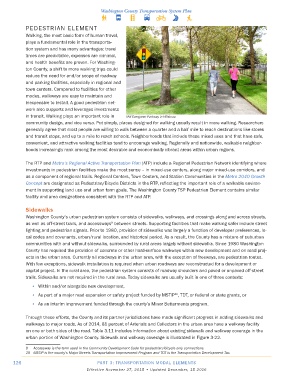
            in transit. Walking plays an important role in   NW Evergreen Parkway in Hillsboro
            community design, and vice versa. Put simply, places designed for walking usually result in more walking. Researchers
            generally agree that most people are willing to walk between a quarter and a half mile to reach destinations like stores
            and transit stops, and up to a mile to reach schools. Neighborhoods that include these mixed uses and that have safe,
            convenient, and attractive walking facilities tend to encourage walking. Regionally and nationwide, walkable neighbor-
            hoods increasingly rank among the most desirable and economically vibrant areas within urban regions.


            The RTP and Metro’s Regional Active Transportation Plan (ATP) include a Regional Pedestrian Network identifying where
            investments in pedestrian facilities make the most sense – in mixed-use centers, along major mixed-use corridors, and
            as a component of regional trails. Regional Centers, Town Centers, and Station Communities in the Metro 2040 Growth
            Concept are designated as Pedestrian/Bicycle Districts in the RTP, reflecting the important role of a walkable environ-
            ment in supporting land use and urban form goals. The Washington County TSP Pedestrian Element contains similar
            facility and area designations consistent with the RTP and ATP.


            Sidewalks
            Washington County’s urban pedestrian system consists of sidewalks, walkways, and crossings along and across streets,
            as well as off-street trails, and accessways  between streets. Supporting facilities that make walking safer include street
                                               9
            lighting and pedestrian signals. Prior to 1980, provision of sidewalks was largely a function of developer preferences, lo-
            cal codes and covenants, urban/rural location, and historical period. As a result, the County has a mixture of suburban
            communities with and without sidewalks, surrounded by rural areas largely without sidewalks. Since 1980 Washington
            County has required the provision of concrete or other hard-surface walkways within new development and on road proj-
            ects in the urban area. Currently all roadways in the urban area, with the exception of freeways, are pedestrian routes.
            With few exceptions, sidewalk installation is required when urban roadways are reconstructed for a development or
            capital project. In the rural area, the pedestrian system consists of roadway shoulders and paved or unpaved off-street
            trails. Sidewalks are not required in the rural area. Today sidewalks are usually built in one of three contexts:
              •  Within and/or alongside new development,
              •  As part of a major road expansion or safety project funded by MSTIP , TDT, or federal or state grants, or
                                                                          10
              •  As an interim improvement funded through the county’s Minor Betterments program.


            Through these efforts, the County and its partner jurisdictions have made significant progress in adding sidewalks and
            walkways to major roads. As of 2014, 81 percent of Arterials and Collectors in the urban area have a walkway facility
            on one or both sides of the road. Table 3.11 includes information about existing sidewalk and walkway coverage in the
            urban portion of Washington County. Sidewalk and walkway coverage is illustrated in Figure 3-22.

            9   Accessway is the term used in the Community Development Code for pedestrian/bicycle only connections.
            10   MSTIP is the county’s Major Streets Transportation Improvement Program and TDT is the Transportation Development Tax.

      126                                 PART 3: TRANSPORTATION MODAL ELEMENTS
                                     Effective November 27, 2015 • Updated December, 15 2016

