


Page 145 - TransportationPlanUsetsGuide
P. 145
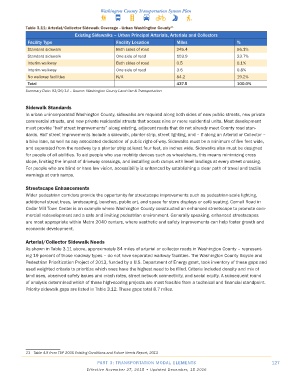
Table 3�11: Arterial/Collector Sidewalk Coverage - Urban Washington County 11
                                Existing Sidewalks – Urban Principal Arterials, Arterials and Collectors
             Facility Type                        Facility Location        Miles                    %
             Standard sidewalk                    Both sides of road       245.4                    56.1%
             Standard sidewalk                    One side of road         103.9                    23.7%
             Interim walkway                      Both sides of road       0.5                      0.1%
             Interim walkway                      One side of road         3.6                      0.8%
             No walkway facilities                N/A                      84.2                     19.2%
             Total                                                         437�5                    100�0%
            Summary Date: 03/26/14 – Source: Washington County Land Use & Transportation


            Sidewalk Standards
            In urban unincorporated Washington County, sidewalks are required along both sides of new public streets, new private
            commercial streets, and new private residential streets that access nine or more residential units. Most development
            must provide “half street improvements” along existing, adjacent roads that do not already meet County road stan-
            dards. Half street improvements include a sidewalk, planter strip, street lighting, and – if along an Arterial or Collector –
            a bike lane, as well as any associated dedication of public right-of-way. Sidewalks must be a minimum of five feet wide,
            and separated from the roadway by a planter strip at least four feet, six inches wide. Sidewalks also must be designed
            for people of all abilities. To aid people who use mobility devices such as wheelchairs, this means minimizing cross
            slope, limiting the impact of driveway crossings, and installing curb ramps with level landings at every street crossing.
            For people who are blind or have low vision, accessibility is enhanced by establishing a clear path of travel and tactile
            warnings at curb ramps.

            Streetscape Enhancements
            Wider pedestrian corridors provide the opportunity for streetscape improvements such as pedestrian-scale lighting,
            additional street trees, landscaping, benches, public art, and space for store displays or café seating. Cornell Road in
            Cedar Mill Town Center is an example where Washington County constructed an enhanced streetscape to promote com-
            mercial redevelopment and a safe and inviting pedestrian environment. Generally speaking, enhanced streetscapes
            are most appropriate within Metro 2040 centers, where aesthetic and safety improvements can help foster growth and
            economic development.

            Arterial/Collector Sidewalk Needs
            As shown in Table 3.11 above, approximately 84 miles of arterial or collector roads in Washington County – represent-
            ing 19 percent of those roadway types – do not have separated walkway facilities. The Washington County Bicycle and
            Pedestrian Prioritization Project of 2013, funded by a U.S. Department of Energy grant, took inventory of these gaps and
            used weighted criteria to prioritize which ones have the highest need to be filled. Criteria included density and mix of
            land uses, observed safety issues and crash rates, street network connectivity, and social equity. A subsequent round
            of analysis determined which of those high-scoring projects are most feasible from a technical and financial standpoint.
            Priority sidewalk gaps are listed in Table 3.12. These gaps total 8.7 miles.


            11   Table 4.8 from TSP 2035 Existing Conditions and Future Needs Report, 2013

                                          PART 3: TRANSPORTATION MODAL ELEMENTS                                   127
                                     Effective November 27, 2015 • Updated December, 15 2016

