


Page 117 - TransportationPlanUsetsGuide
P. 117
Metro Regional Freight Plan
            The 2010 Metro Regional Freight Plan, an element of the RTP, provides data and analysis of freight and goods move-
            ment in the Portland metropolitan region. The plan describes the close relationship between freight transportation,
            trade, and economic growth; and provides an action plan and a tool kit of strategies designed to address freight needs
            and issues in conjunction with the RTP and the 2040 Growth Concept. The plan identifies locations of recurring highway
            congestion (chokepoints) that affect freight movement. Locations and issues identified in Washington County include:

              •  I-5 Corridor (south of OR 217): the corridor is reaching capacity and carries a larger percentage of trucks;
              •  OR 217: inadequate interchange spacing leads to merge/weave congestion and accidents near interchang-
                 es at Southwest Beaverton-Hillsdale Highway, Allen Boulevard, and Denney Road;
              •  Non-continuous or Awkward Parallel Arterials and Connections: improved connections to current or emerg-
                 ing industrial areas are needed (e.g., I-5/OR 99W connector); and
              •  Last-mile chokepoints: locations that experience congested last-mile local industry connectors (e.g., SW
                 124th Avenue from Tualatin-Sherwood Road to the I-5/Elligsen Road interchange).

            Improved access to the North Wilsonville-Tualatin-Sherwood industrial area has been identified as one of the highest
            priority road improvements in the region. OR 99W through Tigard also is identified as a core throughway system bottle-
            neck, with substantial freight impacts. While truck traffic makes up the dominant share of freight movement, upgrades
            to rail main line and rail yard infrastructure also were identified as critical transportation needs. A prioritized project list
            developed by Metro’s Regional Freight and Goods Movement Task Force (2008) is included in the Regional Freight Plan.
            These projects are categorized as high, medium-high, medium-low, or low regional priority, and may not be included in
            the financially constrained RTP project list. The highest priority freight-related projects identified for Washington County
            were identified as medium-high priority projects in the RTP, since the Task Force did not identify any high priority freight
            projects for Washington County.


            Portland Region Economic
            Corridor Evaluation Report
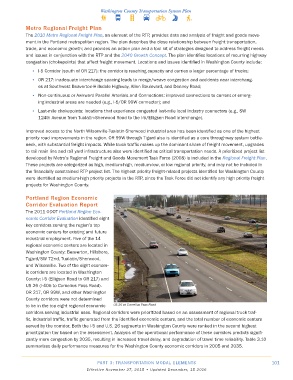
            The 2011 ODOT Portland Region Eco-
            nomic Corridor Evaluation identified eight
            key corridors serving the region’s top
            economic centers for existing and future
            industrial employment. Five of the 14
            regional economic centers are located in
            Washington County: Beaverton, Hillsboro,
            Tigard/SW 72nd, Tualatin/Sherwood,
            and Wilsonville. Two of the eight econom-
            ic corridors are located in Washington
            County: I-5 (Elligsen Road to OR 217) and
            US 26 (I-405 to Cornelius Pass Road).
            OR 217, OR 99W, and other Washington
            County corridors were not determined
            to be in the top eight regional economic   US 26 at Cornelius Pass Road
            corridors serving industrial uses. Regional corridors were prioritized based on an assessment of regional truck traf-
            fic, industrial traffic, traffic generated from the identified economic centers, and the total number of economic centers
            served by the corridor. Both the I-5 and U.S. 26 segments in Washington County were ranked in the second highest
            prioritization tier based on the assessment. Analysis of the operational performance of these corridors predicts signifi-
            cantly more congestion by 2035, resulting in increased travel delay, and degradation of travel time reliability. Table 3.10
            summarizes daily performance measures for the Washington County economic corridors in 2005 and 2035.


                                          PART 3: TRANSPORTATION MODAL ELEMENTS                                    101
                                     Effective November 27, 2015 • Updated December, 15 2016

