


Page 116 - TransportationPlanUsetsGuide
P. 116
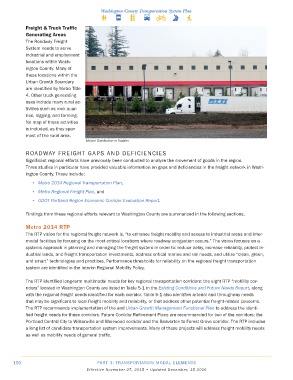
Freight & Truck Traffic
            Generating Areas
            The Roadway Freight
            System needs to serve
            industrial and employment
            locations within Wash-
            ington County. Many of
            these locations within the
            Urban Growth Boundary
            are identified by Metro Title
            4. Other truck generating
            uses include many rural ac-
            tivities such as rock quar-
            ries, logging, and farming.
            No map of these activities
            is included, as they span
            most of the rural area.
                                     Mclane Distribution in Tualatin

            ROADWAY FREIGHT GAPS AND DEFICIENCIES
            Significant regional efforts have previously been conducted to analyze the movement of goods in the region.
            Three studies in particular have provided valuable information on gaps and deficiencies in the freight network in Wash-
            ington County. These include:

              •  Metro 2014 Regional Transportation Plan,
              •  Metro Regional Freight Plan, and

              •  ODOT Portland Region Economic Corridor Evaluation Report.

            Findings from these regional efforts relevant to Washington County are summarized in the following sections.

            Metro 2014 RTP
            The RTP vision for the regional freight network is, “to enhance freight mobility and access to industrial areas and inter-
            modal facilities by focusing on the most critical locations where roadway congestion occurs.” The vision focuses on a
            systems approach in planning and managing the freight system in order to: reduce delay, increase reliability, protect in-
            dustrial lands, and freight transportation investments, address critical marine and rail needs, and utilize “clean, green,
            and smart” technologies and practices. Performance thresholds for reliability on the regional freight transportation
            system are identified in the Interim Regional Mobility Policy.

            The RTP identified long-term multimodal needs for key regional transportation corridors; the eight RTP “mobility cor-
            ridors” located in Washington County are listed in Table 5-1 in the Existing Conditions and Future Needs Report, along
            with the regional freight needs identified for each corridor. Table 5-1 also identifies arterial and throughway needs
            that may be significant to local freight mobility and reliability, or that address other potential freight-related concerns.
            The RTP recommends implementation of the and Urban Growth Management Functional Plan to address the identi-
            fied freight needs for these corridors. Future Corridor Refinement Plans are recommended for two of the corridors: the
            Portland Central City to Wilsonville and Sherwood corridor and the Beaverton to Forest Grove corridor. The RTP includes
            a long list of candidate transportation system improvements. Many of these projects will address freight mobility needs
            as well as mobility needs of general traffic.


      100                                 PART 3: TRANSPORTATION MODAL ELEMENTS
                                     Effective November 27, 2015 • Updated December, 15 2016

