


Page 80 - Rural Tourism Report Washington County
P. 80
CHAPTER 4: RURAL TOURISM REGULATORY FRAMEWORK


                                                                  Right to Farm Law

                                                                  According to the Oregon Department of
                                                                  Agriculture, the Right to Farm Law (adopted
                                                                  1993, updated 1995 and 2001) declares farm
                                                                  and forest practices critical to the welfare
                                                                  of Oregon’s economy. The law limits local
                                                                  governments and special districts from
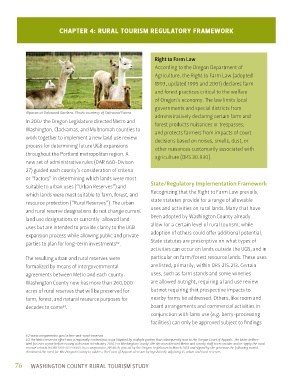
            Alpacas at Oakwood Gardens. Photo courtesy of Oakwood Farms
                                                                  administratively declaring certain farm and
            In 2007 the Oregon Legislature directed Metro and     forest products nuisances or trespasses,
            Washington, Clackamas, and Multnomah counties to      and protects farmers from impacts of court
            work together to implement a new land use review      decisions based on noises, smells, dust, or
            process for determining future UGB expansions         other nuisances customarily associated with
            throughout the Portland metropolitan region. A        agriculture (ORS 30.930).
            new set of administrative rules (OAR 660-Divison
            27) guided each county’s consideration of criteria

            or “factors” in determining which lands were most
            suitable to urban uses (“Urban Reserves”) and       State/Regulatory Implementation Framework
            which lands were most suitable to farm, forest, and   Recognizing that the Right to Farm Law prevails,
            resource protection (“Rural Reserves”). The urban   state statutes provide for a range of allowable
            and rural reserve designations do not change current   uses and activities on rural lands. Many that have
            land use designations or currently-allowed land     been adopted by Washington County already
            uses but are intended to provide clarity to the UGB   allow for a certain level of rural tourism, while
            expansion process while allowing public and private   adoption of others could offer additional potential.
            parties to plan for long-term investments .         State statutes are prescriptive on what types of
                                                  62
                                                                activities can occur on lands outside the UGB, and in
            The resulting urban and rural reserves were         particular on farm/forest resource lands. These uses
            formalized by means of intergovernmental            are listed, primarily, within ORS 215.213. Certain

            agreements between Metro and each county.           uses, such as farm stands and some wineries
            Washington County now has more than 260,000         are allowed outright, requiring a land use review
            acres of rural reserves that will be preserved for   but not requiring that prospective impacts to
            farm, forest, and natural resource purposes for     nearby farms be addressed. Others, like room and
            decades to come .                                   board arrangements and commercial activities in
                           63
                                                                conjunction with farm use (e.g. berry-processing
                                                                facilities) can only be approved subject to findings


            62 www.oregonmetro.gov/urban-and-rural-reserves
            63 The Metro reserves effort was a regionally contentious issue litigated by multiple parties that subsequently was to the Oregon Court of Appeals. The latter deliber-
            ated for over a year before issuing a decision in February 2014. For Washington County, the decision directed Metro and county staff to reconsider and re-apply the rural
            reserve criteria in OAR 660-027-0060. In a compromise, HB 4078, passed by the Oregon Legislature in March 2014 and signed by the governor the following month,
            eliminated the need for Washington County to address the Court of Appeals decision by legislatively adjusting its urban and rural reserves.

       76     WASHINGTON COUNTY RURAL TOURISM STUDY

