


Page 85 - Rural Tourism Report Washington County
P. 85
CHAPTER 4: RURAL TOURISM REGULATORY FRAMEWORK


            Recently Adopted Legislation                        Washington County Land Use Regulations
            Several bills related to rural tourism were enacted in

            the 2015 Oregon Legislative Session, as follows:    Affected Washington County Rural Land Use
                                                                Districts
            Senate Bill 341 & ORS 30.687-67 – Limited           Washington County’s resource districts where the
            Liability for Agritourism Providers and Equine      majority of agricultural production occurs are the
            Activity Operators                                  Exclusive Farm Use (EFU) and Agriculture/Forest
            To facilitate the expansion of rural tourism events   (AF-20) districts. These two districts are the focus

            that bring the public onto farm lands, SB341        of both the agritourism and wineries legislation
            limits liability of farms for perceived or real risks   previously described.
            associated with agritourism when required warning
            notices are posted. ORS 30.687-67 similarly limits   In addition to these two districts, Washington County
            liability of horse ranches and equestrian centers.   has seven other rural land use districts that currently
            The County’s legal staff should determine whether   support varying forms of rural tourism and which
            it already has authority to include related “hold-  may or may not be suitable for the expansion of

            harmless” provisions in the CDC. In any event, these   related uses on an allowed or restricted basis. These
            recently enacted state laws remove a potential      include the resource district known as Exclusive
            constraint to expansion of rural tourism uses. See   Forest Conservation (EFC), and the following non-
            earlier discussion in Chapter 3 (Page 55, item 6).   resource districts:

            Senate Bill 623A                                        • Agriculture and Forest– Five-Acre Minimum
            – Eliminate                                             (AF-5)
            Wine Production                                         • Agriculture and Forest – 10-Acre Minimum
            Restriction                                             (AF-10)

            This bill eliminates
            wine production                                         • Rural Residential – Five-Acre Minimum
            restriction for wineries                                (RR-5)
            when full on-premises                                   • Rural Commercial (R-COM)
            sales licenses are                                      • Rural Industrial (R-IND)
            acquired. This allows

            the simultaneous                                        • Land-Extensive Industrial (MAE)
            sale of wine or hard                                These lands largely support uses serving the needs
            cider under a winery                                of the rural community that cannot be accommo-
            license, and liquor sales                           dated on resource farm and forest lands. Rural tour-
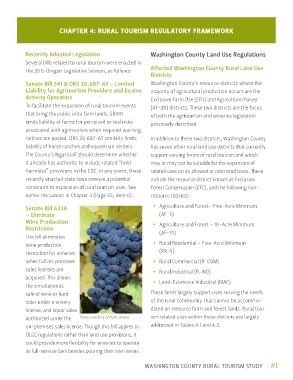
            authorized under the   Photo courtesy of Patti Skinkis  ism related uses within these districts are largely
            on-premises sales license. Though this bill applies to   addressed in Tables 4.1 and 4.3.
            OLCC regulations rather than land use provisions, it
            could provide more flexibility for wineries to operate
            as full-service bars besides pouring their own wines.


                                                             WASHINGTON COUNTY RURAL TOURISM STUDY                81

