


Page 78 - Rural Tourism Report Washington County
P. 78
CHAPTER 4: RURAL TOURISM REGULATORY FRAMEWORK


            How Goals 3 & 4 Translate in Washington County

            Fertile soils, favorable topography, moderate       Non-resource lands make up the remainder of
            climate and rainfall, and proximity to urban        Washington County’s rural land. Non-resource rural
            markets make Washington County one of Oregon’s      lands are not subject to statewide Planning Goals
            most productive agricultural areas, where a wide    3 and 4 because it has been demonstrated that
            range of crops and wood products are produced.      they do not meet the definition of farm and forest
            Consistent with Goals 3 and 4, much of this         lands under state law. In Washington County, such
            most highly valued rural land has been placed       lands are identified as RR-5 (Rural Residential – 5
            within resource districts in the County’s state-    acre minimum), R-COM (Rural Commercial), R-IND
            acknowledged Comprehensive Plan as Exclusive        (Rural Industrial), MAE (Land Extensive Industrial),

            Farm Use/Agriculture and Forest Use (EFU/AF-20)     and “exception lands” designated as AF-5 or AF-10
            or Exclusive Forest Conservation (EFC) land.        (Agriculture and Forestry, 5- or 10-acre minimum,
                                                                respectively). These “exception” lands, have the
                                                                physical capability (e.g. soils) to be in agricultural
                                                                or forest production but have been developed to
                                                                a level or are affected adversely by other factors
                                                                to the extent that they have been determined less

                                                                suitable for commercial farm or forest use.

                                                                Related to this, Oregon’s Marginal Lands Act of 1983
                                                                (Senate Bill 237) created a process for identifying
                                                                what came to be known as “marginal” rural lands.

                                                                Such lands are deemed to be less suited to farming
                                                                and forestry than resource farmland, and are thus
                                                                not protected as rigorously against development of
                                                                non-farm uses. In Washington County, the marginal
                                                                lands designation is applied to AF-20 properties on
                                                                a case-by-case basis, subject to approval of a site-
                                                                specific land use application. Of 36 Oregon counties,
                                                                only Lane and Washington counties adopted the
                                                                provisions of Senate Bill 237 before it was repealed
                                                                in 1993 (215.316). As a result, they are the only two
                                                                “Marginal Lands Counties” in Oregon today, and
                                                                are subject to a different set of state standards than
                                                                applied to Oregon’s 34 other counties. As such, it
                                                                is not always possible to borrow from standards
                                                                implemented by other counties in planning for

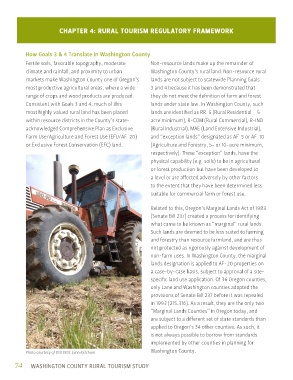
            Photo courtesy of OSU EESC Lynn Ketchum             Washington County.

       74     WASHINGTON COUNTY RURAL TOURISM STUDY

