Starting torque boost
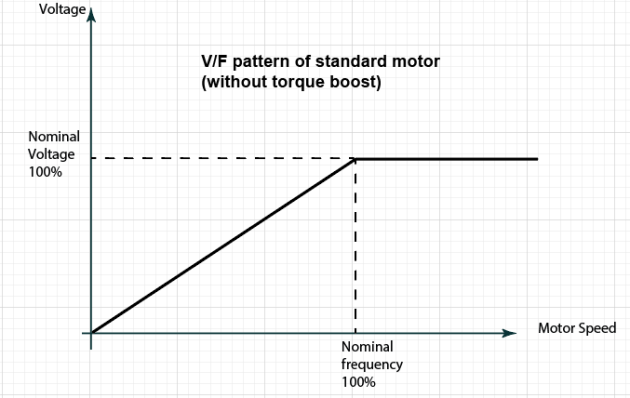
With conventional V/F operating mode, when F (frequency) is changed, V (output voltage) is
changed in the constant ratio (V/F) as shown in the figure below.
For this reason, this system is called V/F control.
The voltage value that is actually valid decreases due to a voltage drop in the wiring or the primary coil of a motor and a sufficient amount of torque cannot be output. The load inertia may also require greater torque to start moving.
The slower the speed is, the more prevalent this phenomenon is.
Boosting the voltage inversely proportional to the speed during ramp-up ensures good torque at low speed, and helps the motor start difficult loads more reliably.
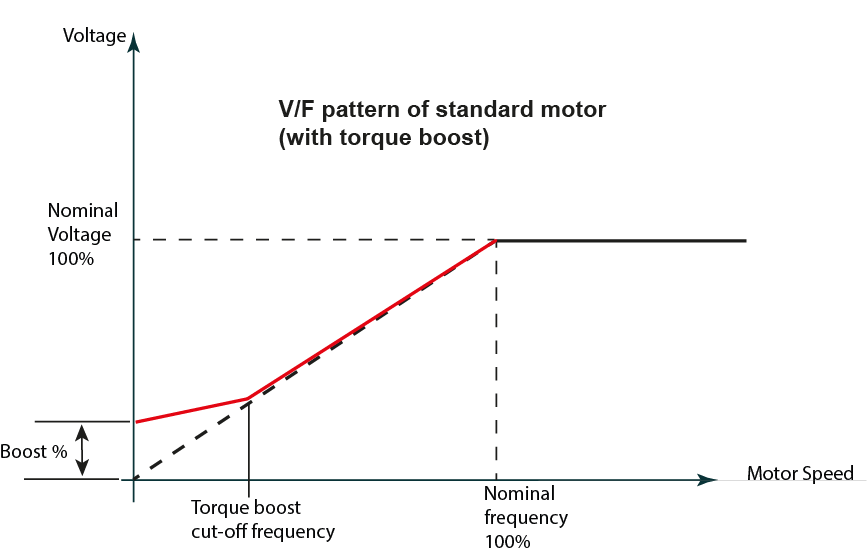
Users can set higher voltage (torque boost ) as indicated with the solid line in the figure below to cover the shortage of the torque at low speed.
Setting the torque boost value must be done with caution and tested with small increments.
If torque boost is increased too much or applied for too long a time, excessive current may be drawn triggering overcurrent protection.
Setting the starting torque boost⚓
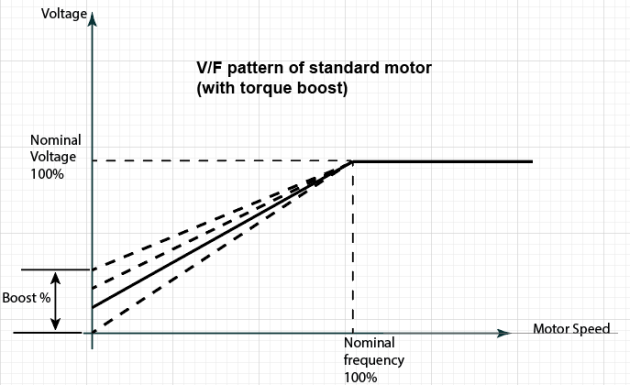
To adapt the starting torque boost to the application, the user can define its amount and its duration.
Amount of starting boost⚓
Parameter Amount of starting boost
Settable from 0% to 30% of nominal operating voltage.
Increments: 0.1%
Default value: 0%
Starting torque boost cut-off frequency⚓
Parameter starting torque boost cut-off frequency
Settable from 20 to 100% of nominal speed.
Default value: 25% (boost stops when the speed reaches this value)