
Safe torque off (STO) function
The "Safe Torque Off" function (STO) is used to prevent the Clean Power VFD from generating torque to the motor and preventing the motor from restarting as long as the STO function is activated.
This prevents the Clean Power VFD/motor system from operating while STO is engaged.
This STO safety function corresponds to stop category 0 according to IEC 60204-1: the stopping is executed by immediate removal of power to the machine actuators.
Note for users, other stop categories are⚓
Stop Category 1: A controlled stop with power available to the machine actuators to achieve the stop and then removal of power when the stop is achieved.
Stop Category 2: A controlled stop with power left available to the machine actuators
When the Clean Power VFD is operating normally it is in "normal" state and the STO function is in "standby" state.
If one or both STO channels are de-energized the STO function is activated and the Clean Power VFD transitions to the "safe" state.
In "safe" state the Clean Power VFD shuts off power to the semiconductors and disables startup
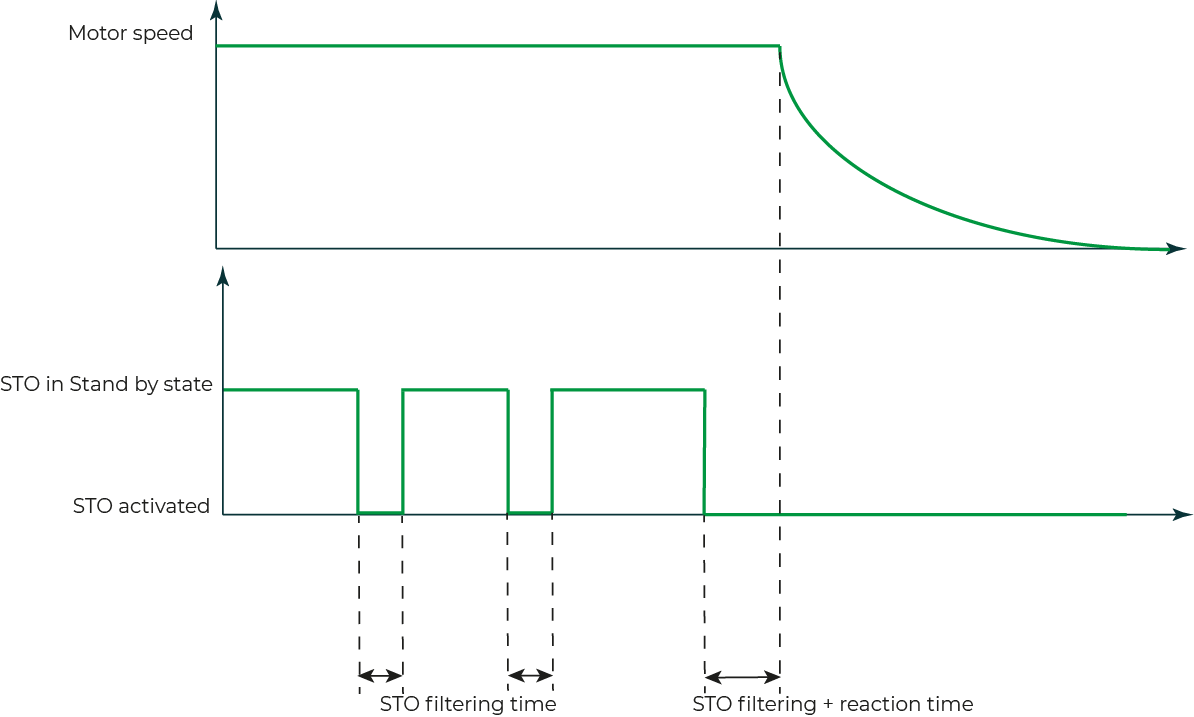
Filtering time refers to the width of the low-level pulse onto STO input. When the input pulse width is less than or equal to the STO filtering time, there is no influence on the operation.
Reaction time is the time interval from the power-off time of any STO input to the stop time of power output components.
Before to use the STO function, a complete risk analysis of the system must be done. Depending on this analysis, additional measures may be necessary to prevent any hazard (e.g. mechanical brake with vertical load).
Acceptance test⚓
The correct operation of the STO function must be checked at least once a year and during the validation (initial start-up) of the equipment safety functions.
The goal of this procedure is to verify that all subsystems of the safety function are operational.
After any maintenance work related to the safety function, or after any modification related to the safety function (wiring, settings, etc) the acceptance test must also be executed.
The checking must be executed by an operator aware of potential risks due to a wrong operation of the safety system. This operator must master safety in general and functional safety specifically. He must report and sign the acceptance test in a dedicated document. Initial acceptance test report and subsequent test reports must be stored in a logbook.